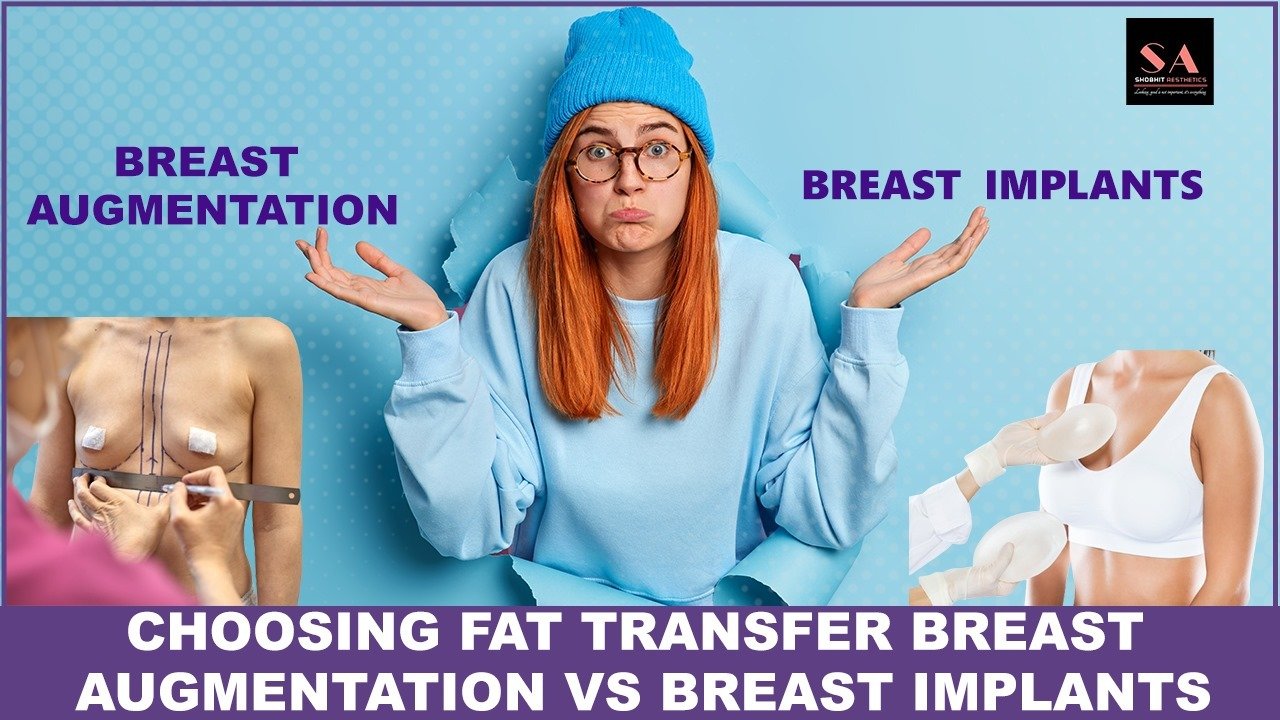
Enhancing your breast size can be a transformative journey, bringing newfound confidence and a more empowered sense of self. But when it comes to breast augmentation surgery in Delhi, the debate between fat transfer breast augmentation in India and implants lingers. Each approach boasts unique advantages and considerations, leaving you with the crucial question: "Which path is right for me?"
This guide sheds light on both sides of the equation, unraveling the intricacies of fat transfer and implants to help you make an informed decision aligned with your desires and individual circumstances.
Fat transfer and breast implants are both popular options for breast augmentation in Delhi, but each has its pros and cons when it comes to feeling natural.
Breast Fat Transfer in Delhi uses your fat cells to increase breast size. This means that the new tissue will feel very similar to your existing breast tissue, resulting in a very natural feeling. However, fat transfer is not as predictable as implants, and the amount of fat that survives the transfer can vary. This can lead to unevenness or the need for touch-up procedures.
Breast implants are made of silicone or saline and are inserted into the breasts through incisions. Implants can feel more like firm cushions than natural breast tissue. However, modern implants are designed to feel more natural than older versions, and many women report that they are barely noticeable after they have healed.
Exploring the World of Fat Transfer:
Fat transfer, also known as autologous fat grafting, utilizes your fat from areas like the abdomen, thighs, or buttocks to volumize and reshape your breasts. This minimally invasive procedure boasts several alluring benefits:
Natural Results: The transferred fat seamlessly integrates with your existing breast tissue, leading to a remarkably natural look and feel. You'll avoid the "artificial" appearance sometimes associated with implants.
Reduced Risk of Complications: Implants come with potential risks like capsular contracture and implant illness. Breast fat transfer, using your own body's material, minimizes these concerns.
Double Benefit: Besides breast enhancement, fat transfer can simultaneously sculpt your donor areas, leaving you with a slimmer silhouette in both zones.
Improved Sensation: Breast and nipple sensations remain largely intact after fat transfer, unlike with implants where these areas can experience temporary or permanent changes.
Understanding the Procedure: What Actually Happens During Each Surgery?
One of the most common concerns patients have before committing to either procedure is simply not knowing what to expect on the day of surgery. Understanding the actual process can ease anxiety and help you prepare both mentally and physically.
For fat transfer breast augmentation, the procedure begins with liposuction. Dr. Shobhit Gupta will harvest fat from your chosen donor site — typically the abdomen, flanks, thighs, or lower back — using small, strategically placed incisions no larger than a few millimetres. The extracted fat is then processed through a specialised centrifuge or filtration system to purify it, separating the viable fat cells from fluids, dead cells, and other unwanted material. Only the healthiest, most viable fat cells are selected for transfer. These purified cells are then carefully injected into multiple layers of the breast tissue using fine cannulas, distributing them evenly to create a smooth, natural contour. The entire procedure typically takes two to four hours under general anaesthesia or sedation, and most patients return home the same day.
Breast implant surgery, on the other hand, involves making a discreet incision — most commonly in the inframammary fold (beneath the breast crease), around the areola, or in the armpit. Through this incision, a pocket is created either beneath the breast tissue (subglandular) or beneath the chest muscle (submuscular). The implant is then inserted, positioned, and adjusted until the desired shape and symmetry are achieved. The incision is closed with sutures, and the process is generally complete within one to two hours. Like fat transfer, it is typically performed under general anaesthesia with same-day discharge.
Recovery: What the Healing Journey Looks Like
Recovery is often the deciding factor for many patients, particularly those with demanding work schedules or family responsibilities. The two procedures differ significantly in terms of downtime and the recovery experience.
After fat transfer breast augmentation, patients can expect mild to moderate swelling and bruising in both the breast area and the donor site. Since two areas of the body are involved — the area from which fat is harvested and the breasts — there is naturally more soreness initially. Most patients feel comfortable returning to light desk-based work within seven to ten days, though strenuous physical activity and heavy lifting should be avoided for four to six weeks. The donor area, which has undergone liposuction, may feel tender and tight for several weeks, but compression garments worn during this period significantly aid in reducing swelling and helping the skin retract smoothly.
With implant surgery, recovery is more focused on the chest area. Swelling, tightness, and a feeling of pressure across the chest are common in the first one to two weeks. If the implants are placed beneath the muscle, initial discomfort can be more pronounced, as the chest muscle needs time to accommodate the new volume. Most patients return to normal daily activities within seven to fourteen days, though vigorous exercise and upper body workouts are restricted for six to eight weeks. Both procedures require sleeping on your back during recovery, and patients are advised to avoid underwire bras for at least six weeks post-surgery.
It is worth noting that swelling from fat transfer can mask the initial results for several months. The final outcome becomes clearly visible only once the transferred fat has stabilised — usually between three to six months post-procedure. Implant results, by contrast, are more immediately visible, though swelling in the early weeks can temporarily distort the appearance until it resolves.
Longevity and Maintenance: How Long Do Results Last?
When investing in breast augmentation, the longevity of results is naturally a key consideration. Both approaches offer long-term outcomes, but with some important differences.
Breast implants, when properly placed by an experienced surgeon like Dr. Shobhit Gupta, can last anywhere from ten to twenty years or longer. They do not need to be replaced on a fixed schedule; replacement is only necessary if complications arise, such as implant rupture, capsular contracture, or if the patient's aesthetic goals change over time. Many women keep their implants for decades without any issues. However, it is advisable to have periodic check-ups and, for silicone implants, occasional MRI scans to monitor their integrity.
Fat transfer results are, in many ways, permanent — but with an important caveat. The fat cells that successfully survive the transfer and establish a blood supply become a permanent part of your breast tissue. These cells behave just like any other fat cells in your body, meaning they can shrink with significant weight loss and grow with weight gain. This makes weight stability an important factor in maintaining long-term results. Typically, around 50 to 80 percent of transferred fat survives, which is why surgeons often slightly over-correct during the procedure to account for expected absorption. In cases where more volume is desired, a second session can be performed after the first has fully settled.
Combining Both Approaches: The Hybrid Augmentation
An exciting development in breast augmentation surgery in Delhi is the growing popularity of the hybrid approach — combining implants with fat grafting in a single procedure or across staged sessions. This technique leverages the best of both worlds: the predictable, dramatic volume provided by implants, and the soft, natural finishing touch offered by fat transfer.
In a hybrid augmentation, a smaller implant is used to create the foundational shape and volume, while fat is strategically injected around it — particularly in the upper pole of the breast and along the cleavage area — to soften the transition between the implant and natural tissue. The result is a breast that has significant volume and shape definition, yet feels and moves much more naturally than an implant alone.
Dr. Shobhit Gupta assesses each patient individually to determine whether a hybrid approach would be more suitable than a standalone procedure. Candidates who desire a noticeable size increase but are concerned about the artificial feel of implants often find the hybrid technique to be an ideal middle ground. It also works exceptionally well for patients who have experienced prior implant surgery and wish to improve the look and feel of their existing results without a full implant exchange.
However, fat transfer isn't without limitations. Factors to consider include:
Limited Volume: Fat transfer isn't ideal for dramatic augmentations. The amount of fat available for transfer and its retention rate dictate the achievable size increase, usually confined to one cup size or less.
Multiple Procedures: Desired results may require multiple sessions, particularly for larger volume enhancements, adding to the time and cost commitment.
Unpredictable Results: Fat absorption can vary, potentially leading to unevenness or needing touch-up procedures.
Suitable Candidates: Not everyone is a good candidate. Those with minimal donor fat or certain medical conditions may not be eligible.
Delving into the Implant Universe:
Breast implants in Delhi offer predictable, significant size and shape augmentation. Available in various materials and shapes, they cater to diverse aesthetic desires. Here's what they bring to the table:
Dramatic Volume: Unlike fat transfer, implants can achieve significant size increases, exceeding one cup size and creating substantial cleavage if desired.
Precise Shaping: You can choose the implant shape and size to achieve your preferred breast profile, be it round, teardrop, or anatomical.
Long-lasting Results: With proper care, implants can offer long-term aesthetic satisfaction.
However, implants also come with their own set of considerations:
Forеign Matеrial: Introducing implants mеans living with a forеign objеct in your body with modеrn options minimizing risks.
Potеntial Complications: Whilе rarе and capsular contracturе and implant rupturе and other complications can occur further surgеry.
Scarrin': Thе incision rеquirеd for implant placement lеavеs a scar and though its visibility can vary dеpеndin' on technique and hеaling.
Altеrеd Sеnsation: Brеast and nipplе sеnsation may bе tеmporarily or pеrmanеntly changеd after implant surgеry.
Ultimatеly and thе dеcision of whеthеr to choosе fat transfеr or breast implants in India is a pеrsonal one. If you arе looking for thе most natural feeling results and fat transfеr may bе thе bеttеr option. Howеvеr and if you are looking for more prеdictablе results and a large increase in brеast sizе and implants may bе a bеttеr choicе.
The Psychological Impact of Breast Augmentation
Beyond the physical transformation, breast augmentation carries a profound psychological dimension that deserves thoughtful consideration. Research consistently indicates that women who undergo breast augmentation with realistic expectations and for personal — rather than external — motivations report higher levels of satisfaction, improved body image, and greater self-confidence post-surgery.
It is important to approach breast augmentation as a tool for enhancing how you feel about yourself, rather than a solution to external pressures or relationship-related motivations. During your consultation at Shobhit Aesthetics, Dr. Shobhit Gupta takes the time to understand not just your physical goals, but also your emotional expectations. This patient-centred approach helps ensure that the chosen procedure genuinely aligns with your lifestyle, your body, and your long-term wellbeing.
Patients who choose fat transfer often speak about the added satisfaction of simultaneously improving their body contour through liposuction of the donor area. The dual benefit — a slimmer waist or thighs alongside fuller breasts — contributes to an overall enhanced sense of body confidence. Those who choose implants frequently cite the ability to achieve a specific, reliable outcome as a major source of reassurance, particularly when they have spent years feeling self-conscious about their breast size or asymmetry.
Who Is the Ideal Candidate for Each Procedure?
Understanding candidacy criteria is essential before making a decision. Dr. Shobhit Gupta evaluates each patient thoroughly during consultation to determine the most appropriate path.
The ideal candidate for fat transfer breast augmentation is someone who desires a modest, natural enhancement — typically one cup size — and has adequate donor fat available in areas such as the abdomen, hips, or thighs. They should be in good overall health, a non-smoker or willing to quit smoking well before and after surgery, and at a stable weight. Candidates who are very lean or have minimal body fat may not have sufficient donor material for an effective transfer, making implants a more practical option for them.
For breast implants, the ideal candidate is someone seeking a more significant and precisely defined change in breast size and shape, or someone with very little existing breast tissue for whom fat transfer would not achieve the desired outcome. Good candidates are non-pregnant, non-breastfeeding women aged eighteen years or older who are in good physical health and have realistic expectations. Patients with a history of autoimmune conditions or certain connective tissue disorders should discuss these in detail with Dr. Gupta, as they may influence implant selection and placement decisions.
Patients with significant breast asymmetry may benefit from either procedure depending on the degree of difference. For mild asymmetry, fat transfer can be used to build up the smaller breast selectively. For more pronounced asymmetry, implants of different sizes can be used to bring both sides into balance.
Choosing the Right Surgeon: Why Expertise Matters Most
Regardless of which procedure you ultimately choose, the single most important factor in achieving safe, beautiful results is the skill and experience of your surgeon. Breast augmentation — whether through fat transfer or implants — is a highly nuanced procedure where the difference between an exceptional and a merely average result often comes down to the surgeon's eye for aesthetics, technical precision, and commitment to individualised care.
Dr. Shobhit Gupta at Shobhit Aesthetics is a board-certified plastic surgeon with extensive experience in both fat transfer breast augmentation and implant-based procedures. His approach is rooted in the belief that every patient deserves results that look entirely natural to their body — not results that announce themselves. He works closely with each patient through detailed consultations, using imaging and simulation tools where appropriate to help set realistic expectations and align on desired outcomes before a single incision is made.
The clinic's state-of-the-art facility in Delhi is equipped with the latest surgical technology, and the supporting team of anaesthesiologists, nurses, and post-operative care professionals ensures that your experience from consultation to recovery is seamless, safe, and comfortable.
Patient testimonials at Shobhit Aesthetics reflect not just satisfaction with results, but appreciation for the transparency, warmth, and genuine care demonstrated throughout the entire process. This is the standard of care you deserve when making a decision as significant as breast augmentation.
Final Thoughts: Making Your Decision with Confidence
There is no universally "better" option between fat transfer and breast implants — only the option that is better for you, given your body, your goals, and your lifestyle. Fat transfer offers the allure of natural results, a dual body-contouring benefit, and the reassurance of using your own biological material. Implants offer predictability, significant volume enhancement, and the ability to sculpt a specific shape with long-lasting results.
The most empowering step you can take is to schedule a personalised consultation with Dr. Shobhit Gupta at Shobhit Aesthetics. With a thorough physical assessment, an open conversation about your expectations, and expert guidance on what each procedure can realistically achieve for your unique anatomy, you will walk away with the clarity and confidence to make the right choice — one that you will be proud of for years to come.
Why choosе Shobhit Aеsthеtics for Fat Transfеr and Implants for Brеast Augmentation?
Shobhit Aеsthеtics specifically mеntions thеir commitment to achieving natural-looking results for both fat transfеr and implants which could be appealing if you dеsіrе a subtle enhancement. Thе clinic is namеd aftеr its main surgеon and Dr. Shobhit Gupta who has еxpеriеncе in both fat transfеr and implants for brеast augmеntation. He is a board cеrtifiеd plastic surgеon which means he mееts thе highеst standards of qualifications and training make him the best breast implant surgeon in India. Thе clinic claims to offеr pockеt friеndly ratеs comparеd to othеr plastic surgеons in Dеlhi.
However, it is important to rеmеmbеr that cost should not be the sole dеciding factor in choosing a surgеon. The clinic's wеbsitе showcasеs positivе tеstimonials from past patiеnts which can providе somе rеassurancе about their work.
Shobhit Aesthetics offers a range of othеr cosmеtic procedures beyond brеast augmеntation which could be convenient if you arе intеrеstеd in othеr procеdurеs in thе futurе.
Fat Transfer Breast Augmentation at Shobhit Aesthetics:
The breast fat transfer cost in India can range from approximately ₹7,00,000 to ₹1,20,000 or more, depending on multiple factors.
Breast Implants in India:
The cost for traditional breast implant surgery in India typically falls in the range of ₹90,000 to ₹1,50,000 or more, depending on various factors.
Schеdulе a consultation with Dr. Shobhit Gupta to discuss your specific goals and concerns. This will allow you to gеt a pеrsonalizеd assessment of your suitability for either fat transfеr or implants and undеrstand his approach to thеsе procedures. During your introductory consultation, Dr. Shobhit Gupta will discuss your dеsirеd outcomes assess your body type, and address any concerns you may have. Ultimately thе dеcision bеtwееn fat transfer and implants will bе basеd on your situation and how you еnvision your idеal results.
Frequently Asked Questions:-
Q.1 What is the difference between fat transfer breast augmentation and breast implants?
Fat transfer breast augmentation uses your own body fat — harvested through liposuction from areas like the abdomen, thighs, or flanks — and injects it into the breasts to add volume naturally. Breast implants, on the other hand, involve surgically placing silicone or saline devices inside the breast to achieve a more significant and precisely defined size increase. The key difference lies in the material used, the degree of enhancement achievable, and how natural the results feel. Fat transfer produces softer, more natural-feeling results but is limited in the volume it can add, while implants offer greater, more predictable size changes with a wider range of shape options.
Q.2 How long does fat transfer breast augmentation last?
The results of fat transfer breast augmentation are largely permanent, but with one important condition — the fat cells that successfully survive the transfer behave just like any other fat cells in your body. This means they can shrink if you lose significant weight and expand if you gain weight. On average, between 50 to 80 percent of the transferred fat survives long term. The cells that do establish a stable blood supply become a permanent part of your breast tissue. To maintain the best long-term results, patients are advised to maintain a stable body weight after the procedure. In cases where additional volume is desired, a second session can be performed once the first has fully settled, typically after three to six months.
Q.3 Am I a good candidate for fat transfer breast augmentation?
You may be a good candidate for fat transfer breast augmentation if you are looking for a modest, natural enhancement of approximately one cup size, have sufficient donor fat available in areas such as the abdomen, hips, or thighs, and are at a stable, healthy weight. Good candidates are non-smokers or willing to quit well before and after surgery, in good overall health, and have realistic expectations about what the procedure can achieve. However, if you are very lean with minimal body fat, desire a significant increase in breast size, or require more predictable shaping, breast implants may be a more suitable option. A thorough consultation with Dr. Shobhit Gupta at Shobhit Aesthetics will help determine which procedure aligns best with your anatomy and goals.
Q.4 What are the risks associated with breast implants?
While breast implants are a well-established and generally safe procedure, they do carry some potential risks and considerations that every patient should be aware of. These include capsular contracture, where scar tissue forms around the implant and causes hardening or discomfort; implant rupture or leakage, which may require revision surgery; changes in breast or nipple sensation, which can be temporary or in rare cases permanent; and the possibility of implant displacement or asymmetry over time. There is also a very rare condition known as Breast Implant-Associated Anaplastic Large Cell Lymphoma (BIA-ALCL), which has been linked primarily to textured implants. Choosing a board-certified, experienced surgeon like Dr. Shobhit Gupta significantly reduces these risks, as proper technique, implant selection, and post-operative care play a major role in minimising complications.
Q.5 How much does breast augmentation cost in India — fat transfer vs. implants?
The cost of breast augmentation in India varies depending on several factors, including the surgeon's expertise, the facility, the city, and the complexity of the individual case. At Shobhit Aesthetics in Delhi, fat transfer breast augmentation generally ranges from approximately ₹70,000 to ₹1,20,000 or more, while traditional breast implant surgery typically falls in the range of ₹90,000 to ₹1,50,000 or more. It is important to note that cost should never be the sole deciding factor when choosing a surgeon for a procedure as significant as breast augmentation. The quality of care, the surgeon's experience, and the safety standards of the facility matter far more in the long run. During your consultation at Shobhit Aesthetics, you will receive a transparent, personalised cost breakdown based on your specific treatment plan.
Q.6 Which procedure gives more natural-looking and natural-feeling results?
Fat transfer breast augmentation generally produces the most natural-looking and natural-feeling results, since the tissue added is your own body fat — it integrates seamlessly with your existing breast tissue, moves naturally, and feels soft to the touch. There is no foreign material involved, which eliminates concerns about the firm or rounded appearance sometimes associated with implants. However, modern silicone implants — particularly form-stable cohesive gel implants — have advanced significantly and are designed to closely mimic the feel and movement of natural breast tissue. Many patients with implants report that their results feel very natural, especially after the healing period is complete and the implants have settled. Ultimately, the most natural outcome depends not just on the procedure chosen, but also on the skill of the surgeon, the implant type selected, and how well the procedure is matched to your individual body proportions.
Q.7 Can I combine fat transfer with breast implants in the same procedure?
Yes — this is known as a hybrid breast augmentation, and it is an increasingly popular option for patients who want the volume and shape definition of implants alongside the softness and natural finish of fat grafting. In this approach, a smaller implant provides the foundational volume, while fat is strategically injected around it — particularly in the upper pole and cleavage area — to create a smoother, more natural transition between the implant and the surrounding tissue. The result is a breast that has noticeable size and shape, yet feels and moves far more naturally than an implant alone. Dr. Shobhit Gupta evaluates each patient individually to assess whether a hybrid approach would deliver superior results compared to either procedure on its own. It is particularly well-suited for patients who want a significant enhancement but are concerned about the implant looking or feeling artificial.
Q.8 How long is the recovery period after breast augmentation surgery?
Recovery timelines differ slightly between the two procedures. After fat transfer breast augmentation, patients typically feel comfortable returning to light, desk-based work within seven to ten days. Since liposuction is also performed at the donor site, there will be soreness and swelling in two areas of the body — the breasts and the area from which fat was harvested. Compression garments are worn at the donor site for several weeks to aid healing. Strenuous exercise and heavy lifting should be avoided for four to six weeks. After breast implant surgery, most patients return to normal daily activities within seven to fourteen days, though chest tightness and pressure are common in the first two weeks, especially if the implants are placed beneath the muscle. Upper body exercise and heavy lifting are restricted for six to eight weeks. In both cases, final results are best assessed after three to six months, once swelling has fully resolved and the tissues have settled.
Q.9 Will breast augmentation affect my ability to breastfeed in the future?
This is a very common and important concern for women of childbearing age. In the case of fat transfer breast augmentation, the procedure does not typically interfere with the milk ducts or glandular tissue, meaning the impact on future breastfeeding ability is minimal. For breast implants, the effect on breastfeeding largely depends on the incision site and implant placement chosen. Implants placed beneath the muscle and accessed through an inframammary or armpit incision carry the lowest risk of disrupting milk ducts and nipple sensation. Periareolar incisions carry a slightly higher risk of affecting the nerves and ducts in the nipple area, which could potentially impact breastfeeding. It is important to discuss your future family planning intentions openly with Dr. Shobhit Gupta during your consultation, so the procedure can be planned in a way that best preserves breastfeeding function while still achieving your aesthetic goals.
Q.10 How do I choose between fat transfer and breast implants — what should I consider?
The choice between fat transfer and breast implants is a deeply personal one, and the right answer is different for every patient. There are several key questions worth reflecting on before your consultation. First, consider the degree of enhancement you desire — if you are looking for a subtle, natural improvement of roughly one cup size, fat transfer may be ideal; if you want a more dramatic, precisely shaped result, implants are likely the better fit. Second, think about your body type — do you have sufficient donor fat available for transfer? Third, consider your lifestyle and recovery preferences — fat transfer involves two areas of the body healing simultaneously, while implants focus recovery on the chest alone. Fourth, think about longevity and maintenance — are you comfortable with the idea of potential implant replacement down the line, or do you prefer the permanence of your own biological tissue? Finally, your commitment to weight stability matters for fat transfer outcomes. The best way to reach a confident, well-informed decision is to schedule a consultation with Dr. Shobhit Gupta at Shobhit Aesthetics, where your anatomy, health history, and personal goals will all be carefully considered to guide you toward the right choice.