Hair Transplant in Jaipur – Restore Your Hair, Restore Your Confidence at Shobhit Aesthetics
Hair loss is far more than a cosmetic concern, for millions of men and women across India, it quietly erodes self-esteem, affects professional confidence, and changes the way people see themselves every single day. If you have been watching your hairline recede or your crown thin without a lasting solution in sight, you have arrived at the right place. Hair transplant in Jaipur at Shobhit Aesthetics offers a permanent, natural-looking, and medically proven answer to hair loss, delivered by one of the most experienced surgical teams in Rajasthan. Our clinic combines internationally recognised surgical techniques, advanced technology, and deeply personalised patient care to help you regain not just your hair, but your confidence. This comprehensive guide walks you through everything, from causes and diagnosis to procedure, recovery, and cost — so you can take the next step with complete clarity.
What Is a Hair Transplant?
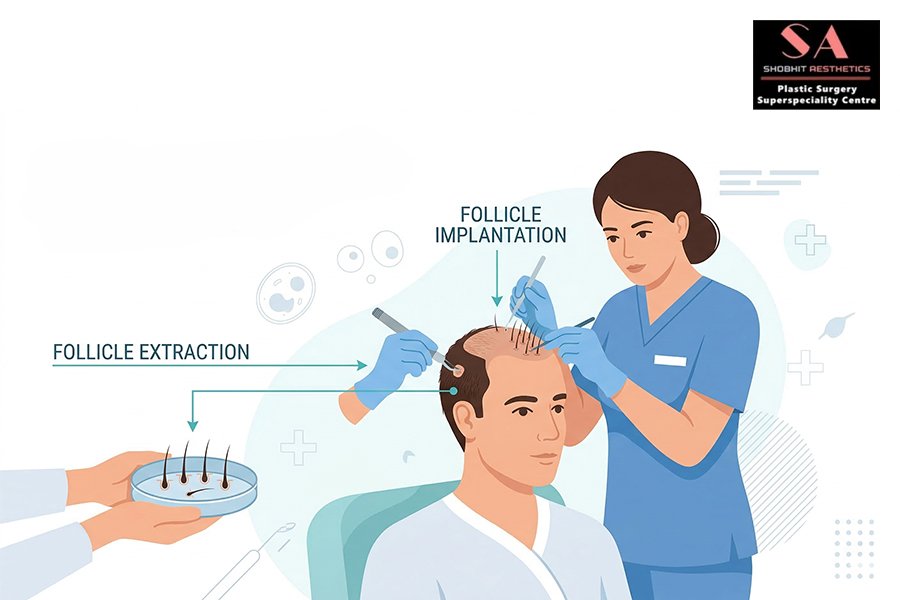
A hair transplant is a minimally invasive surgical procedure in which healthy, genetically resistant hair follicles are harvested from a donor area — typically the back and sides of the scalp — and carefully transplanted into areas experiencing thinning or baldness. Because the transplanted follicles are taken from parts of the scalp that are naturally resistant to the hormone DHT (dihydrotestosterone) — the primary driver of pattern hair loss — they retain this resistance even after relocation, meaning the newly transplanted hair continues to grow naturally and permanently in its new position.
The procedure has evolved dramatically over the past two decades. Today's techniques are refined, minimally scarring, and capable of producing results that are virtually indistinguishable from natural hair growth — with the correct hairline design, angle, and density making all the difference between a result that looks surgical and one that looks entirely natural.
Is hair transplant permanent? Yes — the transplanted follicles are genetically programmed to resist the hormonal causes of hair loss. Once the grafted hair has grown in fully, it behaves and grows just like natural hair — requiring no special products, treatments, or maintenance beyond normal hair care.
What Causes Hair Loss?
Hair loss has multiple causes, and correctly identifying the underlying reason is an essential first step before any treatment is recommended. At Shobhit Aesthetics, every patient undergoes a thorough evaluation before a surgical plan is designed.
- Androgenetic Alopecia (Pattern Hair Loss) — The most common cause, affecting both men and women. In men, it presents as a receding hairline and crown thinning; in women, as diffuse thinning across the crown and parting. It is driven by genetic sensitivity to DHT and progresses predictably over time.
- Alopecia Areata — An autoimmune condition in which the immune system attacks hair follicles, causing patchy hair loss. Surgical hair restoration is not generally recommended until the condition has been stable for a sustained period.
- Traction Alopecia — Hair loss caused by prolonged tension on the hair follicles from tight hairstyles such as braids, buns, or extensions. If caught early, it is reversible; in chronic cases, follicles may be permanently damaged and surgical restoration becomes the most effective option.
- Post-Traumatic or Scar Alopecia — Hair loss resulting from burns, injuries, or surgical scars where the follicles have been destroyed and can no longer produce hair naturally.
- Hormonal and Nutritional Factors — Thyroid dysfunction, iron deficiency, significant crash dieting, and post-pregnancy hormonal shifts can all trigger temporary or, in some cases, longer-term hair loss.
- Stress-Induced Hair Loss (Telogen Effluvium) — Prolonged physical or emotional stress can push a large number of follicles into the resting phase simultaneously, causing noticeable shedding. This is typically temporary but can become chronic in some individuals.
Understanding the cause directs the treatment — which is why a thorough consultation and diagnostic workup always precede any surgical recommendation at our clinic.
Diagnosis and Candidacy Assessment
Our team at Shobhit Aesthetics conducts a detailed assessment before recommending surgical hair restoration. The evaluation includes:
- A clinical examination of the scalp to assess the degree, pattern, and stability of hair loss
- Trichoscopy — a dermatoscopic examination of the scalp and follicles that provides detailed information about follicle health, miniaturisation, and donor density
- Blood tests to rule out underlying medical causes such as thyroid disorders, anaemia, or nutritional deficiencies
- An assessment of the donor area — the density, quality, and total available grafts that can safely be harvested
- A review of your hair loss history, family history, and any treatments previously tried
An ideal surgical candidate is someone whose hair loss has stabilised, who has an adequate donor supply of healthy follicles, is in good general health, and holds realistic expectations about what the procedure can and cannot achieve. Patients with active, rapidly progressing hair loss may benefit from medical management first to stabilise the condition before surgery is considered.
Treatment Options at Shobhit Aesthetics
FUE – Follicular Unit Extraction
FUE is the most widely performed and preferred modern technique for hair restoration, and the primary method used at Shobhit Aesthetics. Individual follicular units — groups of one to four hairs — are extracted one by one from the donor area using a micro-punch tool with a diameter of less than one millimetre. There is no linear scar, no stitches, and minimal downtime. FUE is the gold standard for patients who prefer to keep their hair short and want the most natural, scar-free result.
FUT – Follicular Unit Transplantation
FUT involves removing a narrow strip of scalp from the donor area, which is then dissected under magnification into individual follicular units for transplantation. FUT allows a larger number of grafts to be harvested in a single session and is particularly suitable for patients requiring high-volume restoration. It does leave a linear scar, which is concealed within the surrounding hair.
Beard and Eyebrow Restoration
In addition to scalp restoration, our clinic also offers precision transplantation for beard shaping and density, eyebrow restoration, and scar camouflage — areas that require particular artistry and technical skill to achieve natural-looking results.
Combined Medical and Surgical Management
For patients in the early to mid stages of hair loss, combining surgical restoration with medical treatments such as PRP (Platelet-Rich Plasma) therapy, minoxidil, or finasteride can maximise results — thickening existing hair while transplanted grafts grow in, creating a more comprehensive and dense final outcome.
Why Choose Shobhit Aesthetics – The Best Hair Transplant Clinic in Jaipur
The quality of your result is entirely dependent on the skill, experience, and artistry of your surgical team. Here is why Shobhit Aesthetics stands as the best hair transplant clinic in Jaipur:
- Expert Surgical Leadership — Our clinic is led by the best hair transplant doctor in Jaipur — a surgeon with extensive, dedicated experience in follicular unit extraction and transplantation. The artistry involved in designing a natural hairline and placing thousands of grafts at the correct angle and density is what separates exceptional results from mediocre ones, and it is a skill our team has refined across hundreds of successful procedures.
- Recognised Among the Best in the Region — Patients and peers alike consistently rank Shobhit Aesthetics among the top 10 hair transplant in jaipur clinics — a distinction built on real patient outcomes, transparent practice, and surgical consistency rather than marketing alone.
- Nationally Competitive Standards — Our outcomes stand confidently alongside those of the best hair transplant in india, as patients travelling from outside Rajasthan to our clinic regularly discover. World-class results do not require a trip to Delhi or Mumbai.
- Natural Hairline Design — The aesthetic component of the procedure is taken as seriously as the surgical component. Hairline design, graft angulation, and density distribution are all carefully planned to create a result that looks entirely natural — not transplanted.
- Full Transparency — Our team provides honest, realistic assessments. We will never overpromise on the number of grafts available, the degree of coverage achievable, or the timeline of results.
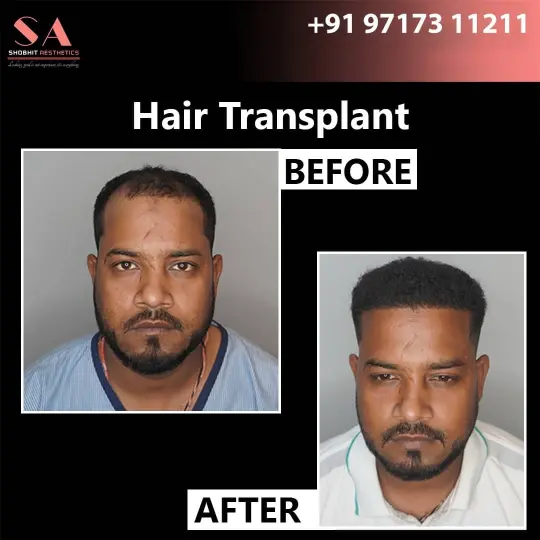
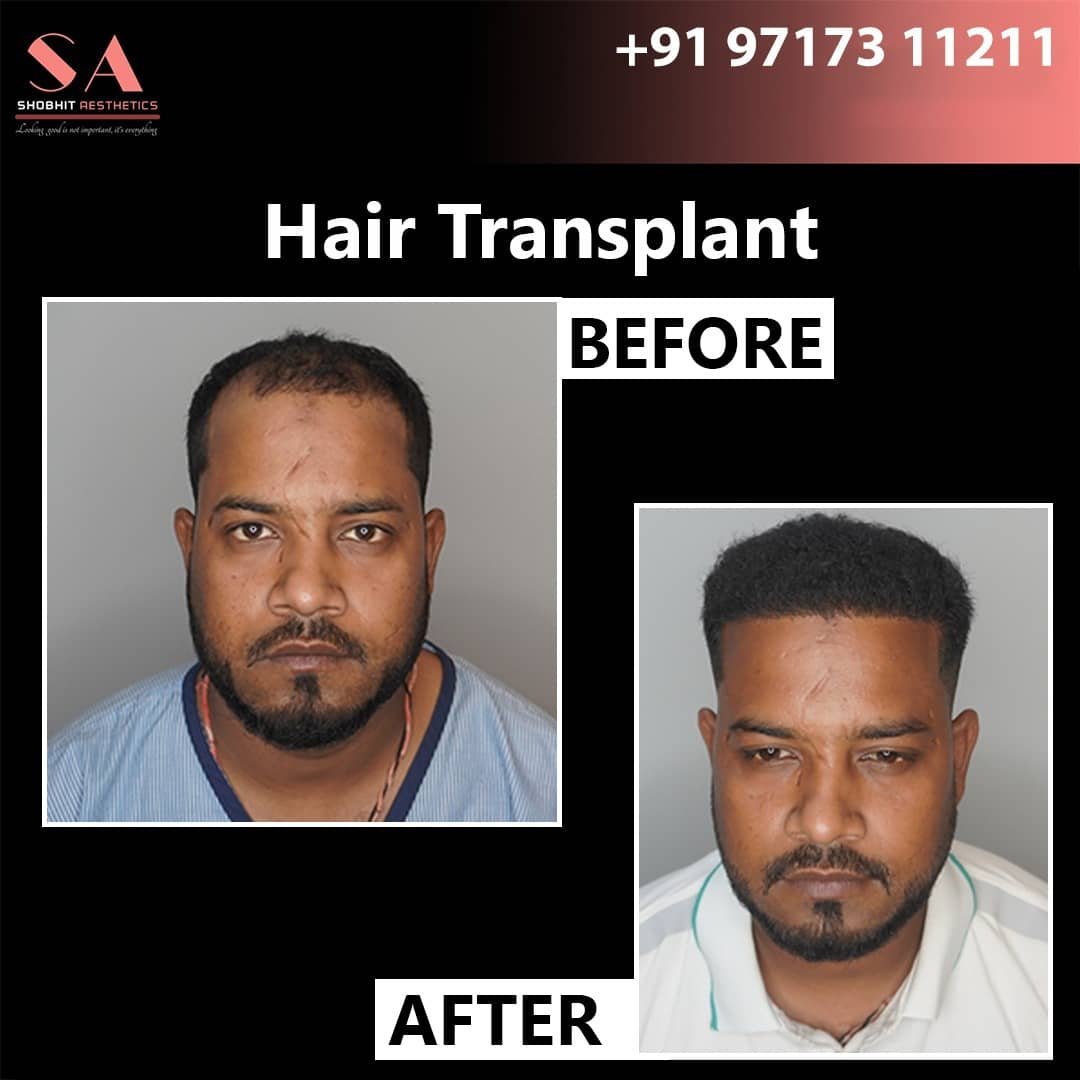
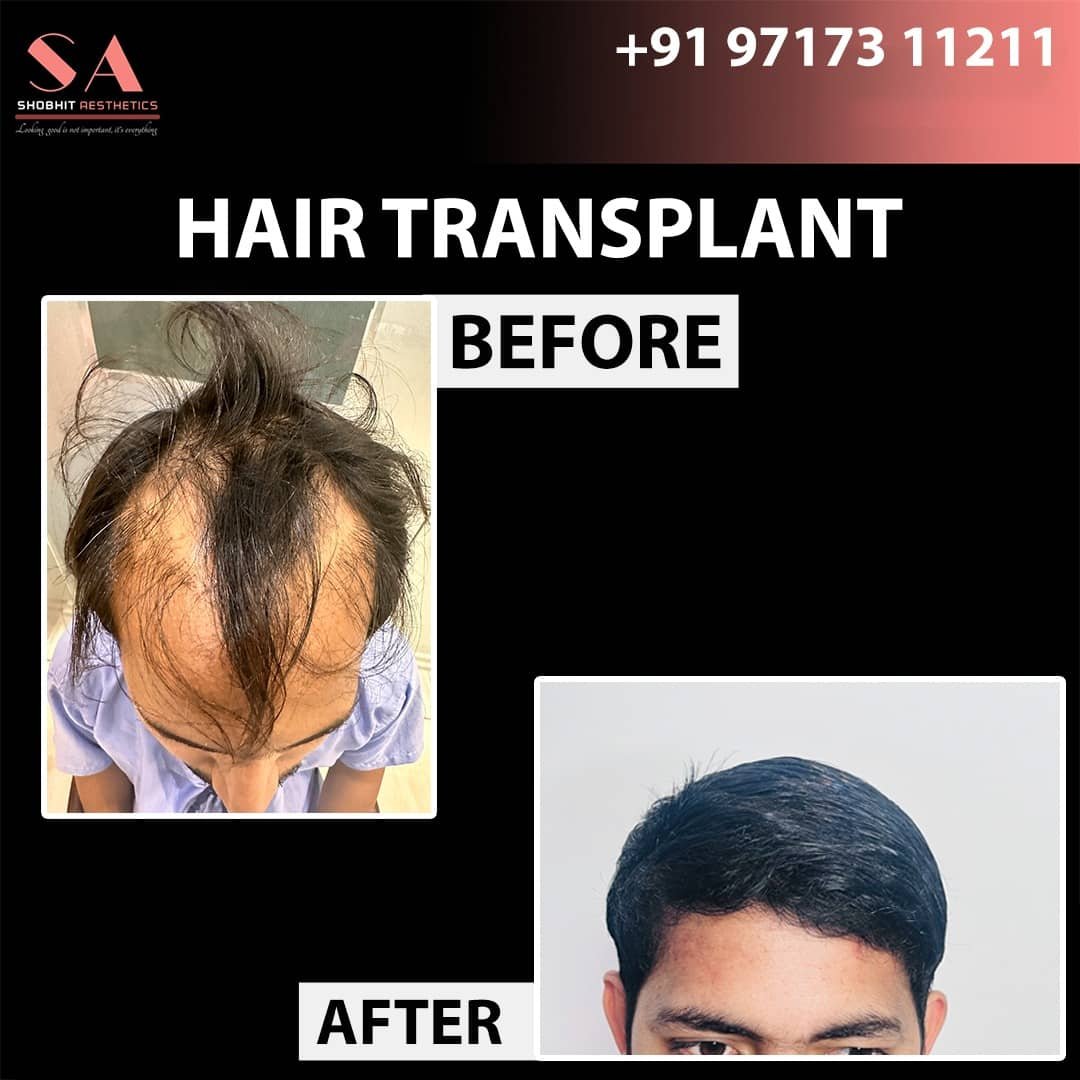
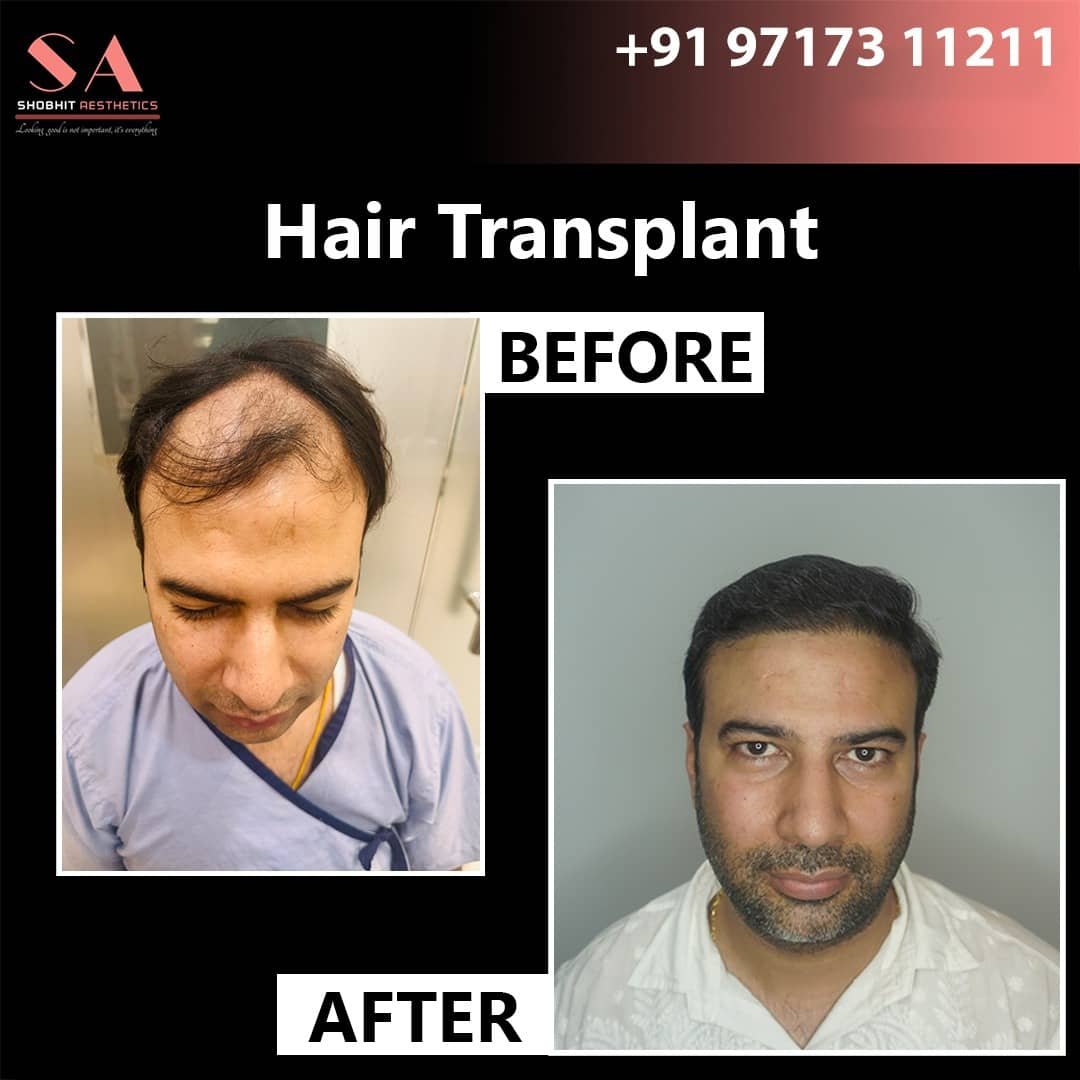
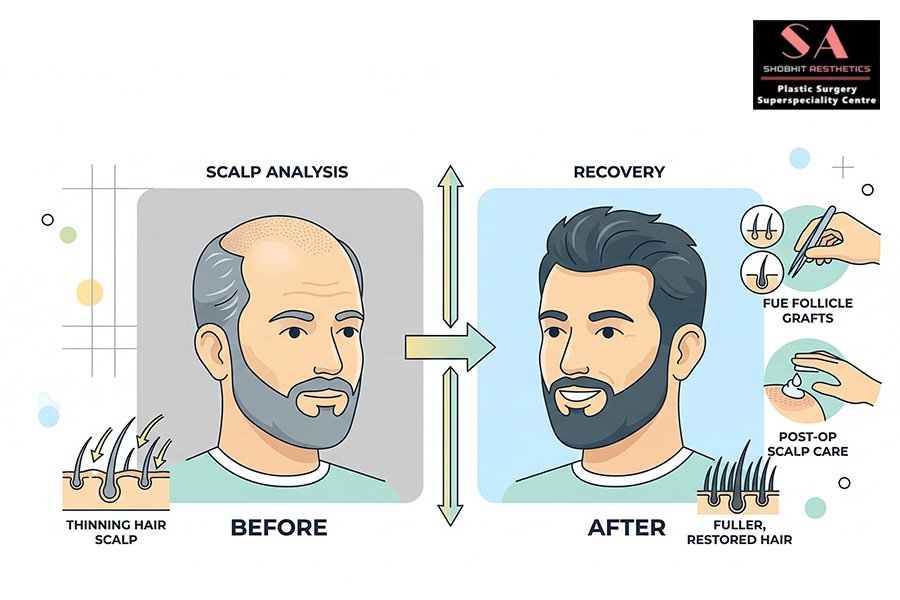
Reviewing genuine hair transplant before and after photographs from patients treated at our clinic remains the most powerful way to evaluate our outcomes. Our team will walk you through our full gallery during your consultation.
The Procedure – Step by Step
Here is a complete walkthrough of what the surgical day involves at Shobhit Aesthetics:
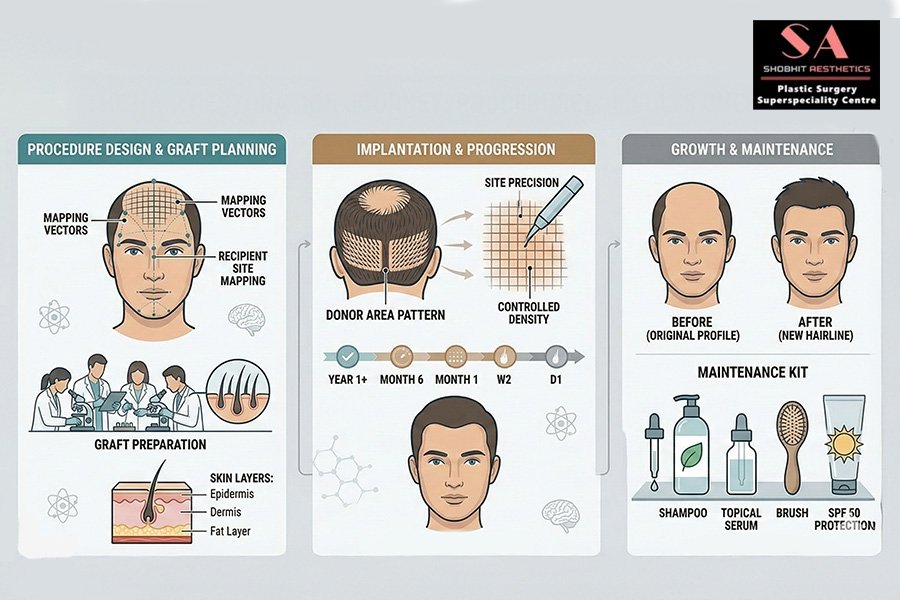
- Pre-operative Preparation — Scalp photographs are taken, the hairline is designed and approved by the patient, and the donor area is trimmed. Pre-operative instructions regarding alcohol, blood thinners, and scalp washing are followed.
- Anaesthesia — Local anaesthesia is administered to both the donor and recipient areas. The procedure is performed while the patient is awake and comfortable — most patients watch television or rest throughout.
- Donor Harvesting (FUE) — Individual follicular units are extracted from the donor area using a precision micro-punch tool. Grafts are carefully stored in a preservation solution to maintain their viability.
- Graft Preparation — Under high magnification, extracted grafts are examined, trimmed, and sorted by size — single-hair grafts for the hairline, multi-hair grafts for density behind it.
- Recipient Site Creation — Tiny incisions are made in the recipient (balding) area at precisely planned angles, directions, and densities to mimic the natural growth pattern of the hair.
- Graft Placement — Prepared grafts are gently placed into the recipient sites one by one with meticulous care, ensuring correct orientation and depth.
- Post-procedure Care — The donor area is dressed, post-operative instructions are provided, and the patient is discharged on the same day with a complete aftercare kit.
A typical session takes between six and ten hours depending on the number of grafts being transplanted — commonly between 1,500 and 4,000 grafts in a single session.
Recovery and Hair Transplant Results
One of the most frequently asked questions about surgical hair restoration is what to expect during recovery and when results become visible. Here is a realistic, honest timeline:
- Days 1–3 — Mild swelling, redness, and scabbing in both the donor and recipient areas are completely normal. The scalp is tender but manageable with prescribed pain relief. Patients are instructed to sleep with the head elevated and to avoid touching the grafts.
- Days 4–10 — Small crusts form around each graft site and gradually shed over the following days. Hair washing resumes gently from day three or four as directed. The transplanted hairs begin to shed during this period — this is expected and is a completely normal part of the process.
- Week 2–4 — Most of the transplanted hairs shed. This phase is known as shock loss and is temporary. The follicles themselves remain healthy beneath the scalp and will begin regenerating.
- Month 2–4 — New hair growth begins to emerge from the transplanted follicles. Hair is initially fine and light before thickening progressively.
- Month 4–8 — Visible and meaningful density improvement becomes apparent. Patients begin to appreciate early hair transplant results and the transformation starts to show clearly.
- Month 10–14 — Full, final results are visible. The transplanted hair has grown in completely, blended naturally with existing hair, and achieved the planned density and coverage. This is the point at which the true impact of the procedure is fully appreciated.
Is hair transplant safe? When performed by a qualified, experienced surgeon in a properly equipped medical facility, the procedure is very safe with a well-established clinical track record. Understanding the hair transplant side effects — which include temporary swelling, numbness, itching, and the expected shedding phase — is important for informed decision-making. Rare complications such as folliculitis, infection, or poor graft survival are minimised through sterile technique, experienced execution, and structured post-operative care. A transparent discussion of the side effects of hair transplant is always part of every consultation at our clinic.
Cost of Hair Restoration in Jaipur
The hair transplant cost in jaipur at Shobhit Aesthetics is structured to be transparent, graft-based, and inclusive of all aspects of your care.
Pricing is calculated on a per-graft basis, meaning the total investment is directly proportional to the number of follicular units transplanted — which in turn depends on the degree of hair loss, the area being covered, and the desired density. This graft-based model ensures complete fairness and clarity in pricing.
The best hair transplant in jaipur price at our clinic reflects the quality of technology, the expertise of the surgical team, and the comprehensiveness of care — not inflated by unnecessary overheads. The hair transplant cost in jaipur rajasthan at our clinic is also significantly more accessible compared to equivalent clinics in Delhi, Mumbai, or Chandigarh — making Jaipur an increasingly sought-after destination for high-quality hair restoration at reasonable cost.
The hair transplant cost jaipur is fully itemised during your consultation — including graft price, session duration, post-operative medications, follow-up visits, and PRP sessions if included — so there are no surprises at any stage of your journey with us.
For patients researching jaipur hair transplant options, the jaipur hair transplant clinic at Shobhit Aesthetics consistently stands out for the combination of surgical expertise, advanced technology, verified patient outcomes, and honest, patient-first communication.
Frequently Asked Questions
The number of grafts depends on the degree and pattern of your hair loss, the area to be covered, and your desired density. Most patients require between 1,500 and 3,500 grafts for significant coverage. Your surgeon will provide a precise recommendation after assessing your scalp during the consultation.
Yes — in the hands of an experienced surgeon, the result is completely natural. Natural-looking outcomes depend on precise hairline design, correct angulation and direction of graft placement, and appropriate density distribution. These are the hallmarks of surgical artistry that our team consistently delivers.
FUE extracts individual follicles without a linear scar — ideal for patients who prefer short hairstyles. FUT removes a strip of scalp, leaving a fine linear scar concealed within the surrounding hair but enabling a larger graft harvest. The right choice depends on your degree of hair loss, donor supply, and lifestyle preferences.
Yes. Female pattern hair loss and traction alopecia are both conditions that respond well to surgical restoration when candidacy criteria are met. Women typically experience diffuse thinning rather than complete baldness, and careful assessment is required to determine whether sufficient donor hair is available.
Patients are advised to stop blood-thinning medications, avoid alcohol for at least a week, and refrain from smoking for two weeks before and after surgery. A thorough pre-operative checklist is provided during your consultation to ensure you are fully prepared.
Simply call our clinic or submit an appointment request through our website. Our team will arrange a comprehensive scalp assessment and consultation with our best hair transplant surgeon in jaipur — providing a full, personalised treatment plan and transparent cost estimate with no pressure or obligation.