Imagine reshaping your body - not with implants, not with padding - but with your own fat, sculpted and transferred to create natural-looking curves. That is the essence of a Brazilian Butt Lift, and it has quietly become one of the most sought-after cosmetic procedures in the world.
Global demand for BBL surgery has surged by over 77% in the last decade, according to data from the International Society of Aesthetic Plastic Surgery (ISAPS). And India is no exception. With a growing middle class, rising body confidence conversations, and world-class cosmetic surgery infrastructure, BBL surgery in India is rapidly becoming a mainstream cosmetic choice - no longer whispered about, but openly researched and planned.
So what exactly is a Brazilian Butt Lift? Who is it for? Is it safe? How much does it cost in India? And - most importantly - what kind of results can you realistically expect?
This guide answers all of those questions in clear, honest, medically accurate detail. Whether you are in the early research stage or actively planning a consultation, this is the most comprehensive BBL resource you will find — written by the team at Shobhit Aesthetics Clinic, where patient safety and surgical excellence are the foundation of every procedure.
Let us start from the very beginning.
What Is a Brazilian Butt Lift (BBL)?
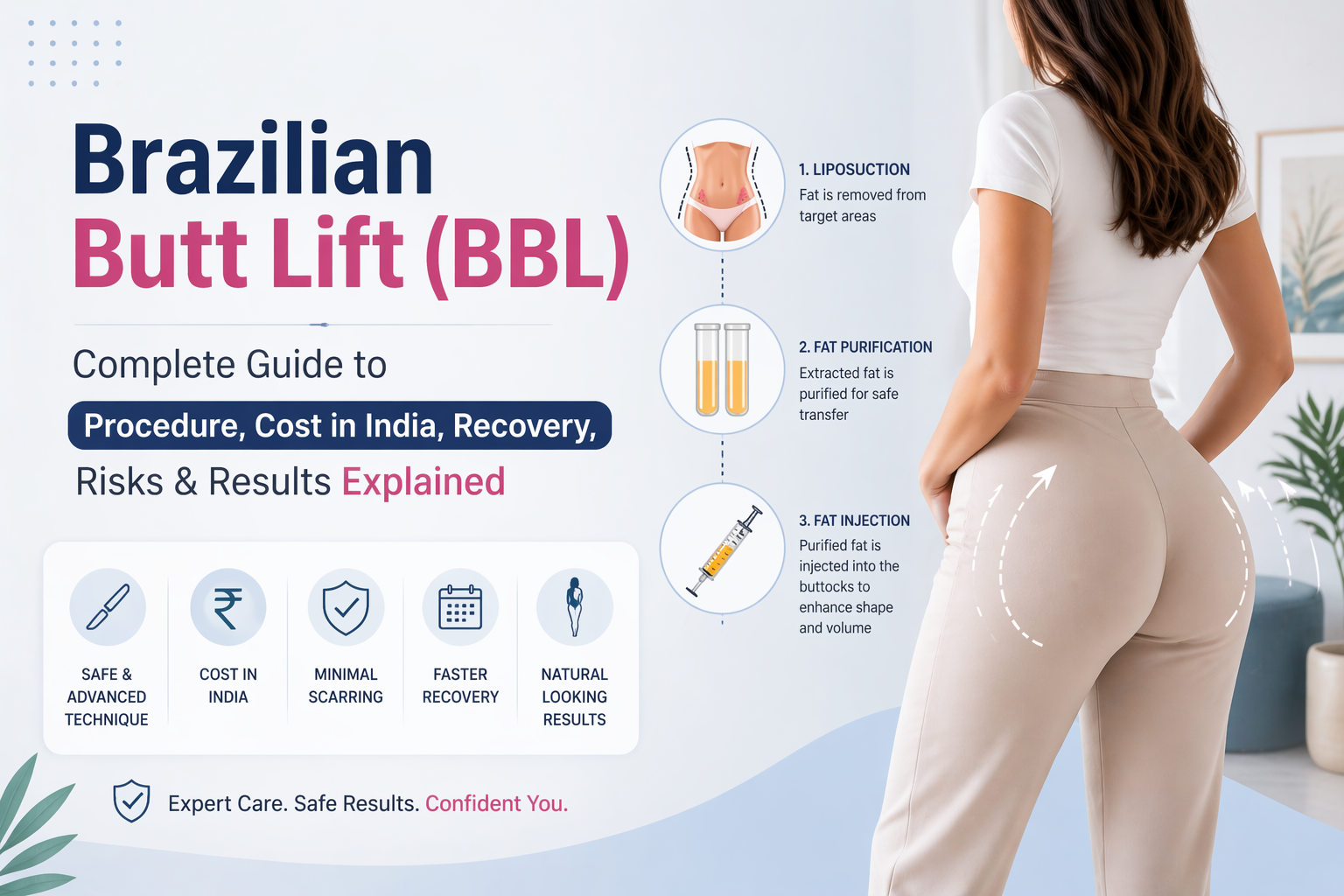
A Brazilian Butt Lift, commonly abbreviated as BBL - is a cosmetic surgical procedure that enhances the size, shape, and projection of the buttocks using the patient's own fat. Unlike traditional butt augmentation, which relies on silicone implants, a BBL uses a two-in-one approach: it removes excess fat from donor areas of the body (typically the abdomen, flanks, back, or thighs) through liposuction, then purifies and reinjects that fat into the buttocks to create fuller, more contoured curves.
The name "Brazilian" is largely cultural — it reflects the Brazilian aesthetic ideal of a naturally full, round, lifted posterior that has long been associated with beauty standards in Brazil and, increasingly, worldwide.
BBL vs. Butt Implants: What Is the Difference?
This is one of the most common questions asked before a consultation. Here is a direct comparison:
| Feature | Brazilian Butt Lift (BBL) | Butt Implants |
|---|---|---|
| Material Used | Patient's own fat | Silicone implants |
| Natural Look & Feel | Yes — highly natural | Moderate |
| Scarring | Minimal (tiny liposuction incisions) | More visible scarring |
| Risk of Rejection | Very low (own tissue) | Possible implant complications |
| Risk Level | Medium | Higher |
| Body Contouring Benefit | Yes — double benefit | No |
| Recovery Period | Moderate (4–6 weeks) | Longer (6–8 weeks) |
| Longevity | Long-lasting with proper care | Long-lasting but implant revision possible |
| Best For | Patients with sufficient donor fat | Patients with very low body fat |
The core advantage of a BBL is the dual benefit: you lose fat from areas you do not want it (like the abdomen or lower back) and gain volume in an area you do (the buttocks). The result looks and feels natural because it is natural — it is your own tissue.
Why Has BBL Become So Popular?
Several cultural, technological, and social factors have driven the global rise of BBL:
- Social media influence — Platforms like Instagram and TikTok have popularised hourglass body shapes.
- Advances in fat transfer technology — Improved purification systems mean more fat survives the transfer, leading to better results.
- Dual sculpting effect — Patients effectively get liposuction and butt augmentation in a single procedure.
- Growing acceptance of cosmetic surgery in India — Changing attitudes mean more people are openly pursuing procedures they once would have kept private.
- Better affordability in India — Compared to the US or UK, butt augmentation cost in India is significantly lower without compromising quality.
How Does a BBL Procedure Work? (Step-by-Step)
Understanding the surgical process helps set accurate expectations and builds confidence in the decision. Here is exactly how a BBL is performed by a qualified cosmetic surgeon:
Step 1: Pre-Surgical Consultation & Planning
Before any incision is made, your surgeon will conduct a thorough consultation. This includes a full medical history review, body composition assessment, discussion of aesthetic goals, and a physical examination to determine the best donor sites for fat harvesting. Photographs may be taken for before-and-after comparison, and a surgical plan is customised for your anatomy.
Step 2: Anaesthesia Administration
A BBL is performed under general anaesthesia or, in select cases, intravenous sedation with local anaesthesia — depending on the volume of fat being transferred and the patient's overall health profile. You will be completely comfortable and asleep throughout the procedure.
Step 3: Liposuction — Fat Harvesting from Donor Sites
Small incisions (typically 3–5 mm) are made in the predetermined donor areas. A thin, hollow tube called a cannula is inserted and used to suction out fat deposits using one of several advanced techniques:
- Tumescent liposuction — The most common; saline solution with anaesthetic is injected to loosen fat before removal.
- Power-Assisted Liposuction (PAL) — A vibrating cannula that makes fat extraction smoother and less traumatic.
- VASER Liposuction — Ultrasound technology that breaks up fat cells before removal, preserving more viable fat cells for transfer.
Common donor sites include the abdomen, flanks (love handles), lower back, inner thighs, and upper arms.
Step 4: Fat Purification & Processing
The harvested fat is not immediately injected. It first goes through a critical purification process to remove blood, fluids, damaged cells, and other impurities. This is typically done using:
- Centrifugation — The fat is spun at high speed to separate pure fat cells from unwanted material.
- Decantation or filtration — Gravity-based separation for gentler processing.
This step is crucial. Higher-quality fat purification leads to a greater percentage of fat cells surviving post-transfer — which directly affects the final result.
Step 5: Fat Injection into the Buttocks
The purified fat is loaded into syringes and injected into the buttocks using a blunt-tipped cannula. The surgeon makes multiple small entry points and injects fat at various depths and angles — layering it carefully to build volume, shape, and symmetry.
A critical safety rule during this step: fat must be injected only into the subcutaneous tissue layer (the fat layer), never into the muscle. Injecting into or below the gluteal muscle dramatically increases the risk of fat embolism — a life-threatening complication. This is why choosing a board-certified, experienced surgeon is non-negotiable.
Step 6: Closure & Recovery Preparation
Once the desired volume and shape are achieved, small incisions are closed with sutures. A compression garment is placed over both the liposuction areas and buttocks to reduce swelling, support healing, and help the newly transferred fat settle properly.
Total procedure time: 2–4 hours, depending on fat volume and number of donor sites.
Who Is an Ideal Candidate for BBL?
BBL surgery is not a one-size-fits-all procedure. You are likely a good candidate if:
- You are in good overall health with no uncontrolled medical conditions
- You have sufficient excess body fat in donor areas for harvesting (typically 1–2 litres minimum)
- You have realistic expectations about outcomes — BBL enhances, not transforms
- You are a non-smoker or willing to stop smoking 4–6 weeks before and after surgery
- You are at or near your ideal body weight (not planning to lose significant weight post-surgery)
- You are bothered by flat, asymmetric, or disproportionate buttocks relative to your frame
- You are psychologically prepared for the recovery process, including activity restrictions
Medical Considerations & Who Should Not Get a BBL
BBL may not be appropriate if you:
- Have a BMI below 22 with insufficient donor fat
- Have active infection, bleeding disorders, or severe systemic illness
- Are pregnant or breastfeeding
- Have unrealistic expectations or body dysmorphic disorder (BDD)
- Are on blood thinners or medications that cannot be paused
- Have had previous significant surgery in the donor or treatment area
A comprehensive consultation with your surgeon will determine your suitability. Never self-diagnose candidacy.
BBL Cost in India: A Detailed Breakdown
One of the most searched questions is: "How much does a BBL cost in India?"
The short answer: ₹1,50,000 to ₹4,50,000+, depending on several key factors.
This range is significantly lower than BBL costs in the US ($8,000–$15,000) or UK (£6,000–£12,000), making India an increasingly attractive destination for medical tourists seeking high-quality body contouring surgery at a fraction of the price.
Cost Factors Explained
| Factor | Cost Impact | Why It Matters |
|---|---|---|
| Surgeon's Expertise & Credentials | High | An MCh/DNB-certified plastic surgeon with extensive BBL experience commands a premium — and for good reason. Skill directly determines safety and results. |
| Clinic Location | Medium | Clinics in metro cities (Delhi, Mumbai, Bengaluru) typically charge more than those in Tier-2 cities. |
| Volume of Fat Required | High | More fat to harvest and transfer means longer surgery time and more resources. |
| Technology Used | Medium | VASER liposuction or PAL technology costs more but delivers better fat viability. |
| Anaesthesia Type | Medium | General anaesthesia adds to the cost compared to local/sedation options. |
| Hospital/Clinic Facility Fees | Medium | NABH-accredited facilities with ICU backup charge appropriately for their standard of care. |
| Pre & Post-Op Care Package | Variable | Includes consultations, blood tests, garments, follow-up visits — bundled packages offer better value. |
| Geographic Region | Low–Medium | Southern cities like Chennai and Hyderabad often offer competitive pricing. |
Approximate Cost by City
| City | Estimated BBL Cost Range |
|---|---|
| Delhi / NCR | ₹2,00,000 – ₹4,50,000 |
| Mumbai | ₹2,50,000 – ₹5,00,000 |
| Bengaluru | ₹2,00,000 – ₹4,00,000 |
| Hyderabad | ₹1,75,000 – ₹3,75,000 |
| Chennai | ₹1,75,000 – ₹3,50,000 |
| Meerut / Tier-2 Cities | ₹1,50,000 – ₹2,75,000 |
Important note on cost and safety: An unusually low price for a BBL should be treated as a red flag. This is a complex surgical procedure that requires an accredited facility, experienced team, and quality consumables. Cutting corners on cost in cosmetic surgery directly increases the risk of complications.
At Shobhit Aesthetics Clinic, we believe every patient deserves to know exactly what they are paying for. Our consultations include a detailed, itemised cost breakdown — no hidden charges, no surprise fees — so you can make an informed decision with complete clarity.
BBL Recovery Timeline: Week-by-Week Guide
Recovery is one of the most important — and most underestimated — parts of the BBL journey. The first 6–8 weeks are critical for ensuring the transferred fat survives and settles correctly.
Recovery Timeline at a Glance
| Timeframe | What to Expect | Key Do's & Don'ts |
|---|---|---|
| Day 1–3 | Moderate swelling, bruising, and soreness in donor and treated areas. Drainage from incisions is normal. | Wear compression garment. Rest. Do NOT sit directly on buttocks. |
| Week 1 | Swelling peaks. Some discomfort managed with prescribed pain relief. Drains (if used) may be removed. | Walk short distances. Sleep on stomach or sides. No strenuous activity. |
| Week 2 | Bruising begins to fade. Energy levels slowly improve. Return to light desk work possible for some patients. | Use a BBL pillow when sitting. No direct pressure on buttocks for 8 weeks. |
| Week 3–4 | Significant reduction in swelling. Shape begins to emerge. Compression garment still required. | Light walks. No gym or high-impact activity. |
| Week 6–8 | Most patients return to normal daily activities. Shape and projection becoming clearer. | Gentle lower body exercises may begin with surgeon approval. |
| Month 3 | Final swelling resolves. Results become much more visible. Fat grafting outcomes stabilising. | Light squats and glute exercises can begin to enhance results. |
| Month 6–12 | Final results fully apparent. Remaining transferred fat has integrated permanently into tissue. | Maintain stable weight. Regular follow-up with your surgeon. |
The "No-Sitting Rule" — Why It Matters So Much
For the first 6–8 weeks, patients are instructed not to sit directly on their buttocks. This is not an arbitrary restriction — it is scientifically based. Direct pressure on the freshly transferred fat compresses the newly developing blood supply to fat cells, causing them to die (fat necrosis), which reduces the final volume and can create uneven results.
Patients use a BBL pillow (a specially designed cushion with a cut-out at the back) when they must sit — for example, during meals or desk work. When driving or travelling, patients are advised to sit on the back of their thighs, not the buttocks.
BBL Recovery Tips from Our Surgical Team
- Hydration is healing — Drink 2–3 litres of water daily to flush out anaesthetic agents and support tissue recovery.
- Protein-rich diet — Adequate protein (chicken, legumes, eggs, paneer) supports cellular regeneration and fat cell survival.
- Compression garment compliance — Wear it consistently for the recommended period, even when it feels uncomfortable. It dramatically improves the final contour.
- Lymphatic massage — Many surgeons recommend manual lymphatic drainage massages from week 2–3 onward to reduce swelling and improve results.
- No smoking — Nicotine severely restricts blood flow to healing tissues and dramatically reduces fat cell survival rates.
Risks & Safety Considerations: What Every Patient Must Know
Informed consent is a cornerstone of ethical cosmetic surgery. BBL, like all surgical procedures, carries risks. Understanding them is not a reason to avoid the surgery — it is a reason to choose your surgeon wisely.
Most Common Risks
1. Fat Embolism (Most Serious) A fat embolism occurs when fat enters the bloodstream and travels to the lungs or brain. It is the most serious risk associated with BBL and was responsible for the procedure having the highest mortality rate among cosmetic surgeries in historical data. However, the risk has dropped significantly with the 2019 ISAPS Safety Task Force guidelines, which mandate that fat be injected only into subcutaneous tissue, never into the gluteal muscle.
Choosing a surgeon who strictly adheres to these updated protocols is essential.
2. Infection As with any surgery, infection is possible. Signs include fever, increased redness, warmth, or discharge at incision sites. Managed with prophylactic antibiotics and proper wound care. Serious infections are rare in accredited facilities.
3. Seroma & Haematoma A seroma is a pocket of fluid that collects under the skin; a haematoma is a collection of blood. Both can occur post-liposuction and may require drainage. Most resolve on their own or with minor intervention.
4. Asymmetry Minor asymmetry is common in early recovery due to uneven swelling. True asymmetry from unequal fat distribution or fat loss is less common with an experienced surgeon but can occur. Minor revisions are occasionally needed.
5. Fat Necrosis When transferred fat cells do not receive adequate blood supply, they die. This can create firm lumps or uneven texture. Good surgical technique and post-op compliance (especially the no-sitting rule) minimise this risk.
6. Scarring BBL incisions are small (3–5 mm) and placed in discreet locations. Scarring is generally minimal and fades over time. Patients with a tendency to form keloids should disclose this pre-operatively.
7. Changes in Skin Sensation Temporary numbness, tingling, or hypersensitivity in donor and treatment areas is common. Sensation typically returns fully within 3–6 months.
8. Anaesthesia-Related Risks General anaesthesia carries standard risks including allergic reaction, respiratory complications, and nausea. A qualified anaesthesiologist managing your care significantly mitigates these.
Expert-Backed Safety Practices
- Only proceed with a board-certified plastic surgeon — In India, look for MCh (Plastic Surgery) or DNB (Plastic Surgery) credentials from a recognised institution.
- Ensure the facility is NABH-accredited or has equivalent quality standards.
- Get pre-operative blood work done — A thorough health screen identifies risk factors before surgery.
- Disclose all medications and supplements — Including herbal supplements, which can increase bleeding risk.
- Ask your surgeon directly about their complication rate and emergency protocols — A confident, ethical surgeon will answer transparently.
BBL Results: Before & After — What to Realistically Expect
Managing expectations is one of the most important parts of any cosmetic surgery consultation. Here is an honest, evidence-based overview of what BBL results look like over time.
Immediate Post-Op (Day 1–7)
Results are not visible at this stage. The buttocks will be swollen, sometimes dramatically so. Do not judge your results in the first week. The appearance immediately post-op is not representative of the final outcome.
Short-Term Results (Week 4–8)
Swelling begins to resolve and you will start to see the early silhouette of your new shape. However, up to 30–40% of the transferred fat may be reabsorbed by the body during this phase — this is normal and expected. Your surgeon accounts for this during the procedure by slightly overfilling.
Medium-Term Results (Month 3–6)
This is when most patients experience their "wow moment." The bulk of swelling has resolved, the remaining fat has begun to integrate with surrounding tissue, and the curves are clearly visible. The result looks and feels natural.
Long-Term Results (Month 6–12 and Beyond)
The fat that has survived to 6 months is considered permanently integrated. It behaves exactly like native fat — it will fluctuate with significant weight changes. If you gain weight, the area may increase; if you lose substantial weight, some volume may be lost.
With a stable body weight, BBL results can last many years — potentially a lifetime.
Factors That Affect Longevity of Results
| Factor | Impact on Results |
|---|---|
| Surgeon's technique | Directly affects fat survival rate |
| Post-op compliance (no-sitting rule) | Critical in first 6–8 weeks |
| Smoking | Severely reduces fat cell survival |
| Weight fluctuations | Can increase or decrease volume |
| Compression garment use | Improves final contour |
| Lymphatic massage | Reduces swelling, improves shape |
| Physical activity (post-recovery) | Glute exercises can enhance and maintain shape |
BBL vs. Butt Implants: Full Comparison
For patients with very low body fat who may not have sufficient donor fat for a BBL, butt implants become a relevant alternative. Here is a thorough comparison to help clarify the decision:
| Feature | Brazilian Butt Lift (BBL) | Butt Implants |
|---|---|---|
| Natural Look | Highly natural | Moderate |
| Natural Feel | Feels like natural tissue | Firmer, implant-like |
| Body Contouring Benefit | Yes — donor area slimmed | No |
| Scarring | Minimal (tiny incisions) | More visible |
| Risk of Rejection | Very low | Higher (implant capsular contracture) |
| Risk of Rupture | Not applicable | Possible |
| Revision Surgery | Less common | More common over time |
| Recovery Time | 4–6 weeks | 6–8 weeks |
| Candidacy | Requires sufficient body fat | Suitable for very lean patients |
| Cost (India) | ₹1,50,000 – ₹4,50,000 | ₹2,00,000 – ₹5,00,000 |
| Longevity | Long-lasting (fat behaves naturally) | Long-lasting (implant lifespan ~10–15 years) |
Bottom line: For most patients, BBL is the preferred option due to its natural results, dual benefit, and lower complication profile. Implants remain a valid option specifically for patients who lack sufficient donor fat.
Post-BBL Care: Maintaining Your Results Long-Term
Surgery delivers the canvas — your lifestyle determines how long the results last. Here is how to protect your investment:
Nutrition
- Maintain a stable, healthy weight. Significant weight gain after BBL can over-expand the treated area; significant weight loss can reduce volume.
- Prioritise lean protein during recovery for tissue healing.
- Stay well-hydrated. Dehydration slows the healing of fat cells.
Exercise (Post-Recovery)
- After receiving surgical clearance (typically at 8–12 weeks), begin glute-focused exercises — squats, hip thrusts, glute bridges — to further develop and maintain the shape.
- Avoid high-impact cardio for the first 8 weeks.
- Maintain an active lifestyle long-term to keep donor areas slim and buttocks toned.
Clothing & Pressure
- Continue wearing your compression garment as directed.
- Avoid tight waistbands or clothing that places excessive pressure on the buttocks in the early months.
- Use your BBL pillow consistently during the no-sitting period.
Follow-Up Appointments
- Never skip your follow-up visits. They allow your surgeon to monitor fat survival, address any concerns early, and document your results.
- Report any unusual changes — firmness, pain, or asymmetry — to your clinic promptly.
FAQs:-
Q1. Is a Brazilian Butt Lift safe in India?
Yes — when performed by a qualified, board-certified plastic surgeon in an accredited facility. BBL safety has improved dramatically following updated international guidelines (ISAPS 2019) mandating subcutaneous-only fat injection. The key is choosing a credentialed surgeon and a NABH-accredited clinic. Avoid unregulated providers offering unusually low prices.
Q2. How long does a BBL last?
BBL results are long-lasting — potentially permanent. Fat that survives the initial 3–6 month integration period behaves like native tissue. Results may be affected by significant weight changes but, with a stable body weight and healthy lifestyle, most patients enjoy their results for many years.
Q3. Is a BBL painful?
Discomfort is moderate, not severe, and is well-managed with prescribed medication. Most patients describe the post-operative experience as soreness similar to an intense workout — particularly in the liposuction donor areas. Pain is typically well-controlled by day 3–5 and most patients are comfortable within 1–2 weeks.
Q4. Can the transferred fat disappear after surgery?
Yes — partially. It is normal for 20–40% of transferred fat to be reabsorbed by the body in the first 2–3 months. Surgeons account for this during the procedure. The fat that remains at 6 months is considered permanently integrated. Proper post-op care — especially the no-sitting rule and avoiding smoking — maximises fat survival.
Q5. How soon can I sit after a BBL?
You should avoid sitting directly on your buttocks for 6–8 weeks post-surgery. When sitting is unavoidable, use a BBL pillow that redirects pressure to the thighs. This protects the newly transferred fat's blood supply during the critical healing period.
Q6. How much fat is needed for a BBL?
A minimum of approximately 300–500 cc of purified fat per buttock is typically required to see a meaningful result, though many patients receive more. You need sufficient donor fat — which is why patients with a BMI below 22 may not be ideal candidates. Your surgeon will assess this during consultation.
Q7. What is the BBL recovery time?
Most patients return to light desk work within 2 weeks and resume normal daily activities by weeks 6–8. Full recovery, including return to exercise, typically takes 8–12 weeks. Final results are visible at 6–12 months.
Q8. Can a BBL be combined with other procedures?
Yes. BBL is commonly combined with tummy tuck (abdominoplasty), breast augmentation, or additional liposuction to create a comprehensive body transformation. Combining procedures can be done safely in appropriate candidates and may reduce total downtime compared to staging procedures separately.
Q9. Will a BBL leave visible scars?
Scarring is minimal. The incisions made for liposuction cannula insertion are typically 3–5 mm — about the size of a small puncture. They are placed in naturally hidden areas (skin folds, crease lines) and generally fade to thin, pale lines over 6–12 months.
Q10. Does BBL require general anaesthesia?
Most BBL procedures are performed under general anaesthesia to ensure patient comfort and surgical precision. In select cases of smaller-volume fat transfer, IV sedation combined with local anaesthesia may be used. Your anaesthesiologist will recommend the safest option based on your health profile.
Understanding BBL for Different Body Types
One of the most nuanced aspects of BBL planning is recognising that the procedure must be customised to the individual's anatomy, not applied as a template.
For Petite Frames
Smaller patients may have less donor fat available, but even moderate volumes of fat transfer (300–400 cc per side) can create a proportionally significant transformation on a petite frame. Precision placement is paramount.
For Athletic Builds
Athletic patients often have low body fat, which limits donor availability. However, strategic fat extraction from areas like the inner thighs, lower back, or flanks — combined with careful injection — can still achieve excellent contouring. VASER liposuction is particularly useful here as it harvests fat efficiently from denser, more fibrous tissue.
For Plus-Size Patients
Patients with a higher BMI typically have abundant donor fat, which is advantageous for large-volume BBL. However, surgical risks (including anaesthesia risk, wound healing) are higher at elevated BMIs. Most surgeons prefer to operate when BMI is below 35, and many recommend weight loss to a stable, healthy range before surgery.
For Post-Pregnancy Bodies
Many mothers seek BBL as part of a Mummy Makeover — a combination of procedures to restore the pre-pregnancy body. BBL combined with abdominoplasty is particularly popular, as pregnancy often leaves both a depleted posterior and an abdominal skin excess that responds well to surgical correction.
Choosing the Right BBL Surgeon in India: A Checklist
The surgeon you choose is the single most important decision in your BBL journey. Use this checklist when evaluating candidates:
- Qualifications: MCh (Plastic Surgery) or DNB (Plastic Surgery) from a recognised Indian institution
- Subspecialty experience: Ask specifically how many BBLs they perform annually
- Facility standards: Operates in a NABH-accredited hospital or equivalent
- Before & after portfolio: Ask to see real patient results — photos from their own practice
- Transparent communication: Willing to discuss risks candidly, not just benefits
- No-pressure consultation: Does not push you toward a decision in the first appointment
- Clear post-op protocol: Provides detailed written instructions for recovery
- Emergency access: 24/7 contact availability for post-operative concerns
- Itemised pricing: Full cost transparency with no hidden fees
Avoid any provider who cannot check all of these boxes. The aesthetic outcome and your safety depend on this choice more than any other factor.
Expert Insight: A Surgeon's Perspective on BBL in India
The landscape of BBL surgery in India has evolved enormously in the past five years. Modern fat transfer technology — particularly VASER liposuction and advanced centrifugation systems — has dramatically improved fat survival rates and overall results. Where surgeons once expected 50–60% fat retention, refined techniques now consistently achieve 70–80% survival in well-selected patients who follow post-operative protocols diligently.
What has also changed is patient awareness. People researching BBL in India today come to consultations better informed, asking sharper questions about technique, safety protocols, and realistic outcomes. This is enormously positive — it raises the standard of care and pushes surgical teams to be more transparent and evidence-based.
The most important message for any prospective BBL patient: results and safety are inseparable. The same techniques that produce beautiful, natural-looking outcomes — careful fat processing, anatomically precise placement, layered injection — are also the techniques that prevent serious complications. There is no trade-off between aesthetics and safety when the procedure is done right.
At Shobhit Aesthetics Clinic, every BBL is performed following international safety guidelines, with individualised surgical planning, and in a fully equipped, NABH-standard facility. Our approach has always been patient-first — which means we will tell you honestly when BBL is the right choice for you, and equally honestly when it is not.
Conclusion: Is a Brazilian Butt Lift Right for You?
A Brazilian Butt Lift is one of the most transformative, naturalfeeling cosmetic procedures available today. When performed by a qualified surgeon in an accredited facility, it offers a dual benefit — slimming donor areas while enhancing the buttocks — with results that are long-lasting and feel authentically like your own body.
Here is a quick summary of everything we have covered:
- What it is: A fat transfer procedure — liposuction + fat injection — not implants.
- How it works: Fat is harvested, purified, and injected in layers into the buttocks.
- Cost in India: ₹1,50,000 – ₹4,50,000+, depending on multiple factors.
- Recovery: 6–8 weeks with the no-sitting rule; full results visible at 6–12 months.
- Safety: Significantly improved with modern subcutaneous-injection protocols. Surgeon selection is paramount.
- Results: Natural-looking, long-lasting, and customisable to your anatomy.
If you have been considering a BBL — or even just curious about whether you are a candidate — the best next step is a consultation with a qualified plastic surgeon who can evaluate your individual anatomy, discuss realistic outcomes, and answer your questions without pressure.
Ready to Take the Next Step?
At Shobhit Aesthetics Clinic, we specialise in advanced body contouring procedures including Brazilian Butt Lift, liposuction, and comprehensive body sculpting. Our consultations are detailed, honest, and completely pressure-free. We want you to feel confident in your decision — whatever that decision may be.
???? Book your personalised BBL consultation today. ???? Visit us at Shobhit Aesthetics Clinic to learn more, view patient results, and speak with our team.
Your body. Your decision. Our expertise.