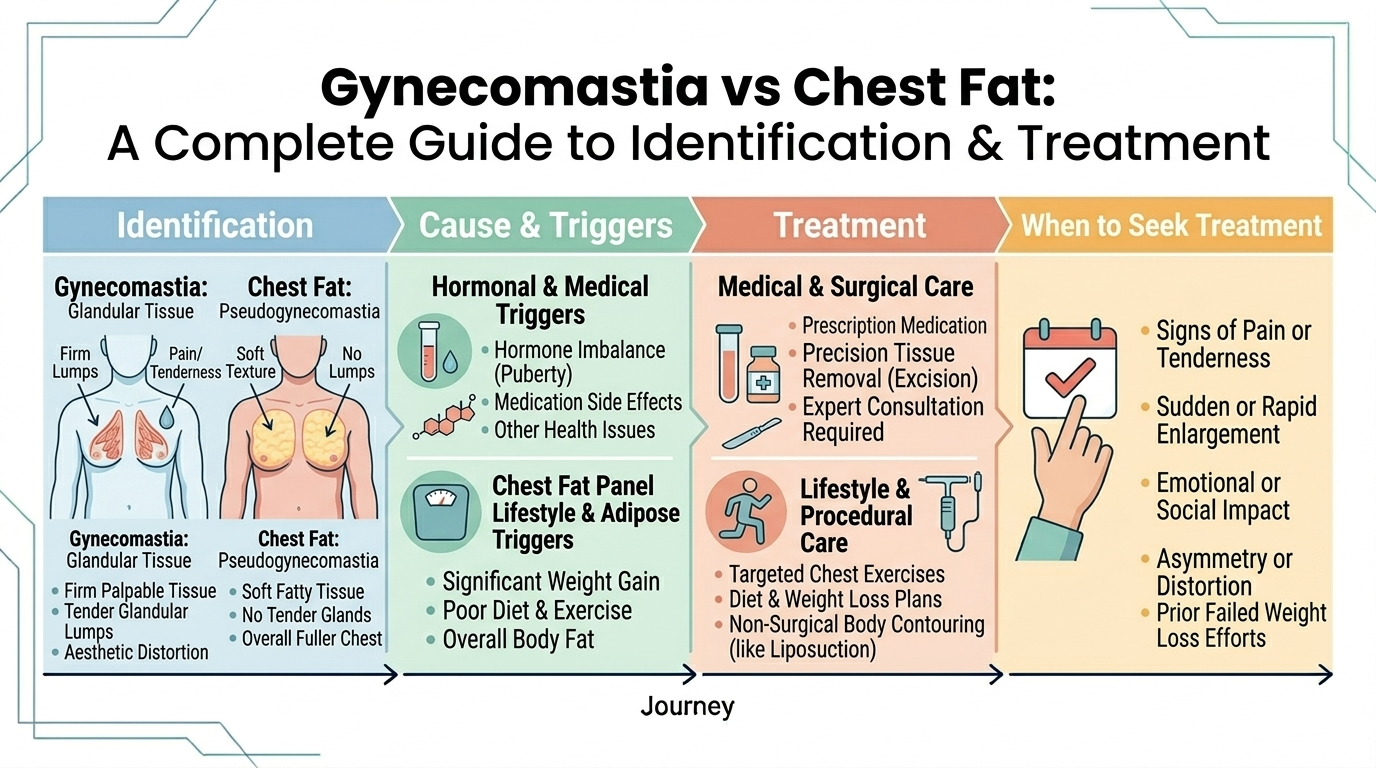
Many men face a condition where their chest appears larger and puffy, and they assume this is due to increased fat in this region. Therefore, they go to the gym, reduce their food consumption, and wait for their chest to go flat. However, after months of this, they still see no change in their chest, as they are not exactly dealing with fat in this region.
It is a fact that gynecomastia, a condition where a man develops larger and puffy male breasts, is one of the most misunderstood and underdiagnosed conditions in male patients. Although this condition looks similar to male chest fat, they are two completely different conditions, and gynecomastia cannot be treated in a similar manner as fat.
Shobhit Aesthetics has many patients who have suffered from this condition for a long time, never knowing exactly what their problem is, and thus living a life where they are embarrassed to go to the gym, embarrassed to go to the beach, and embarrassed to wear clothing that fits, simply due to their condition.
This article will help these patients identify exactly what their problem is, how this problem differs from male chest fat, how they can identify this difference on their own, and finally, what they can expect in terms of treatment.
What Is Gynecomastia?
It is a fact that gynecomastia, a condition where a man develops larger and puffy male breasts, is a medical condition in which the glandular breast tissue in a man's chest develops in larger quantities than normal. This is not fat, but breast tissue, similar to women, but in a male, which develops due to a hormonal imbalance in their bodies.
Every male in the world has a small amount of breast tissue. However, if the levels of testosterone and oestrogen are out of balance and oestrogen is dominant, even if only by a small margin, the breast tissue will begin to develop and cause a swollen or rounded appearance to the chest area.
Gynecomastia may develop on either side of the chest or on both sides. Gynecomastia is a very common problem and is thought to affect nearly 40–60% of males at some stage of their lives.
What is important for males to understand is that gynecomastia vs chest fat is not caused by fat and cannot be cured by losing weight. The breast tissue that grows is not fat but glandular and cannot be cured by losing weight but by medical or surgical intervention to remove it.
What Is Chest Fat in Men?
Chest fat in men is also known as pseudogynecomastia and is a buildup of fat in the chest area. This is not related to any hormonal imbalances and is a buildup of fat due to a number of different reasons. The main reason for chest fat is an excess of calories and a lack of exercise. The buildup of fat in the chest area is the same as the buildup of fat in any other area of the body and is due to a number of different factors. The main cause of fat buildup is a high-calorie intake and a lack of exercise. Some males are also prone to a buildup of fat in the chest area due to genetics.
Causes of chest fat in men:
- Weight gain and obesity
- Lack of exercise
- High-calorie intake
- Genetics – some males are prone to a buildup of fat in the chest area
- Loss of muscle mass due to age
The only difference is that chest fat in males can be controlled with lifestyle changes. Exercising regularly and controlling diet can help reduce chest fat. However, this is not possible in the case of gynecomastia.
Chest Fat vs. Gynecomastia: What is the Actual Difference?
This is the question we are asked the most. From the outside, both gynecomastia and chest fat can be similar. But the actual difference is huge.
Diet, Exercise, and/or Liposuction
One simple way to determine if you suffer from gynecomastia is to pinch the chest area with your fingers. If the tissue is hard and rubber-like and disc-shaped, it is gynecomastia. But if the tissue is soft throughout the chest, it is probably chest fat. But the truth is, many guys actually suffer from both gynecomastia and chest fat. So, it is actually gynecomastia with a layer of fat on top. It is actually one of the biggest factors to consider when determining the best course of treatment.
Gynecomastia Causes: Why Does It Happen?
Understanding gynecomastia causes will enable a man to realize that gynecomastia is a medical condition and not a result of his lifestyle.
- Hormonal Imbalance: The first and foremost fundamental gynecomastia cause. Estrogen promotes breast tissue growth, whereas testosterone inhibits it. Therefore, if a man has a hormonal imbalance, gynecomastia will occur.
- Puberty: A huge number of teenage boys experience gynecomastia at some point in their lives, particularly when they pass through puberty. This is because, at such a time, hormones surge and change dramatically.
- Ageing: As a man ages, his testosterone level decreases. This leads to a hormonal imbalance, and gynecomastia appears.
- Medications: The following medicines have gynecomastia as a side effect, and a man who uses them is more likely to develop gynecomastia:
- Substance Use: Alcohol, marijuana, heroin, and amphetamines have also been known to contribute to gynecomastia.
- Herbal and Nutritional Supplements: Lavender oil, tea tree oil, and some herbal supplements have estrogenic properties, thereby leading to gynecomastia.
Gynecomastia Symptoms: What to Look Out For
Gynecomastia symptoms are quite recognizable once you know exactly what to look for:
Swelling or enlargement of one or both sides of the chest.
In some cases, there is a mild discharge from the nipple, which always needs prompt medical attention. Pain and tenderness are common in the early, active phase of gynecomastia. Long-standing gynecomastia tends to have less pain and tenderness, but more pronounced enlargement.
Gynecomastia Grades and Stages
Doctors categorize gynecomastia under different grades to determine the extent of gynecomastia and plan the most appropriate treatment.
Grade 1: Minor Enlargement
A small amount of breast tissue develops in the nipple area, with no excess skin. This enlargement is not very visible under a shirt but is easily palpable.
Grade 2a: Moderate Enlargement
More breast tissue develops, which extends beyond the areola. There is no excess skin. This enlargement is visible.
Grade 2b: Moderate Enlargement with Mild Skin Excess
This type of enlargement is similar to 2a, with some skin starting to sag or hang.
Grade 3: Severe Enlargement
Significant development of breast tissue with excess skin. The chest takes on a female shape.
Knowing the stages of gynecomastia is important because if a man is in Stage 1 or 2a, liposuction alone may be an option. However, if a man is in Stage 2b or 3, gland removal and skin tightening are required for a flat and masculine chest.
Gynecomastia Treatment Options
There is no one-size-fits-all solution for the problem. Gynecomastia treatment varies depending on the underlying cause of the condition, grade of the condition, duration of the condition, and the desires of the patient.
- Watchful Waiting: If a teenager is experiencing pubescent gynecomastia, doctors recommend waiting 6–12 months to see if the condition will resolve on its own. Since hormonal levels are changing anyway, it usually does.
- Treatment of the Underlying Cause: If a man is taking a medication that is causing his gynecomastia, changing the medication may cure the problem. The same is true if the cause is a health problem such as a thyroid imbalance.
- Medications: If a man is in the initial or active phase of gynecomastia development, medications such as tamoxifen or raloxifene may be prescribed to treat the problem. These medications are estrogen blockers. However, once the breast tissue is developed and hard, medications are not very effective.
- Gynecomastia Surgery: For most men experiencing adult-onset gynecomastia, gynecomastia surgery is the most effective solution for the problem.
What is Gynecomastia Surgery?
Gynecomastia surgery involves:
- Liposuction of fatty deposits in the chest area
- Gland excision – removal of glandular breast tissue through a small incision near the areola
- Skin tightening and nipple repositioning for Stage 3 cases
The procedure is usually done under general anaesthesia and takes about 1–2 hours. The procedure is a day case for most people, which means that you will be able to go home on the same day.
The results are immediate, and when performed correctly, the results are completely natural-looking: flat, firm, male chests with minimal scarring.
Why Choose Shobhit Aesthetics for Gynecomastia Treatment?
We at Shobhit Aesthetics have successfully treated hundreds of men with gynecomastia at all grades. This is why we are the best choice for your gynecomastia surgery:
Accurate Diagnosis First — We make sure you get an accurate diagnosis before we recommend surgery. We also make sure that you don’t get surgery when you don’t really need it.
Customised Surgical Approach — Whether you need liposuction, gland removal, or both, we will make sure your surgery is customised to your individual anatomy as well as the grade of your gynecomastia.
- Minimal Scarring Approach — We ensure that the incisions we make during surgery are precise, resulting in scars that are almost impossible to detect.
- Natural-Looking Results — We ensure that your final result is natural-looking: not over-operated, not sunken, not asymmetrical.
- Full Support Through Recovery — We are with you every step of the way from your initial consultation through your final follow-up.
Can Exercise Reduce Gynecomastia?
This is one of the most common questions we get asked, and the answer is quite simple: exercise can reduce the fat on your chest, but it will not reduce gynecomastia.
Doing exercises such as push-ups, bench presses, and cable flyes will help build the muscles underneath your chest. This can make your chest look more defined, which can help reduce the appearance of fat on your chest. The glandular tissue right underneath your nipple, however, will not reduce in size with exercise because it is not fat. It is breast tissue, and no matter how many exercises you do on your chest, your breasts will not go away.
In fact, some men discover that by developing muscles in their chest area, the puffiness in their nipple area is more noticeable due to the muscles developed in this area.
If you have tried exercising for months without any improvement in your nipple area and your chest area in general, then you can conclude you are experiencing gynecomastia.
Recovery After Gynecomastia Surgery
The recovery process is smooth and comfortable. Here is what you can expect during your recovery:
- First 48–72 hours: You may feel some discomfort in your chest area due to some soreness and swelling.
- Days 3–7: During these days, you may experience swelling in your breast area; however, you can move around comfortably during these days.
- Week 2: You can return to your office work during this time.
- Week 4–6: You can resume light exercises during these days; however, you should avoid any exercises in your chest area during these days.
- Months 3–6: During these months, you can see a significant improvement in your breast area as your chest area settles down completely.
Gynecomastia Cost
The cost of gynecomastia surgery in India varies based on the grade of gynecomastia you are experiencing, as well as the cost of the clinic you choose.
Approximate cost range:
Grade 1 - ₹50,000 - ₹80,000 (Only Liposuction is required)
Grade 2 - ₹80,000 - ₹1,20,000 (Liposuction + Gland Excision)
Grade 3 - ₹1,20,000 - ₹2,00,000+ (Surgery + Skin Tightening)
At Shobhit Aesthetics, we will give you a transparent cost structure after your consultation. No hidden costs. EMI available.
Conclusion
The difference between gynecomastia and fat deposits in the breast area, although small, plays a large role in determining the right course of action. It would be a shame to spend months in the gym trying to get rid of a problem that, in fact, will not improve with exercise. It would, however, make a world of a difference to get the right treatment and know what to do about your gynecomastia.
If you have noticed that there has been an increase in the size of your breasts, or there is a lump under your nipple, or your breasts have taken on a puffed-up appearance, and this has not gone away, then it is time to consider gynecomastia surgery at Shobhit Aesthetics. The results of gynecomastia surgery can make all the difference in the world to your self-esteem. Book your consultation today and find out what exactly is wrong and what can be done about it.
Frequently Asked Questions (FAQs):-
Q1. What is the difference between gynecomastia and chest fat?
Gynecomastia is the development of breast tissue in males due to hormonal imbalances. Chest fat is simply the increase of fat in the chest area due to weight gain. Gynecomastia feels hard and rubbery under the nipple. It does not go away with exercise. Chest fat feels soft and even. It can go away with exercise.
Q2. How can I check whether I have gynecomastia or chest fat?
Press your chest gently. If you can feel a hard disc shape under your nipple, then you have gynecomastia. If your chest feels soft, even, and pinchable, then you have chest fat. You can confirm this by checking your hormones.
Q3. Can exercise help reduce gynecomastia?
No. Gynecomastia cannot be reduced by exercise. Gynecomastia can only be reduced by surgery. If you have not been exercising your chest for some time and have not noticed any improvement in the puffy appearance of your nipples, then you probably have gynecomastia.
Q4. What causes gynecomastia in men?
The most common causes of gynecomastia include hormonal imbalances, which can be caused by an increase in estrogen compared to testosterone. This can be caused by natural developmental stages, like puberty or old age, or can be brought about by medication, anabolic steroids, alcohol, drug abuse, or other medical problems like thyroid or liver disease.
Q5. When should I see a doctor for gynecomastia?
You should seek medical help in the following cases: If the swelling has persisted for more than 6 months, in cases of pain or discomfort, or if only one breast is affected. You should also seek medical help if there is discharge from the nipple or if gynecomastia impacts your self-esteem. The earlier the treatment, the better the outcome, and in most cases, peace of mind.