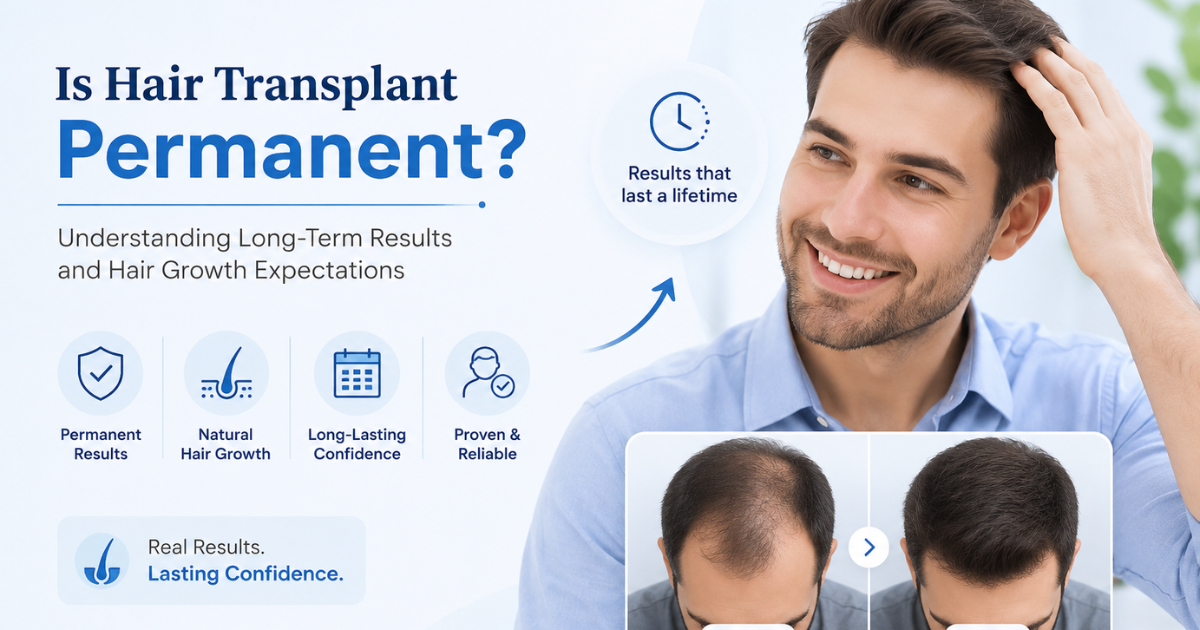
Hair loss can have a significant impact on self-confidence and overall appearance. For many individuals experiencing thinning hair or baldness, a Hair Transplant is often considered one of the most effective long-term solutions. However, one question consistently arises during consultations: Is Hair Transplant Permanent?
The answer is generally yes, but understanding what "permanent" means in the context of Hair Restoration is important. While transplanted hair is typically designed to last for many years, several factors influence long-term outcomes, including genetics, age, hair characteristics, and overall scalp health.
If you are considering a hair transplant, understanding how the procedure works and what to realistically expect from Transplant Results can help you make an informed decision.
Understanding Hair Loss
Before discussing the longevity of a hair transplant, it is important to understand why hair loss occurs in the first place.
The most common cause of hair loss is androgenetic alopecia, often referred to as male pattern baldness or female pattern hair loss.
This condition occurs due to a combination of:
- Genetics
- Hormonal influences
- Aging
- Individual hair follicle sensitivity
Over time, affected hair follicles gradually shrink, producing thinner and weaker hairs until growth eventually stops.
This process often leads individuals to explore Baldness Treatment options such as medications, non-surgical therapies, and hair transplantation.
What Is a Hair Transplant?
A Hair Transplant is a procedure that involves moving healthy hair follicles from one part of the scalp to areas affected by hair loss.
The donor area is usually located at the back or sides of the head, where hair follicles are generally more resistant to the effects of pattern baldness. These follicles are carefully transplanted into thinning or bald regions to restore hair coverage and improve overall appearance.
The goal is to achieve natural-looking Hair Growth that blends seamlessly with existing hair.
Why Are Donor Hair Follicles Important?
One of the key reasons hair transplantation is considered a long-term solution is the unique characteristic of donor hair.
Hair follicles taken from the back and sides of the scalp are typically genetically resistant to the hormones responsible for pattern baldness.
This characteristic is known as donor dominance. Because of this resistance, transplanted follicles often continue producing hair even after being moved to a new location.
This is the primary reason many people view hair transplantation as a permanent form of Hair Restoration.
Is Hair Transplant Permanent?
So, Is Hair Transplant Permanent?
In most cases, transplanted hair follicles are intended to be permanent because they retain the characteristics of the donor area from which they were taken.
Once the transplanted follicles establish themselves in their new location and begin growing, they generally continue producing hair for many years.
However, it is important to understand that permanence does not necessarily mean that every transplanted hair will remain unchanged forever.
Several factors can influence long-term outcomes, including:
- Age-related changes
- Progressive hair loss in non-transplanted areas
- Genetics
- Medical conditions
- Lifestyle factors
For most patients, transplanted hair remains a long-lasting solution, but ongoing hair loss in surrounding areas may still occur.
How Does Hair Growth Occur After a Transplant?
Understanding the timeline of Hair Growth can help set realistic expectations.
Many patients expect immediate results after surgery, but hair restoration is a gradual process.
Initial Healing Phase
During the first few weeks after transplantation, the scalp begins to heal.
Mild redness, swelling, and temporary scabbing may occur as part of the normal recovery process.
Shedding Phase
A few weeks after surgery, many transplanted hairs enter a shedding phase.
This can be alarming for patients, but it is completely normal.
The hair shafts fall out while the transplanted follicles remain beneath the skin.
New Hair Growth
Over the following months, the follicles begin producing new hairs.
This stage marks the beginning of visible Hair Growth.
Maturation Phase
The hair continues to grow, thicken, and mature over time.
Most patients notice progressive improvement throughout the first year after surgery.
The Role of the FUE Technique
One of the most commonly performed hair transplant methods today is the FUE Technique.
FUE stands for Follicular Unit Extraction.
In this approach, individual hair follicles are harvested directly from the donor area and transplanted into thinning or bald regions.
Benefits of the FUE Technique may include:
- Minimal visible scarring
- Faster healing
- Natural-looking results
- Precise graft placement
- Improved patient comfort
The technique has become increasingly popular because it allows surgeons to create natural hairlines and customized restoration plans.
Factors That Influence Long-Term Transplant Results
Although hair transplantation can provide excellent outcomes, long-term Transplant Results depend on several important factors.
Quality of Donor Hair
Strong donor follicles generally contribute to better outcomes.
Hair characteristics such as thickness, texture, and density can influence the final appearance.
Extent of Hair Loss
Patients with stable hair loss patterns often experience more predictable outcomes.
Extensive hair loss may require careful planning to ensure efficient use of available donor hair.
Surgical Technique
The skill and experience of the surgeon play a major role in achieving natural and durable results.
Proper graft handling and placement are essential for successful follicle survival.
Patient Health
Overall health, nutrition, and scalp condition can influence healing and long-term outcomes.
Understanding Hair Density After a Transplant
Many patients are particularly interested in achieving optimal Hair Density.
Hair density refers to the concentration of hair follicles within a given area of the scalp.
Several factors influence density outcomes, including:
- Number of grafts transplanted
- Quality of donor hair
- Scalp characteristics
- Existing hair coverage
- Treatment goals
While a transplant can significantly improve appearance, achieving the exact density of youthful hair may not always be possible.
The objective is often to create the appearance of fuller and natural-looking hair rather than maximum density.
Can Hair Loss Continue After a Hair Transplant?
This is an important consideration.
Although transplanted follicles are generally resistant to baldness, non-transplanted hairs may continue to thin over time.
For example:
- Existing native hair may continue to miniaturize.
- Hair loss progression may continue in untreated areas.
- Additional thinning may occur as part of the natural aging process.
This is why long-term planning is an important part of Hair Restoration.
A comprehensive treatment strategy often considers both current hair loss and future changes.
Setting Realistic Expectations
Hair transplantation can produce impressive improvements, but realistic expectations remain essential.
Patients should understand that:
- Results develop gradually
- Hair growth takes time
- Density varies between individuals
- Hair loss patterns continue to evolve
- Multiple treatment approaches may sometimes be beneficial
A well-informed patient is more likely to be satisfied with the outcome and appreciate the gradual nature of the transformation.
How Long Does a Hair Transplant Last?
One of the biggest reasons people choose a Hair Transplant is the potential for long-lasting results.
In most cases, transplanted hair follicles continue to grow for many years because they are taken from areas of the scalp that are genetically resistant to pattern baldness. For many patients, the transplanted hair remains throughout adulthood and continues to behave much as it did in the donor area.
However, it is important to understand that the aging process affects everyone. While transplanted hair is generally long-lasting, natural changes in hair texture, thickness, and overall scalp condition may still occur over time.
The goal of Hair Restoration is not only to restore lost hair but also to create results that continue to look natural as a person ages.
Can Transplanted Hair Fall Out Again?
This is one of the most common concerns among patients. The answer depends on the stage of recovery and the type of hair being discussed.
Temporary Shedding After Surgery
Shortly after a hair transplant, many patients experience temporary shedding of transplanted hairs.
This process is often called shock loss.
During this phase:
- Hair shafts fall out
- Hair follicles remain intact
- New growth develops later
Although this can be alarming, it is considered a normal part of recovery.
Long-Term Hair Survival
Once transplanted follicles establish themselves, they generally continue producing hair for many years. The follicles retain the characteristics of the donor area, making them more resistant to the hormones associated with pattern baldness.
Continued Loss of Native Hair
While transplanted hair may remain stable, existing non-transplanted hair can continue to thin due to ongoing hair loss.
This is one reason some patients eventually consider additional treatments or future transplant sessions.
Understanding the Success Rate of Hair Transplants
Modern hair transplantation techniques have significantly improved outcomes compared to older procedures.
The success of a Hair Transplant depends on several factors, including:
- Surgeon expertise
- Quality of donor hair
- Graft survival
- Scalp health
- Patient compliance with aftercare instructions
When performed correctly, transplanted follicles typically have a high survival rate.
Successful outcomes are often measured by:
- Natural appearance
- Consistent Hair Growth
- Improved hairline design
- Enhanced Hair Density
- Long-term graft survival
Patients who follow post-operative instructions carefully generally experience the most predictable outcomes.
Hair Growth Timeline After a Hair Transplant
One of the most important aspects of setting realistic expectations is understanding how long hair growth takes.
First Month
During the first few weeks:
- The scalp heals
- Minor redness improves
- Temporary shedding may occur
Visible hair growth is usually limited during this period.
Months Two to Four
Many patients continue experiencing the shedding phase.
This stage can require patience, as visible improvement may still be minimal.
Months Four to Six
New Hair Growth often begins to emerge.
Patients may notice:
- Fine hairs developing
- Increased coverage
- Gradual improvement in appearance
Months Six to Twelve
The transplanted hair continues to thicken and mature.
Significant improvements in Hair Density become increasingly noticeable.
Twelve Months and Beyond
Most patients can appreciate their final Transplant Results within approximately one year, although some individuals continue to see improvement beyond this point.
Will You Need More Than One Hair Transplant Session?
The answer varies from patient to patient.
Some individuals achieve their desired results with a single procedure.
Others may benefit from multiple sessions depending on factors such as:
- Extent of hair loss
- Desired density
- Available donor hair
- Future hair loss progression
Smaller Areas of Hair Loss
Patients with limited hair loss often achieve satisfactory coverage in one session.
Advanced Hair Loss
Individuals with extensive baldness may require multiple procedures to achieve broader coverage and improved density.
A personalized consultation helps determine the most appropriate treatment plan.
Maintaining Long-Term Hair Restoration Results
Although transplanted follicles are generally permanent, maintaining overall hair health remains important.
Patients are often encouraged to:
- Follow a healthy diet
- Manage stress
- Protect scalp health
- Attend follow-up appointments
- Discuss additional hair-loss management strategies with their doctor
Long-term planning helps preserve both transplanted and existing hair.
Factors That Affect Hair Density Over Time
Many patients focus on achieving optimal Hair Density, but density outcomes depend on multiple factors.
Donor Hair Availability
The amount of available donor hair influences how much coverage can be achieved.
Hair Characteristics
Thicker hair often creates the appearance of greater density compared to finer hair.
Extent of Baldness
The larger the treatment area, the more grafts may be required to create fuller coverage.
Scalp Characteristics
Skin quality and scalp elasticity can also influence outcomes.
Understanding these factors helps patients develop realistic expectations regarding final density.
Common Misconceptions About Hair Transplants
Hair Transplants Stop All Future Hair Loss
This is not always true.
While transplanted follicles are generally resistant to baldness, existing native hair may continue to thin over time.
Results Are Immediate
Hair restoration is a gradual process.
Visible improvements develop over several months rather than days or weeks.
Every Patient Achieves the Same Density
Results vary based on donor hair quality, scalp characteristics, and individual treatment goals.
Hair Transplants Are Only for Men
Women experiencing certain types of hair loss may also be candidates for Hair Restoration procedures.
Recovery Tips for Better Results
Following proper aftercare instructions supports healing and graft survival.
Common recommendations include:
- Avoiding excessive scalp trauma
- Following washing instructions carefully
- Protecting the scalp from direct sun exposure
- Taking prescribed medications as directed
- Avoiding strenuous activities during early recovery
These simple measures can contribute to smoother healing and better long-term outcomes.
Is Hair Transplant the Right Baldness Treatment for You?
A Hair Transplant may be a suitable Baldness Treatment option for individuals who:
- Have stable hair loss
- Possess adequate donor hair
- Have realistic expectations
- Desire long-term improvement
- Are in good overall health
A thorough consultation helps determine whether transplantation is the most appropriate solution based on individual needs and goals.
Conclusion
So, Is Hair Transplant Permanent? In most cases, transplanted hair follicles are designed to provide long-lasting results because they are taken from areas of the scalp that are naturally resistant to pattern baldness. While no procedure can completely stop the natural aging process, a successful Hair Transplant can offer significant and durable improvements in appearance, Hair Density, and overall confidence.
Understanding the expected timeline for Hair Growth, the possibility of future hair loss in untreated areas, and the importance of realistic expectations can help patients make informed decisions. At Shobhit Aesthetics, each Hair Restoration treatment plan is personalized to the patient's hair loss pattern, donor hair availability, and long-term goals. With careful planning and expert guidance, patients can achieve natural-looking Transplant Results that continue to complement their appearance for years to come.
Frequently Asked Questions
Is hair transplant permanent for life?
Transplanted hair follicles are generally considered permanent because they are taken from areas resistant to pattern baldness. However, natural aging and changes in existing hair may still occur over time.
How long does a hair transplant last?
In most cases, transplanted hair can last for many years and often remains throughout adulthood when the follicles successfully establish themselves.
Can transplanted hair fall out again?
Temporary shedding after surgery is normal. Once new growth develops, transplanted follicles usually continue producing hair long-term.
What is the success rate of hair transplant?
Modern hair transplantation procedures generally have high success rates when performed by experienced surgeons using appropriate techniques and proper aftercare.
How many sessions are needed for hair transplant?
Some patients achieve their goals with a single session, while others may require multiple procedures depending on the extent of hair loss, desired density, and available donor hair.