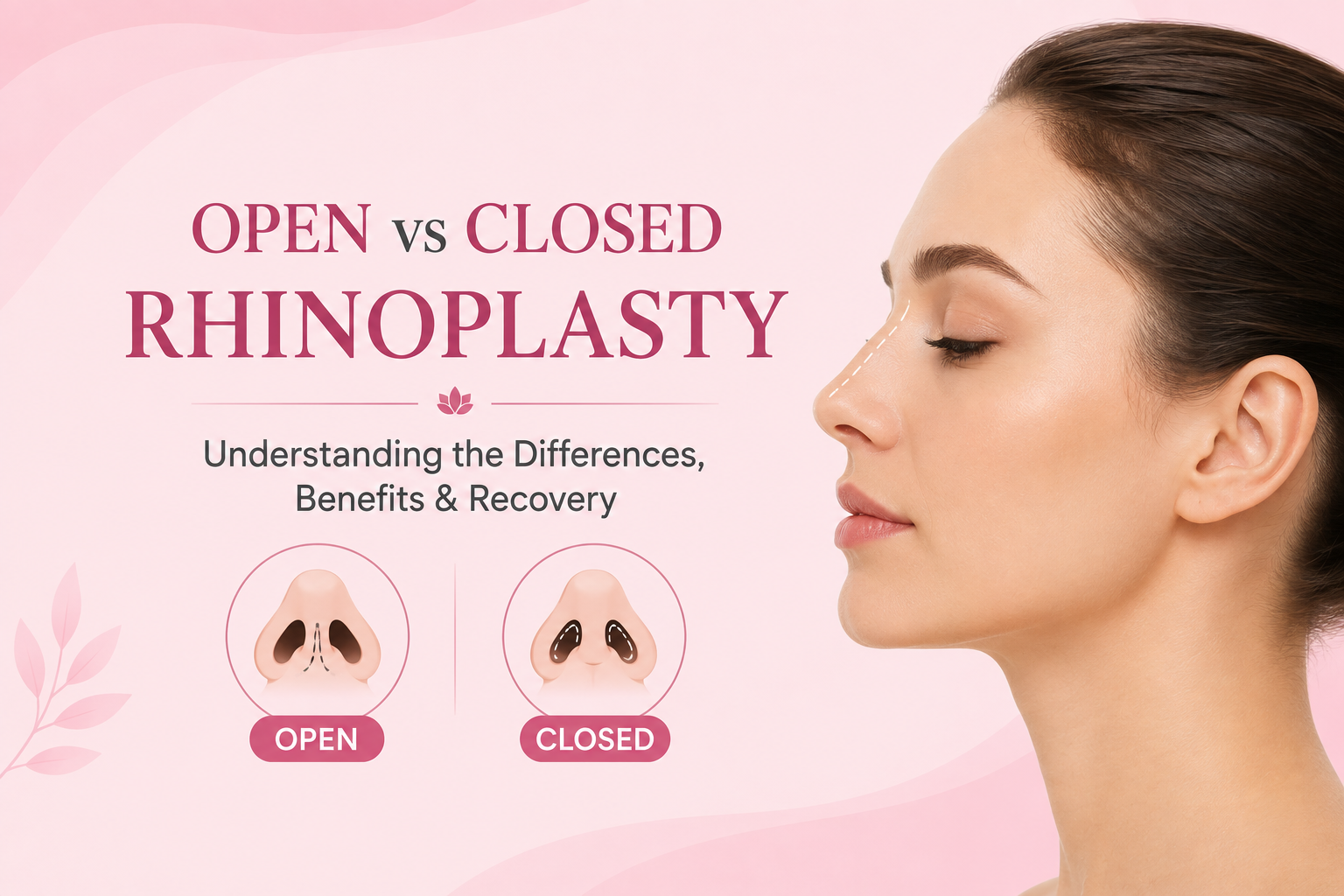
Rhinoplasty is one of the most commonly performed cosmetic and functional facial surgeries worldwide. Whether the goal is to improve the appearance of the nose, correct a breathing problem, or restore the nose after an injury, rhinoplasty offers a highly personalised solution tailored to each individual's facial features and needs.
If you've been researching nose surgery, you've likely come across the terms Open Rhinoplasty and Closed Rhinoplasty. While both procedures aim to reshape or reconstruct the nose, they differ in the surgical approach, the placement of incisions, and the situations in which they are most appropriate.
Many patients assume that one technique is always better than the other. In reality, both approaches have their own advantages, and the right choice depends on factors such as your nasal anatomy, the complexity of the correction, functional concerns, and your desired outcome.
In this guide, we'll explain the differences between open and closed rhinoplasty, how each procedure works, their benefits, and what you can expect during recovery, helping you make a more informed decision about your treatment.
What is Rhinoplasty?
Rhinoplasty is a surgical procedure performed to change the shape, size, or structure of the nose. It can be carried out for cosmetic reasons, functional improvement, or a combination of both.
From an aesthetic perspective, rhinoplasty helps create better facial harmony by refining the nose in proportion to other facial features. Functionally, it may also improve breathing by correcting structural issues within the nose.
Common concerns addressed through rhinoplasty include:
- A prominent nasal hump
- A drooping or bulbous nasal tip
- A crooked nose
- A wide nasal bridge
- Asymmetry
- Congenital nasal deformities
- Breathing difficulties caused by structural abnormalities
- Nose injuries resulting from trauma
Modern nasal surgery focuses not only on improving appearance but also on preserving or enhancing nasal function wherever possible.
Why is Rhinoplasty Performed?
Every patient's reasons for undergoing rhinoplasty are unique. Some individuals seek subtle cosmetic improvements, while others require structural correction to improve breathing or repair damage caused by injury.
Some of the most common reasons include:
Cosmetic Nose Reshaping
Many patients choose rhinoplasty to achieve better facial balance by refining the shape, size, or proportions of the nose.
Functional Improvement
Structural problems such as a deviated nasal septum or internal nasal obstruction can make breathing difficult. Rhinoplasty may be combined with functional procedures to improve airflow.
Correction After Injury
Previous nasal fractures or trauma can alter both the appearance and function of the nose. Surgery can restore both aesthetics and structural stability.
Congenital Differences
Some people are born with nasal deformities that affect appearance or breathing. Rhinoplasty can help improve both function and facial symmetry.
What is Open Rhinoplasty?
Open Rhinoplasty is a surgical technique in which a small incision is made across the columella—the narrow strip of tissue between the nostrils—along with additional incisions inside the nose.
This approach allows the surgeon to gently lift the nasal skin, providing a clear and comprehensive view of the underlying bone, cartilage, and soft tissues.
Because of this enhanced visibility, Open Rhinoplasty offers greater precision when performing complex nose correction procedures or major structural changes.
The technique is commonly recommended for patients requiring significant reshaping or reconstruction of the nose.
Advantages of Open Rhinoplasty
Open Rhinoplasty provides several important benefits, including:
- Excellent visibility of nasal structures
- Greater surgical precision
- Easier correction of complex deformities
- Improved access for cartilage grafting
- Better control during structural reconstruction
- Accurate placement of sutures
This technique is widely used in both cosmetic and reconstructive rhinoplasty procedures.
What is Closed Rhinoplasty?
Closed Rhinoplasty, also known as endonasal rhinoplasty, is performed entirely through incisions made inside the nostrils.
Since no external incision is required, there is no visible scar on the outside of the nose.
The surgeon performs all modifications through these internal incisions while preserving the external skin.
Closed Rhinoplasty is generally suitable for patients requiring more limited nose reshaping, particularly when extensive structural reconstruction is not necessary.
Advantages of Closed Rhinoplasty
Some benefits of Closed Rhinoplasty include:
- No visible external scar
- Less disruption of soft tissues
- Reduced swelling in some patients
- Slightly shorter operating time in selected cases
- Suitable for less complex corrections
However, because visibility is more limited, the procedure requires significant surgical expertise and may not be appropriate for every patient.
Open vs Closed Rhinoplasty: Key Differences
Although both procedures aim to improve the appearance and function of the nose, they differ in several important ways.
1. Surgical Incisions
The most obvious difference is where the incisions are made.
Open Rhinoplasty
- Small incision across the columella
- Additional incisions inside the nostrils
Closed Rhinoplasty
- All incisions remain inside the nostrils
- No external incision
2. Surgical Visibility
During Open Rhinoplasty, lifting the nasal skin allows the surgeon to clearly visualise the nasal framework.
In Closed Rhinoplasty, the surgeon works through internal incisions, which provides more limited visibility but avoids an external incision.
3. Complexity of Surgery
Open Rhinoplasty is often preferred for:
- Significant nose reshaping
- Revision rhinoplasty
- Complex structural corrections
- Major cartilage reconstruction
Closed Rhinoplasty may be suitable for:
- Smaller cosmetic refinements
- Minor bridge corrections
- Limited tip adjustments
- Selected primary rhinoplasty cases
4. Surgical Precision
Because the underlying structures are directly visible during Open Rhinoplasty, surgeons often have greater precision when making complex modifications.
This can be particularly beneficial when multiple structural changes are required during the same procedure.
Benefits of Open Rhinoplasty
Open Rhinoplasty remains one of the most versatile techniques in modern cosmetic surgery, particularly for patients requiring detailed structural work.
Some of its key advantages include:
Better Access to Nasal Structures
The open approach allows surgeons to visualise the entire nasal framework directly, making complex corrections more precise.
Ideal for Complex Cases
Patients requiring extensive nose correction, revision surgery, or reconstruction often benefit from the improved surgical access provided by Open Rhinoplasty.
Greater Precision
Direct visualisation allows careful placement of cartilage grafts and sutures, helping create balanced, natural-looking results.
Improved Symmetry
Because both sides of the nose are clearly visible throughout surgery, achieving symmetrical refinements becomes easier.
Benefits of Closed Rhinoplasty
Although Open Rhinoplasty offers several advantages for complex procedures, Closed Rhinoplasty also remains an excellent option in selected patients.
Some of its benefits include:
No Visible External Scar
Since all incisions are hidden inside the nostrils, there is no visible scar on the outside of the nose.
Less Soft Tissue Disruption
The closed approach generally preserves more of the soft tissue envelope, which may contribute to reduced swelling in some cases.
Faster Procedure in Selected Cases
For straightforward cosmetic refinements, Closed Rhinoplasty can sometimes be completed more efficiently.
Excellent Results for Appropriate Candidates
When used in suitable cases, Closed Rhinoplasty can achieve natural-looking aesthetic improvements while preserving nasal function.
Which Procedure is Better for Nose Reshaping?
Many patients ask whether Open Rhinoplasty or Closed Rhinoplasty is better for nose reshaping.
The answer depends entirely on the individual's anatomy and treatment goals.
Open Rhinoplasty is often recommended when significant structural modifications are required, while Closed Rhinoplasty may be appropriate for carefully selected patients with less complex concerns.
Rather than focusing solely on the surgical technique, the most important factor is selecting the approach that allows the surgeon to achieve safe, predictable, and natural-looking results.
A comprehensive consultation and detailed examination are essential in determining which technique is most suitable for each patient.
Rhinoplasty Recovery: Open vs Closed
Recovery is one of the biggest concerns for anyone considering rhinoplasty. Whether you undergo Open Rhinoplasty or Closed Rhinoplasty, the healing process follows a similar timeline, although there may be slight differences depending on the complexity of the surgery and the extent of the correction performed.
Immediately after surgery, it is normal to experience mild swelling, bruising around the eyes, nasal congestion, and slight discomfort. These symptoms are temporary and improve gradually as healing progresses.
The First Week
During the first few days after surgery, patients may experience:
- Swelling around the nose and eyes
- Mild bruising
- Nasal congestion
- Tenderness
- Temporary difficulty breathing through the nose due to swelling
A nasal splint is usually placed to protect the newly shaped nose and is typically removed after about one week, depending on your surgeon's recommendations.
Returning to Daily Activities
Most patients can:
- Return to light daily activities within a few days.
- Resume office work or school after approximately one week.
- Avoid strenuous exercise and heavy lifting for about four to six weeks.
- Protect the nose from accidental impact during the healing period.
Although the initial recovery is relatively quick, rhinoplasty recovery continues for several months as the remaining swelling gradually subsides.
Which Rhinoplasty Technique Leaves Less Scarring?
Scarring is a common concern among patients researching nose surgery.
Open Rhinoplasty
Open Rhinoplasty involves a small incision across the columella, the strip of skin between the nostrils.
In most cases:
- The incision heals very well.
- The resulting scar becomes faint over time.
- Once fully healed, the scar is usually difficult to notice.
Because the incision is placed in a discreet location, it generally becomes barely visible after complete healing.
Closed Rhinoplasty
Closed Rhinoplasty involves only internal incisions.
Since all surgical cuts are made inside the nostrils:
- There is no visible external scar.
- External skin remains untouched.
- Cosmetic concerns regarding external scarring are eliminated.
Although Closed Rhinoplasty avoids an external incision, the choice between techniques should always be based on surgical requirements rather than scar placement alone.
Which Procedure Has a Shorter Recovery Time?
Many patients assume that Closed Rhinoplasty always heals faster.
While Closed Rhinoplasty may involve slightly less swelling in carefully selected cases due to reduced soft tissue dissection, the overall recovery differences between the two techniques are often smaller than expected.
Recovery depends on several factors, including:
- Complexity of the surgery
- Amount of structural modification
- Individual healing response
- Post-operative care
- Overall health
Whether you undergo Open or Closed Rhinoplasty, following your surgeon's instructions carefully is the most important factor in achieving a smooth recovery.
Which Rhinoplasty Technique Provides Better Results?
One of the most frequently asked questions is whether Open Rhinoplasty provides better results than Closed Rhinoplasty.
The answer is that neither technique is universally better.
Excellent outcomes can be achieved with both approaches when the procedure is selected appropriately.
Open Rhinoplasty is often preferred for:
- Significant nose correction
- Complex structural changes
- Revision rhinoplasty
- Severe asymmetry
- Cartilage grafting
- Major nasal reconstruction
Closed Rhinoplasty may be ideal for:
- Minor cosmetic refinements
- Selected primary rhinoplasty cases
- Patients requiring less extensive correction
- Carefully selected nose reshaping procedures
Ultimately, the quality of the result depends more on careful surgical planning and the experience of the plastic surgeon than on the technique itself.
Are There Any Risks Associated with Rhinoplasty?
Like any cosmetic surgery procedure, rhinoplasty carries certain risks. Fortunately, complications are uncommon when surgery is performed by an experienced plastic surgeon and appropriate post-operative care is followed.
Possible risks include:
- Swelling
- Bruising
- Infection
- Bleeding
- Temporary numbness
- Breathing difficulties
- Minor asymmetry
- Delayed healing
- Need for revision surgery in selected cases
Your surgeon will discuss these potential risks during your consultation and explain the measures taken to minimise them.
How to Choose the Right Rhinoplasty Technique
Choosing between Open and Closed Rhinoplasty should never be based solely on online comparisons or personal preferences.
The most appropriate approach depends on:
- Your nasal anatomy
- The complexity of the correction
- Functional breathing concerns
- Previous nasal surgeries
- Desired cosmetic outcome
- Skin thickness
- Cartilage structure
During your consultation, your plastic surgeon will carefully examine your nose, discuss your expectations, and recommend the technique that is most likely to achieve safe, natural-looking, and long-lasting results.
A personalised surgical plan is always more important than choosing one technique over another.
Why Choose Shobhit Aesthetics for Rhinoplasty?
Rhinoplasty is one of the most technically demanding procedures in facial plastic surgery. Achieving a nose that looks natural, complements your facial features, and maintains proper breathing requires both surgical expertise and an artistic understanding of facial harmony.
At Shobhit Aesthetics, every rhinoplasty procedure begins with a detailed consultation and facial assessment. We carefully evaluate your nasal anatomy, facial proportions, breathing concerns, and aesthetic goals before developing a personalised treatment plan.
As a trusted Plastic Surgery Superspeciality Centre, Shobhit Aesthetics offers advanced nasal surgery using modern surgical techniques with a strong emphasis on patient safety, precision, and natural-looking outcomes. Whether your treatment involves subtle nose reshaping, complex nose correction, or functional improvement, our approach is tailored to your individual needs rather than following a standard technique for every patient.
From pre-operative planning and surgery to rhinoplasty recovery and follow-up care, our experienced team is committed to providing comprehensive support throughout your treatment journey. Our goal is to enhance both the appearance and function of your nose while preserving facial balance and achieving results that look refined and natural.
Frequently Asked Questions
What is the difference between open and closed rhinoplasty?
Open Rhinoplasty involves a small external incision across the columella, allowing the surgeon to lift the nasal skin and directly visualise the underlying structures. Closed Rhinoplasty is performed entirely through internal incisions, leaving no visible external scar. The choice depends on the complexity of the procedure and the patient's anatomy.
Which rhinoplasty technique leaves less scarring?
Closed Rhinoplasty leaves no visible external scar because all incisions are inside the nostrils. Open Rhinoplasty involves a small incision on the columella, but in most cases, the scar heals well and becomes barely noticeable over time.
Which procedure has a shorter recovery time?
Both techniques have similar overall recovery timelines. While Closed Rhinoplasty may involve slightly less swelling in selected cases, the speed of recovery depends more on the complexity of the surgery and individual healing than on the surgical approach itself.
Is Open Rhinoplasty more suitable for complex cases?
Yes. Open Rhinoplasty is often preferred for complex nasal corrections, revision surgeries, significant structural changes, and procedures requiring cartilage grafting because it provides greater visibility and precision during surgery.
Which rhinoplasty technique provides better results?
Neither technique is inherently better. The best results are achieved by selecting the approach that is most appropriate for your nasal anatomy, treatment goals, and the complexity of the surgery.
How do I know which rhinoplasty technique is right for me?
The most suitable technique can only be determined after a comprehensive consultation with an experienced plastic surgeon. Factors such as your nasal structure, skin thickness, breathing function, previous surgeries, and desired outcome all influence the choice of procedure.
Conclusion
Choosing between Open Rhinoplasty and Closed Rhinoplasty is an important decision, but the right choice depends on your individual anatomy and treatment goals rather than the technique alone. While Open Rhinoplasty offers greater visibility and precision for complex nose correction, Closed Rhinoplasty is an excellent option for selected patients requiring less extensive nose reshaping with no visible external scar.
Understanding the differences in surgical approach, recovery, scarring, and expected outcomes helps you make a well-informed decision about your nose surgery.
At Shobhit Aesthetics, we believe that successful rhinoplasty is about more than changing the shape of the nose—it is about creating facial harmony while preserving or improving nasal function. Our experienced specialists combine advanced surgical techniques with personalised treatment planning to deliver safe, natural-looking, and long-lasting results. If you're considering rhinoplasty, schedule a consultation with our team to determine the most appropriate approach for your unique needs.