If you’ve been reading about nose surgery for a while now, you've likely heard terms such as “open,” “closed,” “non-surgical,” “revision,” etc., which can get quite confusing.
For most, it’s not just about looking better. It's about knowing what would look best on their faces, what would feel right for them, and what would look natural, given their years of thought.
This article will explain the different types of rhinoplasty, their procedures, and how doctors decide which is best for you. It’s neither intended to force you into making a decision nor to dissuade you from making one. It’s to provide you with enough information to make an informed decision.
What is Nose Rhinoplasty?
Nose Rhinoplasty is a type of surgical or non-surgical procedure to reshape or restructure the nose for functional or cosmetic reasons.
To put it in simpler words, rhinoplasty can include the following:
- Changing the size or shape of the nose
- Refining the nose
- Correcting any kind of asymmetry
- Correcting breathing issues by restructuring the internal areas of the nose
It is a highly customized procedure. Even though two people may have the same issues, their rhinoplasty can be completely different because of differences in their faces, skin, etc.
When we talk about rhinoplasty, we are referring to a structured surgical process in which the bones and cartilage are modified to achieve a natural look.
What Leads People to Consider Different Rhinoplasty Types?
Before you learn about the various types of rhinoplasty, you should know why people consider various types of rhinoplasty in the first place.
Some of the reasons include:
- Visible problems that need correction, such as the shape of the nose
- A bump, a wide bridge, or a drooping nose tip
- Past injury or trauma
- Accidents can result in both aesthetic and functional problems
- Breathing problems
- Internal problems that affect the flow of air through the nose
- Past rhinoplasty that was not satisfactory
- Some people may not be happy with the previous results
As can be seen, these reasons often overlap. In other words, a person may have a cosmetic reason for wanting rhinoplasty types but may also have a breathing problem. This is why there is no single “best” technique. The best technique depends on what needs correction, both internally and externally.
How Do Doctors Decide the Right Approach?
Doctors don’t decide the right approach based on what’s popular or what they think looks best. Instead, doctors assess and then decide.
Doctors assess and then decide the right approach based on:
- Facial proportions: The shape of the nose, in relation to the shape of the chin, lips, and face
- Skin thickness: This affects how the results will look, as thick or thin skin may require a different technique
- Internal structure of the nose: This affects how well the results will last
- Patient expectations: What the patient wants, versus what can be done
This step is important, as doctors need to avoid giving patients unrealistic results. A well-designed rhinoplasty focuses on harmony, not drastic or unnatural change.
Understanding the Main Rhinoplasty Types
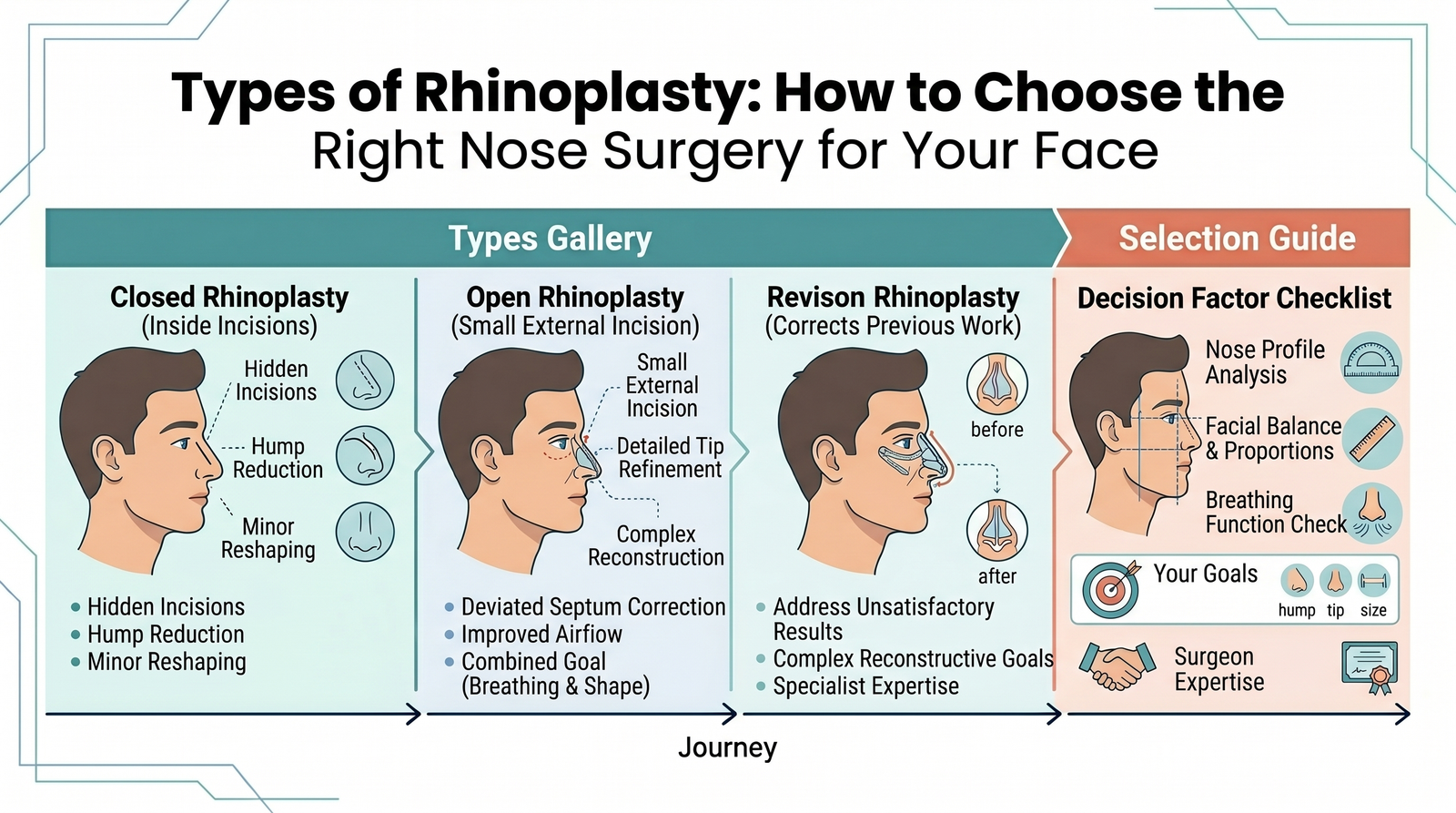
There are several ways to perform rhinoplasty, and each has a purpose. The type of rhinoplasty that a person needs depends on how much correction is necessary.
The most common types of rhinoplasty are:
- Open technique: This type of rhinoplasty is used for more complex reshaping of the nose
- Closed technique: This type of rhinoplasty is used for minor or moderate correction of the nose
- Non-surgical approach: Temporary correction using fillers.
- Revision Rhinoplasty: Corrective Rhinoplasty following previous Rhinoplasty.
All of these techniques have their own uses. The idea is not to adopt the latest technology but the best technology for your particular case.
Open Rhinoplasty: When More Precision is Needed
Open Rhinoplasty is a method where an incision is made on the strip of skin that is located between the nostrils. This method enables the surgeon to lift up the skin so that the underlying structure is visible.
This method is usually recommended in the following cases:
- Complex reshaping: Significant changes in nose structure or symmetry.
- Revision Rhinoplasty: When correction is needed for a previous Rhinoplasty.
- Refinement of the nose tip: When precise correction is needed.
- Severe asymmetry or deformity: This method is preferred because, with complete visibility of the internal structure, more control is possible.
But in most cases, patients needing precise structural correction will be able to achieve good results with open rhinoplasty because more precision is possible with this method.
Closed Rhinoplasty: A Less Invasive Rhinoplasty Method
This method involves making all incisions on the internal part of the nose. There is no external scar.
This method is usually recommended in the following cases:
- Minor or moderate corrections.
- Small changes in nose shape or contours.
- For patients seeking minor refinements.
- For patients seeking minor refinements in nose shape or contours.
- For patients where internal visibility is not essential.
This method is preferred because there is no external scar.
Slightly Quicker Initial Recovery Period
However, it also has its limitations. The fact that it is not exposed means that it may not be suitable for correcting more complex issues.
Both methods, open and closed, are safe and effective if done by an experienced surgeon. The choice is not about which is better; it is about which is better for your specific case.
Non-Surgical Options: Temporary Alternatives
For those who are not yet ready for surgery, there are other options available.
These include:
Liquid Rhinoplasty: This is done through dermal fillers that help in smoothing out bumps and other irregularities.
Temporary Contour Correction: This helps in improving symmetry and overall look.
Fast and easy procedure with minimal downtime required
It helps in:
- Adding volume
- Smoothening out bumps
- Improving contours
However, it does not help in:
- Sizing down the nose
- Improving breathing
- Resulting in permanent changes
While non-surgical alternatives can be beneficial, particularly for individuals uncertain about undergoing rhinoplasty, it's crucial to acknowledge that they are not as effective as surgery for those requiring structural changes.
However, that brings us to an important point. How exactly does one make this decision, and what factors should be taken into consideration?
How to Choose the Right Type of Rhinoplasty for Your Face
It is not about choosing something that you have heard about; it is about choosing something right for your face.
Every nose is unique, and more importantly, every face is unique. The same procedure may look natural and acceptable to one person but not to another.
To put it in simpler words, if your concern is minor, you can opt for a less invasive procedure. However, if your concern is structural, you would naturally require a surgical procedure.
The purpose of rhinoplasty is not to change your look but to make your nose look natural with your other facial features.
What Happens During Rhinoplasty Surgery?
It is natural to feel apprehensive about undergoing any kind of surgery, let alone something as delicate as rhinoplasty. Knowing what happens during rhinoplasty types surgery can remove a lot of apprehension from your mind. While the process can vary from person to person, there is a general process that most rhinoplasty surgeons follow.
The general process of rhinoplasty surgery is as follows:
- Anesthesia: The rhinoplasty surgery is conducted with general anesthesia.
- Incisions: Deciding whether to use an open or closed procedure.
- Reshaping of nose: The reshaping of the nose is done, which can include the reshaping of bone and cartilage.
- Correction of internal structures: Difficulty in breathing can be corrected at the same time.
The rhinoplasty surgery process is well planned. This process is as important as the procedure itself because it allows for well-controlled changes that are proportional to your other features.
The rhinoplasty surgery process can take anywhere from 1.5 to 3 hours.
Recovery: What You Should Realistically Expect
Recovery is probably the part that you are most worried about, and you must have concerns about it. The stages that you go through during recovery are as follows:
- First few days: Swelling, mild pain, and nasal congestion are experienced. A splint is also put in place for support.
- Week 1: The splint is removed. There is still bruising and swelling, though it is subsiding.
- Week 2-3: Most of the evidence of surgery is gone at this time. You can go out and socialize at this time.
- 1-3 months: Nose shape is refined as swelling subsides.
Recovery is not immediate. Although you look good in a matter of weeks, healing inside is still going on for months. Patients are also advised to avoid heavy exercise, sleep with their head up, and adhere to post-operative care. Patience is also important in this time. Thatfinal result is not immediate, and understanding this is important in order to avoid unnecessary anxiety.
Understanding Rhinoplasty Cost
The cost of rhinoplasty is probably the most asked question, and it is also one of the most common concerns. However, it is not fixed. The cost is as follows:
It depends on the experience and expertise of the surgeon, the complexity of the case, the type of rhinoplasty, and the setup.
However, it is important to understand that it is a precision surgery. This means that if you choose based on price alone, you might end up dissatisfied. A consultation will be able to give you a better estimate based on your specific case.
Why Choosing the Right Clinic Matters
Not only is it important that you choose the right rhinoplasty surgeon, but it is also important that you choose the right clinic. The result of your surgery will depend on it.
Important things to look for:
- A good plastic surgeon with expertise in nose jobs.
- A good facility with adequate infrastructure.
- Consultation process.
- Natural results.
A good clinic will not only guide you but also inform you if you don’t need Rhinoplasty or if your expectations need to be adjusted.
Why Choose Shobhit Aesthetics for Rhinoplasty
Selecting a clinic for Rhinoplasty is not just about undergoing a medical or cosmetic procedure but also about trusting your doctor with your concerns. At Shobhit Aesthetics, we focus on delivering a balanced approach that is not only medically sound but also considers all aspects of your concerns. We prioritize delivering evaluated solutions over assumptions. We also believe in being honest with our patients, which is why we will not hesitate to advise you if rhinoplasty cost is not what you need or if your expectations need adjustment.
- Experienced Plastic Surgeon: Our team at Shobhit Aesthetics is headed by Dr. Shobhit Gupta, a plastic surgeon with considerable experience in conducting plastic and cosmetic surgeries. Having conducted numerous nose jobs, we understand that small changes make a huge difference in nose reshaping.
- Personalised Treatment Planning: Every face is unique, so is every treatment plan. We do not offer standard solutions but personalized solutions that have been tailored according to your needs.
- Focus on Natural Results: While we do not focus on delivering artificial results, we do believe in delivering results that not only blend in with your features but also with your face.
- Strong Safety and Aftercare Support: The procedures are carried out in a well-equipped clinical setting with appropriate safety measures. Patients are also provided with adequate support during the healing process.
This approach enables patients to be more confident with all the knowledge at their disposal.
Conclusion
The first step towards making an informed decision is gaining knowledge about the different types of nose jobs. Each type of nose job, whether open, closed, or non-surgical, is appropriate in its own way.
There is no particular type that is superior or more appropriate than others. The choice of a nose job depends on your facial features, concerns, or expectations.
When done in the right manner with adequate knowledge, nose jobs can be beneficial in enhancing your beauty in a harmonious manner.
If you wish to undergo nose rhinoplasty, the first step is to seek advice from a qualified surgeon. The surgeon will then personally assess your features and guide what is appropriate for your case.
FAQs
What are the different types of Rhinoplasty procedures?
There are open, closed, non-surgical (liquid), and revision Rhinoplasty procedures depending on the amount of correction that is needed.
What is the difference between open Rhinoplasty and closed Rhinoplasty?
Open Rhinoplasty involves making a small external incision, whereas closed Rhinoplasty is conducted entirely internally with no external scar.
How do I choose the right type of Rhinoplasty for my face?
The right type depends on your facial features, concerns, or expectations.
What is Non-Surgical Rhinoplasty and How Does it Work?
It makes use of fillers to temporarily modify the shape of the nose by adding bulk and contouring the nose.
Can revision rhinoplasty improve the outcome of the previous nose surgery?
Yes, revision rhinoplasty is done to improve the outcome of the previous surgery.