Hair loss is not just about losing hair. For most people, it is about slowly watching a part of themselves disappear. The hairline that used to frame your face begins to creep back. The crown starts to thin. And every morning in the mirror, it gets a little harder to ignore.
Men and women both deal with hair loss, and the emotional weight of it is real. It affects confidence, self-image, and social comfort. For many people it quietly shapes everyday choices , what to wear, how to stand in a photo, whether to go swimming or not.
The good news is that hair restoration has come a very long way. It is no longer the era of obvious plugs and unnatural-looking hairlines. Today, a well-performed hair transplant can restore a hairline that looks so completely natural that nobody around you will ever be able to tell you had anything done.
At Shobhit Aesthetics, hair restoration is one of our core specialities. We work with patients at every stage of hair loss, from early thinning to advanced baldness, and we offer the full range of modern techniques so that every patient gets a treatment plan built around their specific situation.
This guide covers everything you need to know. The different techniques available, how the procedure works, what kind of hair transplant results to expect, what costs look like, and the non-surgical treatments that can complement or sometimes replace surgery altogether.
What Is a Hair Transplant?
A hair transplant is a surgical procedure in which hair follicles are taken from one part of the scalp, called the donor area, typically the back or sides of the head, and carefully transplanted into the areas that are thinning or bald.
The science behind it is straightforward. Hair follicles at the back and sides of the scalp are genetically resistant to DHT, the hormone responsible for male-pattern baldness. When these resistant follicles are moved to a balding area, they continue to grow there permanently, just as they did in their original location.
This is what makes a hair transplant different from every other hair loss solution on the market. Shampoos, supplements, and topical treatments can slow hair loss or slightly improve density, but they do not create new permanent hair. A hair transplant does.
Why Does Hair Loss Happen?
Before choosing any treatment, it helps to understand why hair loss is happening in the first place. The cause affects which treatment works best and how well results will last.
Androgenetic alopecia, commonly known as male or female pattern baldness, is by far the most common cause. It is genetic and hormone-driven. In men it typically starts at the temples and crown. In women it usually presents as diffuse thinning across the top of the scalp.
Alopecia areata is an autoimmune condition where the immune system attacks hair follicles, causing patchy hair loss. This is not always suitable for transplant until the condition is stable.
Traction alopecia is caused by prolonged tension on the hair from tight hairstyles like braids, ponytails, or extensions. It is common in women and a hair transplant can often restore lost hairlines.
Post-illness or post-surgical hair loss, hormonal imbalances from thyroid disorders or PCOS, nutritional deficiencies in iron, Vitamin D or B12, and scalp scarring from burns or injuries are also common causes that we evaluate carefully before recommending any treatment.
Diagnosis: How Is Hair Loss Assessed?
At Shobhit Aesthetics, we never jump straight to recommending surgery without a thorough evaluation. A detailed scalp examination checks hair density, follicle health, and the pattern and extent of loss. Trichoscopy, a specialised diagnostic tool, magnifies the scalp and follicles to assess their health at a level the naked eye simply cannot reach.
Blood tests check hormone levels, thyroid function, and nutritional deficiencies. Donor area assessment evaluates the quality and availability of donor hair, which is critical for transplant planning. Not everyone has enough donor hair for full coverage and we always communicate this honestly.
We also use the Norwood Scale for men and the Ludwig Scale for women to classify the degree of hair loss and guide treatment decisions.
Once this full picture is clear, we can recommend whether surgery, a non-surgical approach, or a combination of both is the right path for you.
Hair Transplant Types: All the Techniques Explained
Understanding hair transplant types helps you have an informed conversation with your surgeon about what suits your hair loss pattern, your lifestyle, and your goals.
FUE Hair Transplant
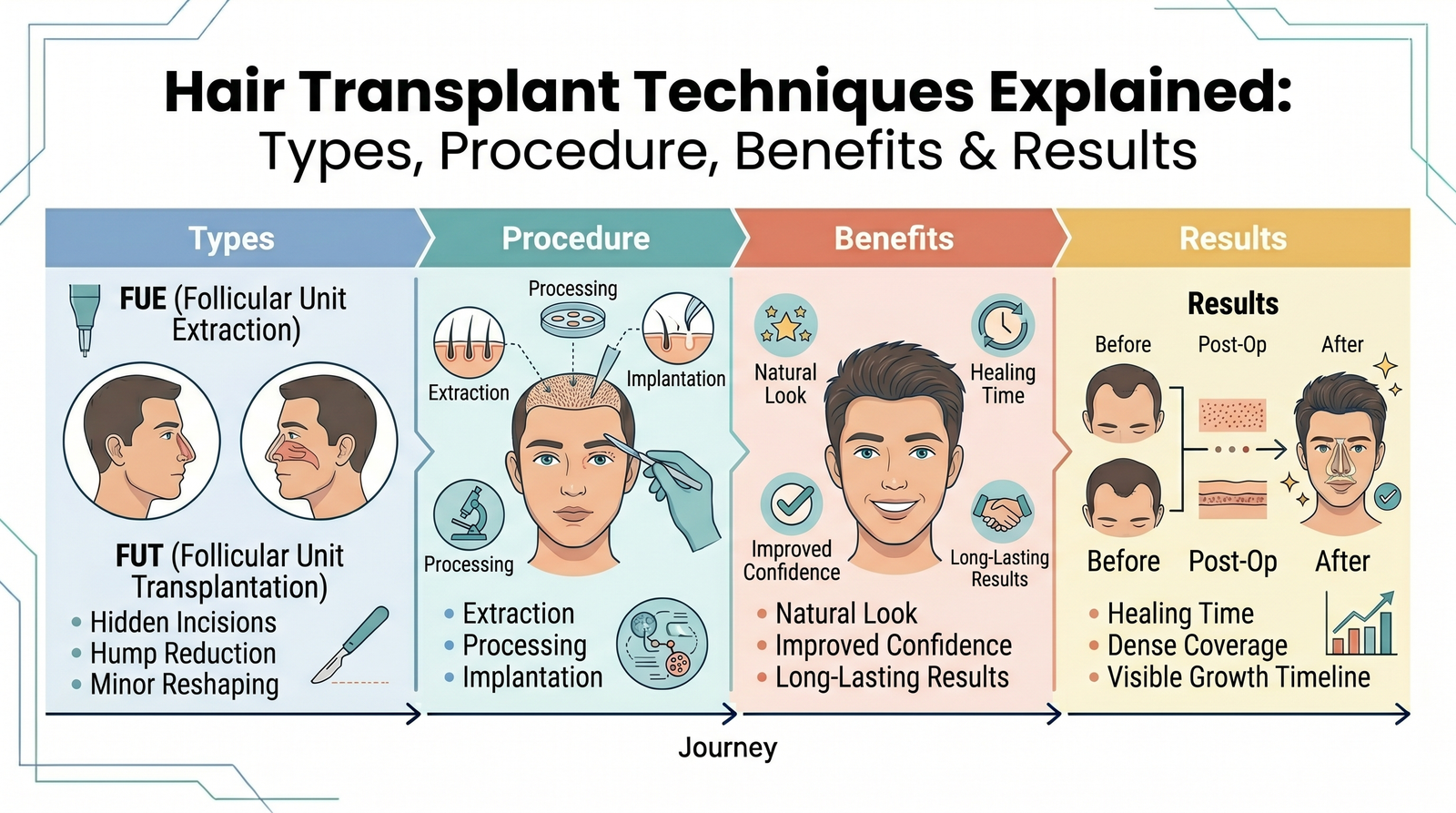
FUE hair transplant stands for Follicular Unit Extraction and it is currently the most popular technique worldwide. Individual hair follicles are extracted one by one from the donor area using a tiny circular punch tool, typically 0.6 to 1mm in diameter. These follicles are then implanted into the recipient area through small incisions.
FUE leaves no linear scar, making it ideal for people who prefer short hairstyles. Recovery is faster compared to FUT, downtime is minimal, and follicles can even be harvested from beard, chest, or body hair when scalp donor supply is limited. Most patients return to work within a week.
FUT Hair Transplant
FUT hair transplant, also called the strip method, involves surgically removing a strip of scalp from the donor area at the back of the head. This strip is then dissected under magnification into individual follicular units, which are implanted into the recipient sites.
FUT allows a larger number of grafts in a single session, making it ideal for advanced hair loss. Graft survival can be slightly better since the follicles spend less time outside the body. It is also generally more cost-effective per graft. The main consideration is a linear scar at the back of the scalp, which is easily hidden when hair is kept at a normal length.
Long Hair Transplant
A long hair transplant is a variation of FUE in which the hair is not shaved before the procedure. The donor follicles are extracted while the hair remains at its natural length and are transplanted complete with the longer hair shaft.
This technique lets the surgeon see the direction and angle of the transplanted hair in real time, allowing for more precise placement. It also means there is no obvious post-operative shaving phase, making it the preferred choice for professionals, public figures, or anyone who cannot afford visible signs of having had a procedure. It requires greater surgical skill and time, which is reflected in the cost.
Synthetic Hair Transplant
A synthetic hair transplant uses biocompatible synthetic fibres rather than the patient's own follicles. These fibres are implanted into the scalp to create the appearance of hair density. This option is considered when a patient does not have adequate donor hair of their own.
It is important to be clear-eyed about this option. Synthetic fibres do not grow, they are not permanent, and there is a higher risk of infection or rejection compared to natural follicle transplantation. At Shobhit Aesthetics, we discuss this only after all natural donor possibilities have been fully explored.
Non-Surgical Hair Treatments
Not every patient needs surgery. For early-stage hair loss or as a complement to a hair transplant, non-surgical treatments can deliver meaningful results on their own.
PRP Hair Treatment
PRP hair treatment stands for Platelet-Rich Plasma therapy. A small sample of your blood is drawn, processed in a centrifuge to concentrate the growth-factor-rich platelets, and then injected into the scalp. These growth factors stimulate dormant follicles, increase blood supply to the scalp, and slow ongoing hair loss.
PRP does not create new hair where follicles are completely gone. But for patients with thinning hair where follicles are still alive but weak, it can significantly improve density and halt further loss. It is also commonly used alongside transplant surgery to improve graft survival and speed up growth. Sessions are typically done once a month for three to four months, followed by maintenance every six months.
Mesotherapy
Mesotherapy for hair loss involves injecting a customised blend of vitamins, minerals, amino acids, and DHT-blocking agents directly into the scalp. These microinjections nourish the follicles, improve scalp circulation, and address nutritional deficiencies at the root level.
Mesotherapy works particularly well in the early stages of hair loss and for patients who are not yet candidates for surgery. It is also used as a maintenance treatment after a transplant to protect remaining natural hair.
The Hair Transplant Procedure: Step by Step
Here is a clear breakdown of the hair transplant procedure from start to finish.
The process begins with a detailed consultation where your surgeon discusses your goals, assesses your scalp, and designs a hairline suited to your facial structure and age. The number of grafts needed is estimated based on the extent of hair loss.
On the day of surgery, the donor and recipient areas are cleaned and local anaesthesia is administered. In FUE, the donor area is typically shaved. In a long hair transplant, the hair is left at its full length. In FUT, the donor strip area is prepared for excision.
During extraction, FUE follicles are removed one by one using the micro-punch tool while FUT involves removing a strip which is then dissected into grafts by the team under magnification. Extracted follicles are carefully sorted and stored in a preservation solution while recipient sites are prepared.
The surgeon then makes tiny incisions in the recipient area at precise angles, depths, and densities. This step is arguably the most artistic part of the procedure, as it determines how natural the final result will look. Each follicular unit is then placed individually into a recipient site.
A light dressing may be applied after the procedure. Detailed aftercare instructions are provided and most patients go home the same day. The full procedure takes anywhere from six to ten hours depending on the graft count.
Hair Transplant Benefits
The hair transplant benefits go well beyond what you can see in the mirror.
The results are permanent. Transplanted hair is genetically DHT-resistant and continues to grow for life with proper care. The appearance is completely natural because modern techniques allow surgeons to replicate the natural growth angle, direction, and density of your original hairline.
There are no ongoing costs for maintenance products the way there are with topicals or medications. Once healed, transplanted hair can be cut, styled, and coloured just like natural hair. Most patients also report a meaningful improvement in confidence, comfort in social settings, and overall quality of life after their procedure.
Why Choose Shobhit Aesthetics?
There is no shortage of clinics offering hair transplants today. Here is what sets Shobhit Aesthetics apart.
Our hair transplant specialists are qualified surgeons who understand both the medical and aesthetic dimensions of hair restoration. We offer every major technique under one roof, including FUE, FUT, long hair transplant, PRP, and mesotherapy, so we can recommend the right combination for each individual case.
Hairline design at our clinic is never generic. It is planned around your facial proportions, your age, and your long-term hair loss trajectory. Our clinical protocols are designed to maximise graft survival at every stage from extraction to implantation.
We believe in honest consultations. We tell you exactly how many grafts you need, what result is realistically achievable, and what the process involves. And we stay closely in touch through every stage of your recovery.
Hair Transplant Results: What to Realistically Expect
In the first few days after surgery, the transplanted area looks red with small scabs at the graft sites. This settles quickly.
Between weeks two and four, most transplanted hairs shed. This phase is called shock loss and it is completely normal. The follicles remain alive underground and this shedding does not affect the final result.
From month three or four, new hair begins to emerge from the transplanted follicles. It starts fine and light but thickens over the following months. By months six to nine, the improvement in density becomes clearly visible. By twelve to eighteen months, the full and final hair transplant results are visible, with hair fully grown, thickened, and settled into its natural pattern.
The patience required in the first few months is the hardest part for most patients. But those who stick with it are consistently pleased with where they end up.
Hair Transplant Cost
Hair transplant cost in India varies based on the technique used, the number of grafts required, the surgeon's experience, and the quality of the facility.
FUE hair transplant typically costs between Rs 40 and Rs 120 per graft, putting a full session anywhere between Rs 60,000 and Rs 2,00,000 or more depending on graft count. FUT hair transplant costs between Rs 30 and Rs 80 per graft. Long hair transplant ranges from Rs 1,50,000 to Rs 3,00,000 or more. PRP hair treatment sessions range from Rs 5,000 to Rs 15,000, and mesotherapy sessions typically fall between Rs 4,000 and Rs 10,000.
At Shobhit Aesthetics, all costs are discussed openly during your consultation with a full breakdown provided. We offer flexible payment options and EMI facilities so that finances are never a barrier to getting the care you need.
Recovery: What to Expect After Surgery
In the first three days there is mild swelling of the scalp and forehead, some redness, and small scabs at the graft sites. Sleeping with your head elevated during this period helps. From day four onwards scabs begin to fall off naturally. Gentle washing begins as guided by your surgeon.
By the second week most swelling and redness has resolved and most patients return to desk work. Weeks three and four bring the shock loss phase. This is expected and not a sign that anything has gone wrong.
From month two onwards, the follicles enter their growth phase and new hairs begin to emerge. Avoiding direct sun on the scalp for four weeks, skipping heavy exercise for two to three weeks, and not wearing tight caps or helmets for three to four weeks all support a smooth recovery.
Conclusion
Hair loss can feel like something happening outside your control. But with the right information and the right team, it does not have to define how you look or how you feel about yourself.
Whether you are in the early stages of thinning and want to explore PRP hair treatment or mesotherapy, or you have significant bald patches and are ready for FUE or FUT hair transplant surgery, there is a solution that fits where you are right now.
At Shobhit Aesthetics, we are not here to push a procedure. We are here to help you find the right answer for your hair, your face, and your life. Every consultation starts with listening and ends with a plan that genuinely makes sense for you.
Book your hair restoration consultation at Shobhit Aesthetics today and take the first real step toward getting your hair and your confidence back.
Frequently Asked Questions:-
What are the different types of hair transplant techniques?
The main hair transplant types are FUE, FUT, long hair transplant, and synthetic hair transplant. Non-surgical options like PRP hair treatment and mesotherapy are also used for early-stage hair loss or as complementary treatments. Each technique suits different patients depending on their hair loss severity, lifestyle, and available donor hair.
What is the difference between FUE and FUT hair transplant methods?
In FUE hair transplant, individual follicles are extracted one by one using a micro-punch tool, leaving no linear scar. In FUT hair transplant, a strip of scalp is removed and follicles are separated from it. FUT allows more grafts in a single session and suits advanced hair loss cases well, while FUE is preferred by those who want minimal scarring and a quicker return to daily life.
Which hair transplant technique is best for hair loss treatment?
There is no single best technique because it depends entirely on the individual. FUE works well for most patients with moderate hair loss who want no visible scarring. FUT suits those needing a large number of grafts in one session. Long hair transplant is ideal for patients who need the procedure to remain discreet. Your surgeon at Shobhit Aesthetics will recommend the most suitable approach after assessing your specific case.
How long does it take to see results after a hair transplant?
Initial growth begins around months three to four, with more noticeable density appearing from months six to nine. Full hair transplant results are visible between twelve and eighteen months after surgery. The early shedding phase, which most patients find unsettling, is completely normal and does not affect the outcome.
Is a hair transplant a permanent solution for hair loss?
Yes, for the transplanted hair the result is permanent. The follicles moved during the procedure are resistant to DHT and will continue to grow for life. However, existing natural hair around the transplanted area may continue to thin over time. Treatments like PRP hair treatment and medications like minoxidil or finasteride are often recommended alongside surgery to protect the surrounding hair.