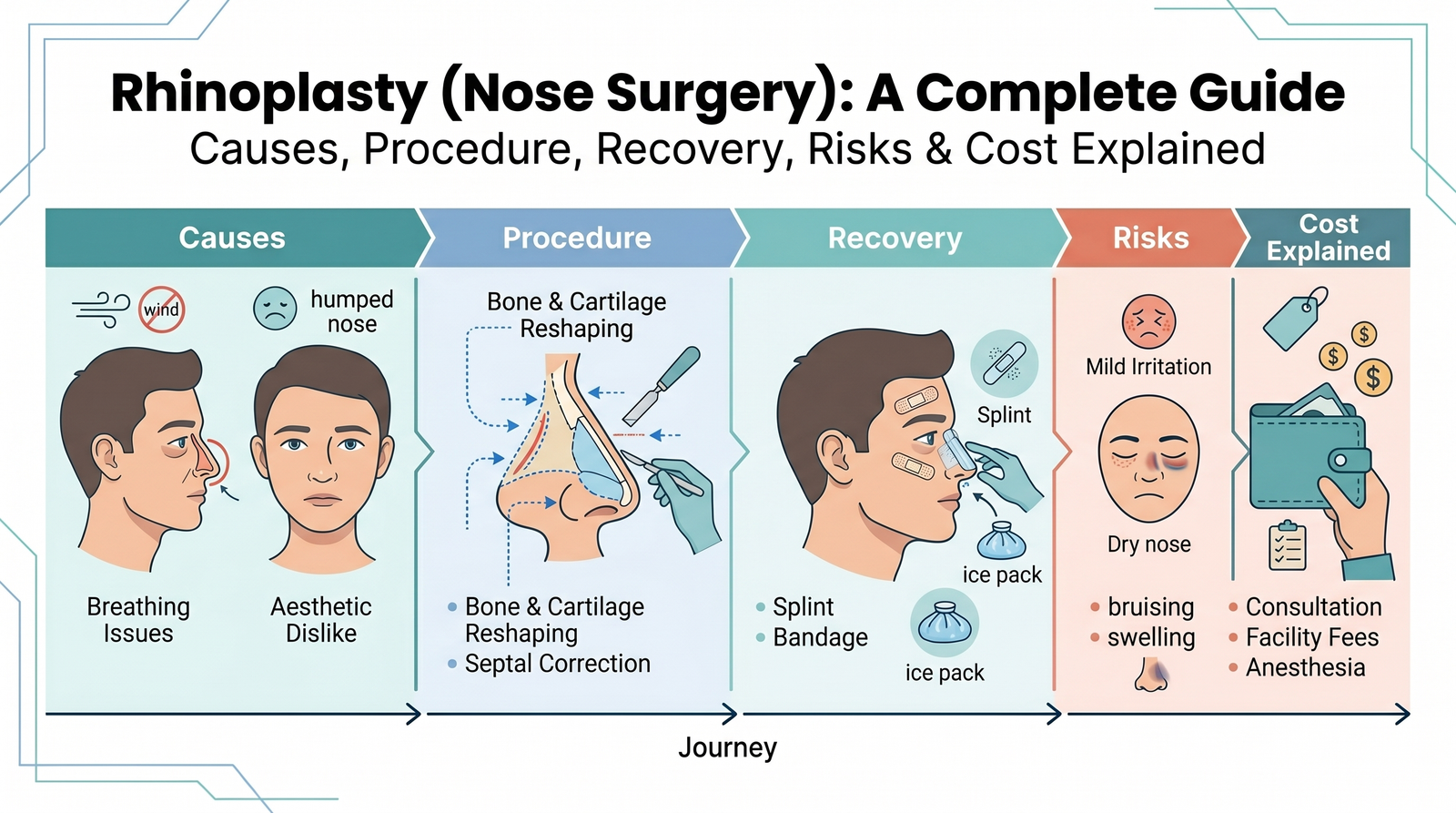
Your nose is more than an organ; it affects your facial balance. A slight change in its shape can completely alter how you look and feel. However, this part of your body also determines whether you can breathe properly.
In this case, it is worth considering rhinoplasty surgery.
Many people believe that rhinoplasty is a purely cosmetic procedure. However, in reality, it is both cosmetic and functional. Some people choose this operation because they are not satisfied with their appearance, while other patients need help with breathing. In both cases, a well-thought-out rhinoplasty procedure will address both problems.
In today's article, we'll talk about who should consider rhinoplasty, what makes people choose this operation, and what types of rhinoplasty there are.
What Is Rhinoplasty?
Rhinoplasty is a plastic surgical procedure that changes the shape and structure of your nose. A rhinoplasty operation can either reshape your nose, correct the proportions of its various parts, or help you solve the problem of breathing.
Well-done Nose Rhinoplasty pays special attention to the following factors:
- Facial balance
- Natural appearance of the nose
- Breathing ability
It aims not at changing your nose but making it look harmonious with the rest of your face.
Why Do People Go For Rhinoplasty?
Every person considers rhinoplasty for their own unique reasons. Sometimes, people decide to undergo this operation because they have aesthetic problems, while others prefer to deal with breathing disorders. Let us take a closer look at these aspects.
1. Aesthetic Issues
There are many people who consider rhinoplasty due to their dissatisfaction with the nose's appearance.
They may complain that their nose has a bump on the bridge, is too big or wide, has a drooping tip, is crooked, etc. In this case, a rhinoplasty procedure will be helpful as it will allow them to get rid of these defects.
2. Functional Problems
Sometimes, patients choose rhinoplasty for a functional reason.
This means that they experience difficulties while breathing or have blocked nasal passages, deviated septum, etc. In this situation, rhinoplasty will help them achieve comfortable breathing, as it addresses breathing-related problems. This is a so-called functional rhinoplasty procedure.
3. Injury or Accident
An accident or injury might damage the shape and functions of the nose.
In this situation, there may appear such problems as:
- Disorders in appearance
- Difficulty in breathing
In this case, a well-performed rhinoplasty can help fix these issues.
4. Congenital Problems
Some people may be born with certain structural abnormalities in their nose.
These abnormalities may relate to such problems as:
- Appearance of the nose
- Difficulty in breathing
- Facial imbalance
Thus, choosing the right Rhinoplasty Types in this case becomes critically important.
Various Rhinoplasty Types Explained
Open Rhinoplasty:
Open Rhinoplasty is mostly suggested for complicated cases.
Open Rhinoplasty involves:
- Making a tiny incision between the nostrils
- Carefully lifting the skin
- Having excellent visibility of the underlying structure
Recommended for:
- Complex remodeling
- Tip augmentation
- Revision surgeries
Used to achieve:
Better precision and visualization during detailed alterations.
Closed Rhinoplasty: Closed Rhinoplasty is less aggressive than open rhinoplasty.
- Closed Rhinoplasty entails:
- Creating all incisions on the inside of the nose
- Leaving no visible scars
Suitable for:
- Simple corrections
- Small structural adjustments
Advantages include:
- Faster recovery
- Reduced swelling
- Absence of any external markings
It might not be the best choice for complicated cases needing significant reshaping.
Non Surgical Rhinoplasty (Liquid Rhinoplasty)
Those seeking non-surgical options for their nose may try Non Surgical Rhinoplasty. Also called Liquid Rhinoplasty, the technique involves using fillers to enhance the nose contour temporarily.
- It helps with:
- Eliminating small irregularities
- Increasing symmetry
- Augmenting the nasal bridge
Key facts:
- Involves no incisions or sutures
- A quick process (typically performed within 30 minutes)
- Temporary results
Ideal for minor modifications but unable to shrink the nose or correct breathing problems.
What Rhinoplasty Type is Suitable for Your Case?
There is no one-size-fits-all solution. The optimal Rhinoplasty Types vary depending on:
- Facial anatomy
- Skin elasticity
- Goals
- Functionality
Proper evaluation helps determine whether you qualify for Open Rhinoplasty, Closed Rhinoplasty, or Non Surgical Rhinoplasty.
Who is Eligible for Rhinoplasty Surgery?
Not everybody needs surgery, and not everyone qualifies for the procedure.
If you meet the following criteria, you might be eligible for Rhinoplasty Surgery:
- Being dissatisfied with the shape of your nose
- Experiencing breathing difficulties
- Having fully developed facial structure
- Being physically healthy
- Possessing reasonable expectations
It is crucial to understand that Nose Rhinoplasty enhances your appearance without creating perfection.
How will Rhinoplasty Surgery Improve Your Looks?
Rhinoplasty Surgery provides several benefits, including:
- Looking more natural
- Complementing facial contours
- Achieving proper balance
- Maintaining or improving breathing function
The best results are those not too obvious. Everyone should notice an improvement in overall facial attractiveness, not just a "new nose."
Final Words About Expectations
Patients usually come with altered pictures or celebrity nose comparisons. Every individual has a unique face.
A professional approach to Rhinoplasty Surgery involves:
- Truthful communication
- Planning realistic outcomes
- Preventing overtreatment
Natural-looking results always turn out better in the long run.
Rhinoplasty Surgery: Process and Steps
While the surgery itself is not simple at all, having an understanding of all its steps and processes involved is essential for feeling more relaxed and confident.
In this article, you will get to know each stage of Rhinoplasty Surgery from start to finish.
Step 1: Rhinoplasty Consultation, Everything Starts Here
To begin with any Nose Rhinoplasty, one needs to make an appointment for a consultation with an experienced surgeon.
It may sound like an easy task, but in reality, this step defines your further surgical plan and the result you will get in the end.
The surgeon will need to:
- Evaluate your cosmetic problem
- Assess your nose anatomy (bone, cartilage, skin type, etc.)
- Test your breathing function and the condition inside your nasal cavity
- Discuss your expectations and preferences
At the consultation, the surgeon may ask about:
- Any past injuries or accidents affecting your nose
- Previous operations
- Your medical history
There is no taboo in sharing any information regarding your nose. Discuss all your problems honestly and openly.
Expectation Setting at Consultation
An important moment to mention is the step called expectation setting.
Sometimes, people bring photos with their nose edited or some other examples of results they want to achieve.
But remember, the effect of Rhinoplasty depends greatly on your personal anatomy.
In this case, a professional doctor will:
- State realistic expectations
- Refrain from over-promising unrealistic results
- Suggest you the best rhinoplasty types for your case
This step will help you to achieve the desired effect without compromising your appearance.
Step 2: Getting Prepared for Rhinoplasty Surgery
After deciding to go through Rhinoplasty Surgery, you will be provided with certain preparation instructions.
They include such aspects as:
Medical Checkup
To be sure that you will not have any serious complications, you will undergo some tests.
Guidelines for Pre-Surgical Treatment
Here are some of them:
- Do not take any blood thinning medicine
- If you smoke, stop this bad habit
- Limit alcohol consumption
Healthy Lifestyle Changes
Before the procedure, try to keep your health in good condition by:
- Maintaining your nutrition
- Hydrating yourself well
- Getting plenty of sleep
This step is essential for making the entire process safer.
Step 3: The Day of the Surgery
After undergoing preparation for Rhinoplasty, you will have to go to the surgery room.
How does the entire procedure look? Let us find out!
Prior to Surgery
You will have your nose prepared:
- Cleaning
- Making markings if necessary
- Consulting once again with your surgeon
- Anaesthesia
Most rhinoplasties require general anesthesia, meaning that you will be put to sleep.
Local anesthesia with sedation may be used in selective cases.
Step 4: The Rhinoplasty Surgery (Operation Theatre)
Finally, the time has come to perform your nose reshaping surgery.
Depending on your surgery, the procedure might have different steps. Here we explain the general process of nose surgery.
- Incision
In case of open rhinoplasty, incision is made between the nostrils. In case of closed rhinoplasty, incision is made inside the nose. - Accessing the Structure
Through the incision, surgeon gains access to: Bone Cartilage
The surgeon can start reshaping at this point. - Reshaping the Nose
This is one of the most crucial steps of the entire rhinoplasty procedure.
Depending upon the problem you face, surgeon may:
- Make corrections for the nasal bump on the bridge
- Reshape the nasal tip
- Straighten the nose
- Modify cartilage
- Correct the internal structure in order to improve breathing ability
Every step requires precision from the surgeon.
- Addressing Breathing Problems
If you have some issue with breathing, they are corrected along with cosmetic corrections.
Such procedures include: Correction of a septum Straightening of breathing airway
Thus, nose rhinoplasty may be both a cosmetic and functional treatment.
- Closure
Once nose reshaping has been done: Skin is put back Incisions are carefully closed
In the case of closed rhinoplasty procedure, all changes are performed inside the nose. In the case of open rhinoplasty, an incision is made from the outside. This incision will then be stitched up.
- Application of Support
After rhinoplasty procedure, certain measures are taken in order to make sure that changes remain in place until the body heals:
Placing a splint on the nose Applying internal support structures where necessary
Duration of Surgery
As mentioned above, rhinoplasty procedure usually takes anywhere between 1.5 and 4 hours. Time spent in operation theatre may vary depending upon:
Case complexity Surgeon
Your doctor will provide more accurate information regarding the procedure.
Non-surgical Rhinoplasty and Liquid Rhinoplasty
The process is very different in the case of non-surgical rhinoplasty procedure:
Operation theatre is not required Fillers are injected carefully Time taken is 15-30 minutes
Nevertheless, there are certain limitations when it comes to non-surgical rhinoplasty:
Results are temporary Problematic breathing cannot be solved by non-surgical rhinoplasty
Immediate Post-procedure Phase
Immediately after the rhinoplasty surgery, patient is moved to the recovery area where he or she may feel:
- Mild swelling
- Mild discomfort
- Congested nose
After surgery, you may need to stay overnight before you go home.
First Few Days Post-Surgery
First few days are crucial for the healing process.
You may observe: Swelling around the nose and under the eye Milder bruising Feeling like congestion
Your doctor will explain everything you have to do after surgery. Some common tips include:
Elevating your head Avoiding contact with your nose Taking prescribed medications
Results After Rhinoplasty Surgery
One of the things which you need to know is that rhinoplasty results are not instant.
Initial swelling will disappear within two to three weeks First visible improvements will become visible in a couple of weeks Final result will take several months
Therefore, patience is one of the keys to successful recovery from rhinoplasty procedure.
Important Points to Remember Before Rhinoplasty
Here are some things which you should never forget when considering rhinoplasty:
Personalized surgery Results depend on your body Healing takes time Natural look is more attractive
- Post-Rhinoplasty: What to Expect After Surgery?: Now, when you have gained some knowledge on the Rhinoplasty procedure, it is the next logical step to know about the post-Rhinoplasty care, its duration, risks, and cost.
There is plenty of information on the subject and we'll do our best to help you sort out all the essential details. - Rhinoplasty Recovery Time & Process: As we mentioned earlier, after Rhinoplasty Surgery you can enjoy not only aesthetic improvement of your nose but also breathing enhancement. Yet, this is a complicated procedure that requires recovery after it. Below, we've summed up the main points related to this stage.
- Initial Phase: The first 5-7 days after your surgery is a crucial period when you need to take all the necessary care and avoid doing anything that might influence the outcome of your surgery.
Here are the signs that you will experience during this period:
- Nose and eyes swelling
- Bruising
- Mild nasal congestion
- Discomfort
During Rhinoplasty Recovery Time, doctors place a splint on your nose. You will remove it after 7 days.
In order to facilitate the healing process during this stage, you will need to perform the following actions:
- Keep your head elevated when you are resting
- Do not touch or apply pressure to your nose area
- Take medication prescribed by your doctor
Visible Results
After the first week of recovery, your nose will start to transform. Swelling will gradually subside and bruising will also go away. This period will continue till month 3. By this time, you'll start observing the changes. Although the result you are going to obtain at this stage will look more or less final, you will see no definitive changes.
Final Results
During this stage, your nose will completely recover and your surgery results will become final. Swelling will be hardly noticeable and the new shape will be fixed.
Factors Influencing Rhinoplasty Recovery Time
Unfortunately, not all patients have the same healing speed. There are some features that can affect the process of your recovery after Rhinoplasty Surgery, including:
- Type of procedure – Open or Closed
- Thickness of your skin
- Complexity of the problem
- Your health state
- Following post-operative instructions accurately
How to Recover From Rhinoplasty Quickly?
Here are some tips that will ease your recovery and facilitate its fast performance:
- Do not perform any physical activity within the next two weeks
- Initially, do not wear glasses directly on your nose
- Avoid dusty and smoggy areas
- Consume healthy food in moderate portions
- Do not smoke or drink alcohol
Rhinoplasty Risks & Side Effects
Any surgical procedures are accompanied by possible risks and side effects. Rhinoplasty is not an exception here. Below, we have listed the most common risks that may occur.
Temporary Risks
Some of them are common for every procedure and they will eventually disappear during the healing period:
- Swelling
- Bruising
- Pain
- Nasal congestion
Other Risks
Although they are less frequent, still they may happen. They are the following:
- Infection
- Bleeding
- Asymmetry
- Difficulty breathing
- Unsatisfactory result
Yet, as we mentioned earlier, with proper preparation and surgery planning, you have almost zero chances of developing complications.
Will My Rhinoplasty Fail?
Although such outcomes are rather rare, yet they cannot be completely ruled out. In order not to face a risk, you should:
- Understand your expectations realistically
- Prepare the Rhinoplasty process thoroughly
- Choose the surgeon and clinic carefully
Rhinoplasty Revision
Sometimes, revision rhinoplasty becomes necessary after the initial procedure fails. This type of surgery implies making minor corrections to achieve the desired result. Here are the reasons why revision rhinoplasty will be required:
- Surgery result turned out to be unsatisfactory
- Breathing problems persisted
- Healing influenced the outcome
- Understanding Rhinoplast Cost
We receive numerous inquiries on this question. Below, we will tell you everything you should know about Rhinoplasty Cost in India.
Cost Factors
There is a wide range of features that can influence Rhinoplasty price:
- Experience of the Surgeon
- Clinical setting
- Procedure type (Open, Closed, Non surgical)
- Complexity of the problem
- Location
Rhinoplasty Price in India
As far as the average price for this procedure is concerned, you may spend the amount in the range of:
₹70,000 - ₹2,50,000 (it can be higher in some cases).
In contrast to traditional surgery, Liquid Rhinoplasty is performed in several sessions, therefore it costs less per session.
Is Rhinoplasty Worth It?
The answer to this question lies in the advantages of the procedure. If you undergo Rhinoplasty Surgery successfully, you will get the following benefits:
- Facial balance improvement
- Increased self-confidence
- Improved breathing
Thus, you should be ready to devote some time and money to this procedure but its benefits will be worth your efforts.
Permanent Or Temporary Result?
There are two types of Rhinoplasty, each of which can provide either permanent or temporary results.
Open/Closed Rhinoplasty → Permanent results
Non surgical or Liquid Rhinoplasty → Temporary results
After healing, surgical Nose Rhinoplasty results will be stable for a long time, unless affected by serious damage.
Conclusion
In order to get the best Rhinoplasty results and avoid possible risks and complications, one needs to know as much information as possible regarding the procedure. Hopefully, the above information will be useful for you and your further decisions.
Only when you understand the procedure, you'll be able to decide upon its type and determine how much time you need to devote for achieving the desired goal.
FAQs:-
Q: What is rhinoplasty and why people choose this procedure?
A: It is a procedure that allows correcting the appearance and function of the nose. It is often performed for aesthetic purposes, but sometimes it is used to fix breathing issues.
Q: How much time will my Rhinoplasty Surgery take and how long should I wait to restore?
A: The duration of Rhinoplasty surgery itself is 1.5-3 hours. Initial recovery period is about 1-2 weeks while total rhinoplasty recovery period lasts longer for months.
Q: What are the possible risks and side effects after my surgery?
A: Swelling, bruising, and slight discomfort are rather common side effects that will pass with time. In rare cases, a person might develop breathing disorders or an asymmetric nose.
Q: How expensive this surgery is in India?
A: As far as the cost of Rhinoplasty in India is concerned, you should know that its price varies from ₹70,000 to ₹2,50,000.
Q: Are rhinoplasty results permanent?
A: Yes, they are if you've undergone open rhinoplasty. However, non-surgical rhinoplasty provides you with temporary results only.