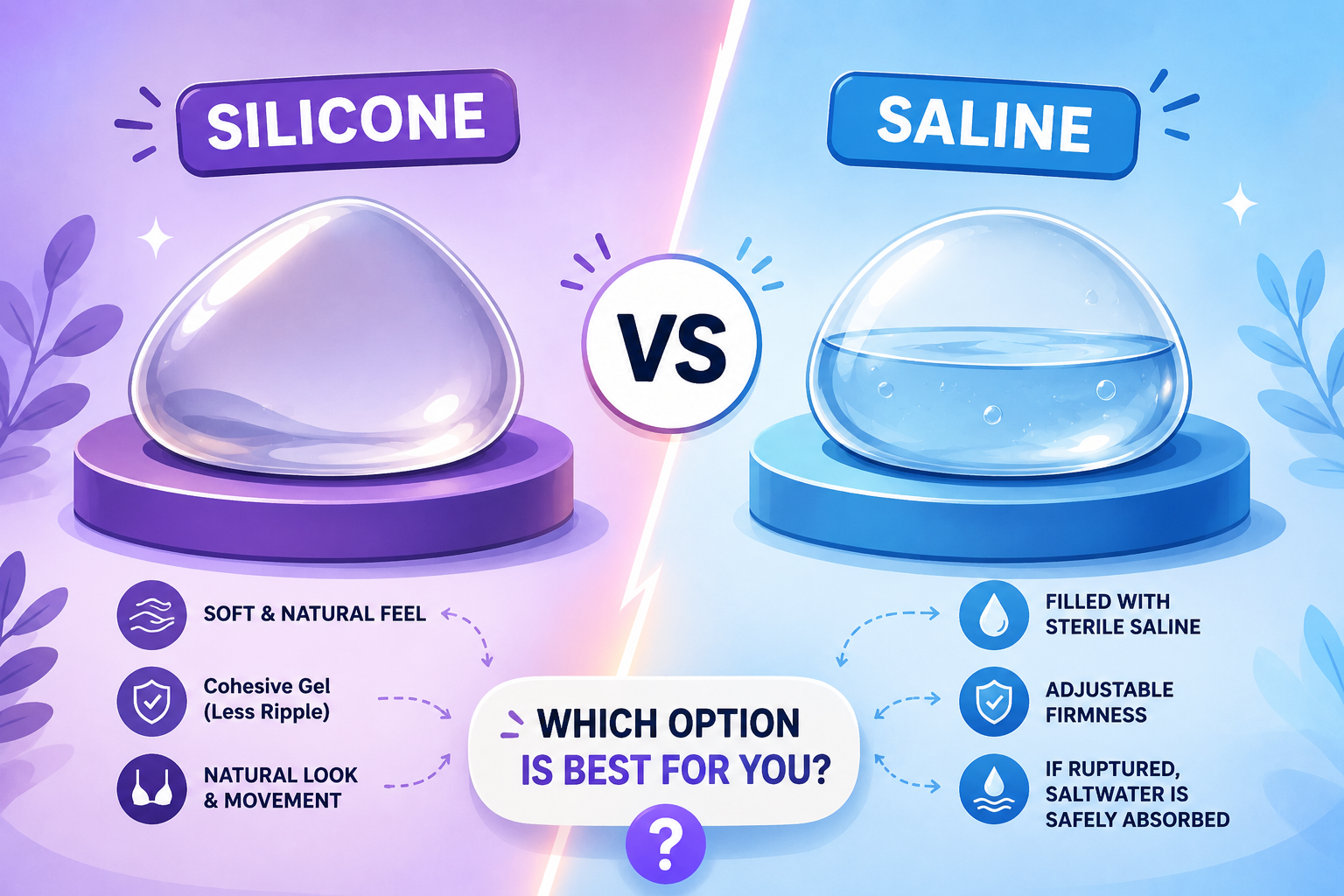
Choosing to undergo breast augmentation is a deeply personal decision that involves careful research, realistic expectations, and professional guidance. One of the most important choices in this journey is selecting the right type of implant. For most individuals, the decision comes down to two primary options: silicone and saline breast implants. While both are widely used, FDA-approved, and effective, they differ in terms of feel, appearance, safety considerations, and overall experience.
Understanding these differences is essential to making a confident and informed choice. Silicone implants are known for their natural feel and realistic appearance, while saline implants offer advantages such as easier rupture detection and adjustable sizing during surgery. Each option has its own set of benefits and trade-offs, and the right choice depends on your body type, lifestyle, and aesthetic goals.
This guide is designed to provide a clear and comprehensive comparison of silicone and saline breast implants. From how they work to long-term results and recovery expectations, you’ll gain the knowledge needed to determine which option aligns best with your needs and preferences.
What Are Breast Implants, and Why Do People Choose Them?
Breast implants are medical devices surgically placed to enhance the size, shape, or fullness of the breasts. They are commonly used for cosmetic reasons — to increase volume, improve symmetry, or change the overall shape — as well as for reconstructive purposes following mastectomy or injury.
There are two primary types of breast implants currently approved for use: silicone implants and saline implants. Both have an outer shell made of silicone, but the substance used to fill that shell is different, and those differences matter.
People choose breast augmentation for a wide range of personal reasons. Some want to restore breast volume lost after pregnancy, breastfeeding, or significant weight loss. Others want to improve symmetry between breasts that are noticeably different in size. Many simply want to feel more confident and comfortable in their own skin. Whatever your reason, it is valid — and understanding your implant options is the first step toward making a decision that truly works for you.
Silicone Breast Implants: What You Need to Know
Silicone implants are filled with a cohesive silicone gel — a soft, thick substance that closely resembles the feel of natural breast tissue. This is the defining quality that sets them apart from saline implants and is the primary reason many people prefer them.
How They Work
The silicone gel inside these implants is designed to hold its shape and stay together, even if the outer shell is damaged. This is sometimes referred to as "cohesive gel," and in structured or "gummy bear" implants, the gel is even firmer and more form-stable. Silicone implants come pre-filled from the manufacturer, which means they are ready to be placed as-is during surgery.
Why People Choose Silicone
The most frequently cited reason people opt for silicone is the natural look and feel. Because the gel mimics the soft, pliable quality of real breast tissue, the results often feel more authentic — both to the person wearing them and to the touch. Silicone implants also tend to produce less visible rippling beneath the skin, which is a significant concern for people with thinner or less dense natural breast tissue.
In terms of appearance, silicone implants tend to maintain a smooth, consistent shape. They sit naturally in the breast pocket and generally produce results that are difficult to distinguish from natural breasts in many cases.
What to Keep in Mind
One important consideration with silicone implants is rupture detection. If a silicone implant ruptures, the gel does not flow freely — it tends to stay within the implant shell or the surrounding tissue pocket. This is known as a "silent rupture" because there may be no immediate obvious change in appearance. For this reason, the FDA recommends that people with silicone implants undergo periodic MRI screenings to monitor their condition.
Because silicone implants come pre-filled, they also require a slightly larger incision than saline implants. However, modern surgical techniques have minimized this difference significantly, and incision scars are typically placed in discreet areas.
Saline Breast Implants: What You Need to Know
Saline implants are filled with sterile salt water — essentially the same fluid your body uses naturally. Unlike silicone implants, saline implants are inserted into the body while empty and then filled once they have been positioned correctly.
How They Work
During surgery, the empty shell is placed through a small incision and positioned in the breast pocket. The surgeon then fills the implant with the desired amount of saline solution before sealing it. This method allows for some degree of size adjustment during the procedure itself, which is a unique advantage of saline implants.
Why People Choose Saline
Saline implants come with a clear safety advantage in the event of a rupture. If the outer shell fails, the saline solution leaks out and is harmlessly absorbed by the body. Because the breast deflates visibly, the rupture is immediately noticeable — making detection easy and prompting timely replacement without the need for routine MRI screenings.
Another benefit is the smaller incision size. Because the shell is filled after placement, a smaller opening is needed, which can mean less visible scarring and a slightly less invasive surgical experience.
What to Keep in Mind
The main trade-off with saline implants is feel. Many people describe them as slightly firmer than silicone, and they may not replicate the texture of natural breast tissue as convincingly. Additionally, saline implants are more likely to produce visible rippling — the slight wave or wrinkle you might see or feel beneath the skin. This can be more noticeable in people with less natural breast tissue to provide coverage.
That said, saline implants can still produce excellent, natural-looking results, particularly when there is adequate natural tissue to disguise the implant edges.
Side-by-Side: Key Differences Between Silicone and Saline Implants
Understanding the differences between these two types side by side can help clarify your thinking.
Feel and Texture: Silicone implants feel softer and more like natural breast tissue, while saline implants tend to feel firmer. This is one of the most significant differences and often the deciding factor for many people.
Appearance: Silicone generally produces a more natural appearance with less risk of rippling. Saline can look very natural too, but may show slight rippling — particularly in slimmer individuals with less natural coverage.
Incision Size: Because silicone implants are pre-filled, they require a slightly larger incision. Saline implants, filled after placement, usually require a smaller one.
Rupture Detection: Silicone ruptures can go undetected (silent rupture), while saline ruptures cause an immediate, noticeable deflation. This makes saline easier to monitor without imaging.
Customization: Saline implants allow small volume adjustments during surgery, giving the surgeon some flexibility to achieve symmetry. Silicone implants come in fixed sizes and cannot be adjusted intraoperatively.
Monitoring Requirements: The FDA recommends periodic MRI screenings for silicone implants to detect silent ruptures. Saline implants do not require this type of monitoring.
Approval Age: In the United States, saline implants are approved for cosmetic augmentation starting at age 18, while silicone implants are approved starting at age 22. Both are approved for reconstructive use at any age.
Which Type Looks More Natural?
For many people, the appearance of their results is the top priority. So which type looks more natural?
In most cases, silicone implants produce a softer, more natural-looking result. The cohesive gel closely mimics the behavior of real breast tissue — it moves naturally, holds its shape, and integrates more seamlessly with the surrounding anatomy. The risk of visible rippling is also lower, which contributes to a smoother, more realistic look.
That said, the "most natural" result is not solely determined by the type of implant. It also depends heavily on:
Your natural anatomy. People with more natural breast tissue can often achieve a convincingly natural look with either implant type, since the tissue provides additional coverage over the implant.
Implant size. Choosing an implant that is proportionate to your frame and existing tissue produces the most natural outcome. Oversized implants rarely look natural regardless of type.
Implant shape. Round implants and anatomical (teardrop-shaped) implants both have their advantages and produce different silhouettes. Your surgeon can help you determine which shape suits your goals.
Surgeon skill and technique. The placement method, incision location, and surgical precision all influence the final result. An experienced, board-certified plastic surgeon brings expertise that makes a significant difference.
Implant Placement: Above or Below the Muscle?
One factor that people often overlook is implant placement — specifically, whether the implant goes above or below the chest muscle (pectoralis major). This decision affects both the appearance and feel of the results.
Subglandular placement (above the muscle): The implant sits between the breast tissue and the chest muscle. This can make the implant more visible, particularly in slimmer patients, but recovery time is generally shorter.
Submuscular placement (below the muscle): The implant sits partially or entirely beneath the chest muscle. This provides more tissue coverage over the implant, which can produce a more natural look and feel — especially for those with less natural breast tissue. However, recovery may take slightly longer.
For many patients, submuscular placement is recommended to improve the natural appearance of the result and reduce the risk of certain complications like capsular contracture. Your surgeon will evaluate your anatomy and discuss the best placement option during your consultation.
Safety: Are Breast Implants Safe?
Both silicone and saline breast implants are FDA-approved medical devices that have been used safely in millions of procedures worldwide. When performed by a qualified surgeon using high-quality implants and followed by proper aftercare, breast augmentation is considered a safe procedure.
That said, like any surgery, there are risks involved. It's important to be fully informed before proceeding.
Capsular contracture is one of the more common complications. This occurs when the scar tissue that naturally forms around the implant begins to harden and tighten, which can distort the shape and cause discomfort. It is more common in certain patients and can be addressed surgically if it becomes a problem.
Implant rupture is another consideration. As discussed, saline ruptures are immediately noticeable and easy to address, while silicone ruptures may go undetected without regular imaging.
Infection is a risk with any surgical procedure. Antibiotics are typically prescribed to minimize this risk, and following aftercare instructions carefully is essential.
Changes in nipple or breast sensation can occur after surgery, ranging from increased sensitivity to reduced sensation. These changes are often temporary but can sometimes be permanent.
Breast Implant Illness (BII) is a term used by some patients to describe a range of symptoms they believe are related to their implants, including fatigue, joint pain, brain fog, and others. The medical community continues to research this phenomenon, and anyone experiencing such symptoms should speak with their doctor.
Being well-informed and choosing an experienced, board-certified plastic surgeon is the most powerful way to minimize your risks.
How Long Do Breast Implants Last?
Breast implants are not lifetime devices. However, that doesn't mean they need to be replaced on a fixed schedule. Most implants last anywhere from 10 to 15 years, and many people go longer without any issues.
Replacement is typically only needed if a problem arises — such as a rupture, capsular contracture, or a change in desired size — or if the patient simply wants to make a change. Some people never need a replacement at all.
Several factors affect how long your implants will last:
Implant quality: Higher-quality implants from reputable manufacturers tend to be more durable and longer-lasting.
Surgical technique: A skilled surgeon minimizes the risk of complications during placement, which can contribute to a longer lifespan for the implants.
Lifestyle factors: Significant weight fluctuations, smoking, poor nutrition, and certain medications can impact how the implants behave over time and how the surrounding tissue changes.
Age and natural body changes: As the body ages, skin loses elasticity and breast tissue changes. These natural shifts can affect how implants look and feel over time, even if the implants themselves remain intact.
Regular follow-up appointments with your surgeon — ideally once a year — are an important part of ensuring your implants remain in good condition and that any concerns are addressed early.
Recovery: What to Expect After Surgery
Recovery from breast augmentation is a process, and understanding what lies ahead helps you prepare physically and mentally. Here is a general timeline of what most patients experience:
Days 1–2: Swelling, tightness, and discomfort are common. Arm movement is typically limited, and complete rest is essential. Most patients have a drain placed temporarily to manage fluid.
Week 1: Swelling begins to subside, and pain becomes more manageable with prescribed medications. Many patients return to light, sedentary activities. A surgical bra or support garment is usually worn at all times.
Weeks 2–4: Most discomfort fades significantly. Daily movements feel easier, swelling continues to reduce, and the breasts begin to take on a more natural appearance. Most patients return to non-strenuous work.
Weeks 4–6: Swelling is minimal. The implants begin to settle into their final position — a process sometimes called "dropping and fluffing." Light exercise may be approved by your surgeon, while high-impact activities are still restricted.
Months 2–3: By this point, your results are largely visible. The breasts feel softer, more natural, and more settled. However, internal healing continues for up to a year, and final results fully emerge over time.
Following your surgeon's aftercare instructions carefully — including activity restrictions, garment use, and medication schedules — is one of the most important things you can do to support a smooth recovery and optimal results.
Long-Term Results: What Can You Realistically Expect?
Both silicone and saline implants can deliver beautiful, long-lasting results when selected and placed correctly. However, it's important to approach the process with realistic expectations.
Silicone implants tend to offer softer, more natural-looking results over time. The cohesive gel maintains its shape well, and the lower risk of rippling means the results remain smooth and consistent.
Saline implants can also produce very satisfying results, particularly in patients with sufficient natural tissue. Over time, however, slight rippling may become more noticeable as the skin changes with age.
It's also worth noting that your results will not remain static forever. Your body will continue to age, your weight may fluctuate, and hormonal changes — including those associated with pregnancy, breastfeeding, or menopause — can affect how your breasts look and feel over time. Implants do not prevent the natural aging process.
Managing expectations honestly is one of the most important parts of the consultation process. A good surgeon will walk you through realistic outcomes based on your specific anatomy and goals — not a generic ideal.
Choosing the Right Implant for Your Body and Goals
When it comes to choosing between silicone and saline, there is no objectively correct answer. The right implant is the one that aligns with your unique body, goals, and priorities.
Consider silicone if:
- You want the softest, most natural feel possible
- You have limited natural breast tissue and want to minimize visible rippling
- A natural appearance is your top priority
- You're comfortable with periodic MRI monitoring
Consider saline if:
- You prefer to know immediately if a rupture occurs
- You want flexibility in size adjustment during surgery
- A slightly firmer feel is acceptable to you
- You want to minimize the size of your incision
Other factors to discuss with your surgeon:
- Your body type, frame, and chest wall shape
- The amount of natural breast tissue you have
- Your aesthetic goals — subtle enhancement versus more dramatic change
- Your lifestyle, activity level, and long-term plans (including future pregnancies)
The most important step you can take is scheduling a thorough consultation with a board-certified plastic surgeon. This allows you to receive personalized recommendations based on your anatomy, review before-and-after photos, and ask all the questions that matter to you.
Why Consultation Is the Most Important Step
No amount of online research can replace a proper, in-person consultation with a qualified plastic surgeon. During your consultation, your surgeon will:
- Evaluate your existing breast tissue, skin quality, and chest anatomy
- Discuss your aesthetic goals and expectations
- Recommend implant types, sizes, and placement options based on your body
- Walk you through the surgical process, risks, and recovery
- Answer any questions you have in detail
This consultation is also the moment to be completely honest about your expectations and concerns. The more openly you communicate, the better your surgeon can tailor a plan that truly fits you.
Don't hesitate to ask about your surgeon's credentials, experience, and before-and-after gallery. Choosing a surgeon you trust and feel comfortable with is just as important as choosing the right implant.
Conclusion
Deciding between silicone and saline breast implants ultimately comes down to your personal priorities, anatomy, and desired outcomes. Both options are safe, effective, and capable of delivering beautiful, long-lasting results when chosen and placed correctly. The key difference lies in how they feel, how they behave over time, and how they align with your expectations.
Silicone implants are often preferred for their soft, natural feel and lower risk of visible rippling, making them an excellent choice for individuals seeking a more realistic look. On the other hand, saline implants offer peace of mind with immediate rupture detection, smaller incisions, and intraoperative flexibility in sizing. These factors make them appealing for those who prioritize simplicity and transparency.
It’s important to remember that breast augmentation is not just about the implant type—it’s about achieving harmony with your body. Factors such as implant size, shape, placement, and the expertise of your surgeon play a critical role in the final outcome.
A thorough consultation with a qualified, board-certified plastic surgeon is essential to ensure the best results. With the right guidance and realistic expectations, you can make a decision that enhances both your appearance and confidence.
Frequently Asked Questions (FAQs)
Q1: What is the main difference between silicone and saline breast implants?
Silicone implants are filled with a cohesive gel that closely mimics the feel of natural breast tissue, while saline implants are filled with sterile salt water. Both have a silicone outer shell. Silicone tends to feel softer and look more natural, whereas saline implants are firmer and allow for immediate rupture detection due to visible deflation.
Q2: Which type of breast implant feels more natural?
Most people — including patients and surgeons — agree that silicone implants feel more natural. The cohesive gel inside silicone implants closely resembles real breast tissue in texture and movement. Saline implants can feel slightly firmer and may show more rippling, especially in patients with minimal natural breast tissue to provide adequate coverage.
Q3: Are silicone implants safer than saline implants?
Both silicone and saline implants are FDA-approved and considered safe for use. The key difference lies not in safety but in rupture detection. Silicone ruptures may go unnoticed (silent rupture) and require periodic MRI monitoring. Saline ruptures are immediately visible due to deflation. Neither is inherently safer — both carry similar overall risk profiles.
Q4: How long do breast implants typically last?
Most breast implants last between 10 and 15 years, with many lasting even longer without complications. They are not lifetime devices, but replacement is only necessary if a problem occurs, such as rupture or capsular contracture, or if you choose to change your size. Regular follow-up appointments with your surgeon are essential for long-term monitoring.
Q5: How do I decide which implant is right for me?
The right implant depends on your body type, the amount of natural breast tissue you have, your aesthetic goals, and your personal priorities. Factors like feel, appearance, incision size, and rupture detection all matter differently to different people. A detailed consultation with a board-certified plastic surgeon will provide personalized guidance based on your unique anatomy and desired outcome.
Q6: Can breast implants affect breastfeeding in the future?
Breast implants may or may not affect breastfeeding, depending on the surgical technique used, incision location, and implant placement. Many people with implants breastfeed successfully. However, some techniques — particularly those involving incisions near the areola — may have a greater impact on milk ducts and supply. If future breastfeeding is a priority, discuss this with your surgeon before choosing an approach.
Q7: What is capsular contracture, and how can it be prevented?
Capsular contracture occurs when the scar tissue that naturally forms around a breast implant hardens and tightens, causing discomfort and distortion. It is one of the more common complications of breast augmentation. While it cannot be entirely prevented, risks are reduced by choosing an experienced surgeon, using textured implants when appropriate, and following post-surgical aftercare instructions carefully and consistently.
Q8: Is there a difference in recovery time between silicone and saline implants?
Recovery time is generally similar for both implant types, as the surgery itself follows a comparable process. However, the placement of the implant — above or below the chest muscle — can affect how long recovery takes. Submuscular placement tends to involve more initial discomfort and a slightly longer recovery. Most patients return to light activities within a week regardless of implant type.
Q9: Will my breast implants look the same forever?
No — your results will evolve over time. Implants settle and change slightly in the weeks and months following surgery, and your body will continue to age naturally. Weight fluctuations, pregnancy, hormonal changes, and skin aging can all affect how your breasts look over time. While the implants themselves may remain intact for many years, your overall appearance will shift as your body does.
Q10: What questions should I ask during my breast augmentation consultation?
During your consultation, ask about your surgeon's board certification, experience, and before-and-after portfolio. Discuss which implant type, size, and placement they recommend for your specific body, and why. Ask about the risks, the recovery process, and what happens if a complication arises. Understanding total costs, follow-up expectations, and long-term monitoring requirements will also help you feel fully prepared.