The eyes are often described as the windows to the soul, and for good reason. They are one of the first features people notice when meeting someone, and they communicate emotion, energy, and vitality more powerfully than almost any other facial feature. Yet, for many people, the eyes are also the first place where aging becomes visible. Fine lines, sagging skin, and persistent puffiness can make a person look exhausted or far older than they feel inside, regardless of how much sleep they get or how well they take care of themselves.
This is the reality that brings thousands of men and women to consider cosmetic eyelid surgery each year. Known medically as blepharoplasty, this procedure has become one of the most sought-after treatments in aesthetic medicine, not because it changes how a person looks dramatically, but because it restores what time has quietly taken away. A rested, alert, youthful appearance around the eyes can have a profound impact on overall confidence and how others perceive you.
However, blepharoplasty is not a single, one-size-fits-all procedure. There are two distinct types: upper eyelid surgery and lower eyelid surgery, and each targets a very different set of concerns. Understanding the difference between the two, and knowing which one (or whether both) might be right for you, is the essential first step toward making a well-informed decision.
This blog explores the full picture of upper and lower blepharoplasty: what each procedure involves, how they differ, what the surgical process looks like, what recovery entails, and what kind of results you can realistically expect.
Why Do Eyelids Age Faster Than the Rest of the Face?
To understand why blepharoplasty is often needed, it helps to first understand why the eyelids age the way they do.
The skin around the eyes is among the thinnest on the entire body, sometimes as thin as 0.5 millimetres. This delicate skin contains very few oil glands, which means it is more susceptible to dryness, and it is constantly in motion as you blink, squint, smile, and express yourself thousands of times a day.
Over time, collagen and elastin, the proteins responsible for keeping skin firm and supple, begin to break down. The result is skin that loses its elasticity and begins to sag. Around the eyes, this manifests in specific ways depending on the area affected:
On the upper eyelids, the skin begins to droop and fold over the natural crease, sometimes creating a hooded appearance that can partially obstruct vision. The upper eyelid looks heavy, and the overall expression appears tired or closed-off.
On the lower eyelids, fat deposits that normally cushion the eyeball begin to bulge forward as the membrane holding them in place weakens. This creates the characteristic under-eye bags that make a person look perpetually fatigued. Loose, crepey skin in this area adds to the aged appearance.
Genetics also plays a significant role. Some people develop pronounced eye bags or droopy lids in their thirties, while others may not notice significant changes until their fifties or sixties. Sun exposure, smoking, poor sleep, and certain health conditions can all accelerate the process.
What Is Blepharoplasty?
Blepharoplasty is a surgical procedure designed to correct age-related or congenital changes in the eyelids. It can be performed on the upper eyelids, the lower eyelids, or both simultaneously.
The primary goals of blepharoplasty include:
- Removing excess or sagging skin
- Eliminating or repositioning fat deposits
- Tightening loose muscle and tissue
- Restoring a more defined, youthful eyelid contour
- In some cases, improving vision when excess skin obstructs the field of sight
It is important to understand that blepharoplasty is not designed to address wrinkles around the outer corners of the eyes (crow's feet), lift sagging eyebrows, or treat dark circles caused by pigmentation rather than shadowing from puffiness. These concerns may require different or complementary treatments such as Botox, fillers, or a brow lift.
Upper Eyelid Surgery: A Closer Look
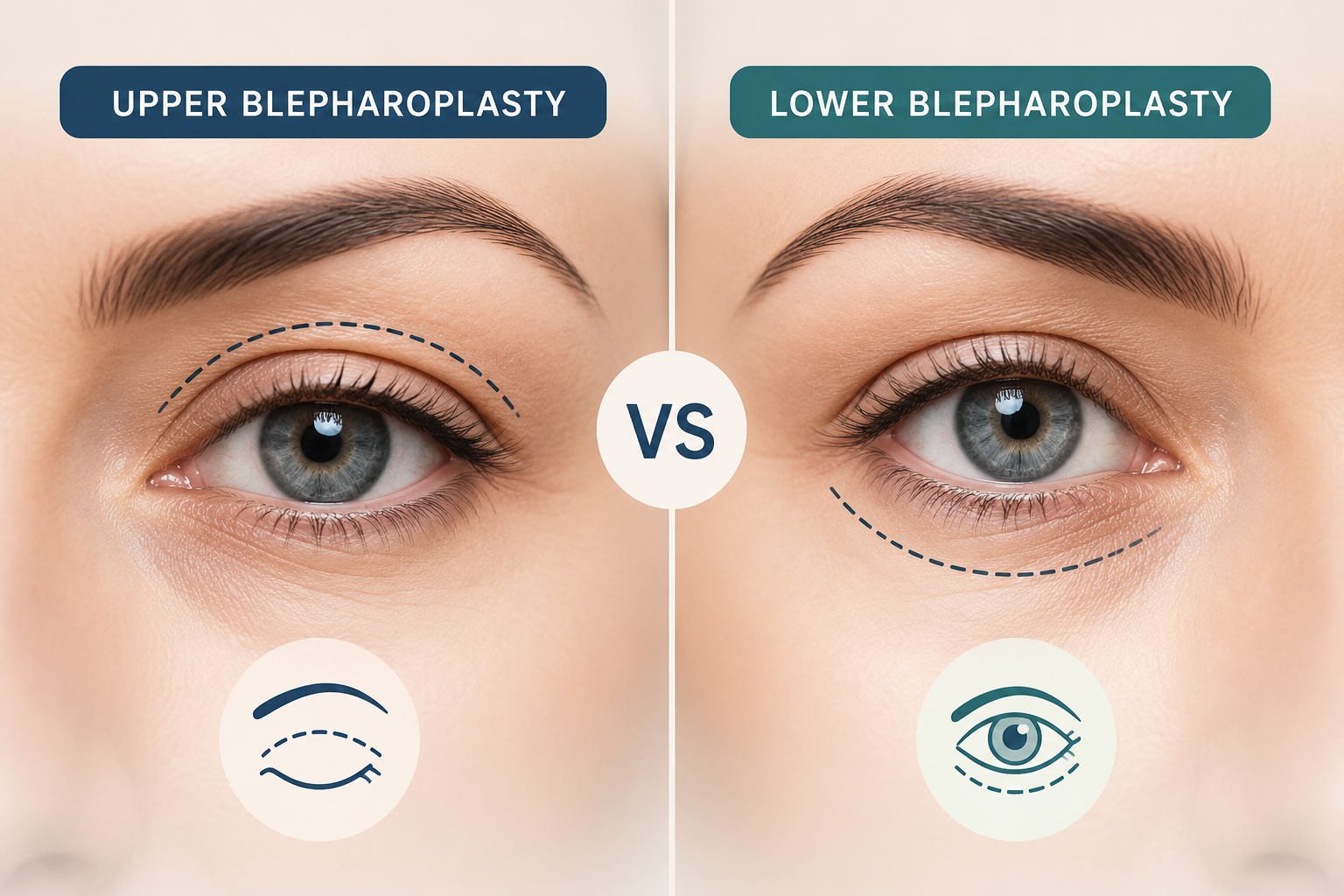
Upper eyelid surgery, also known as upper blepharoplasty, focuses on correcting concerns affecting the upper portion of the eye, specifically the skin and tissue above the eye that has begun to sag or droop.
Who Needs Upper Eyelid Surgery?
The ideal candidate for upper eyelid surgery typically notices one or more of the following:
- Excess skin hanging over the upper eyelid crease, creating a heavy or hooded look
- A loss of the natural eyelid fold, making it difficult or impossible to apply eye makeup
- Difficulty keeping the eyes fully open due to the weight of sagging skin
- A persistent tired or stern expression despite feeling well-rested
- In more advanced cases, skin drooping low enough to interfere with peripheral vision
This last point deserves special attention. When excess upper eyelid skin droops far enough to cover part of the pupil or upper visual field, it becomes a functional issue, not just an aesthetic one. In such cases, upper eyelid surgery may be covered by health insurance as a medically necessary procedure, a detail worth exploring with both your surgeon and your insurance provider.
How Is Upper Eyelid Surgery Performed?
Upper blepharoplasty is typically performed under local anaesthesia with sedation, making it a comfortable, outpatient procedure that usually takes between 45 and 60 minutes.
The surgical process follows these steps:
Step 1: Preoperative Marking Before the incision is made, the surgeon carefully marks the area of skin to be removed, following the natural crease of the upper eyelid. This meticulous planning ensures that results are symmetrical and that the eyelid crease lands in a natural, aesthetically pleasing position.
Step 2: Incision Along the Natural Crease The incision is placed precisely within the eyelid's natural fold. This strategic placement means that once healing is complete, the resulting scar is virtually invisible, hidden within the crease itself.
Step 3: Removal of Excess Tissue Excess skin is excised. In some cases, a small amount of underlying muscle or fat may also be removed or adjusted to achieve a smoother contour.
Step 4: Closure The incision is closed with very fine sutures that leave minimal scarring. These may be dissolvable or may be removed in a follow-up appointment approximately one week after surgery.
The end result is an eyelid that appears more open, defined, and refreshed, with the natural crease restored and excess heaviness eliminated.
Lower Eyelid Surgery: A Closer Look
Lower eyelid surgery, or lower blepharoplasty, addresses a completely different set of concerns, targeting the area beneath the eye. Where upper blepharoplasty is primarily about excess skin and drooping, lower blepharoplasty is largely about under-eye bags, puffiness, and loose skin.
Who Needs Lower Eyelid Surgery?
You may be a good candidate for lower eyelid surgery if you experience:
- Persistent under-eye bags that make you look tired even when fully rested
- Puffiness beneath the eyes that does not resolve with sleep or skincare
- Loose or crepey skin below the lower lashes
- A shadowing effect below the eye that creates a dark, sunken appearance
- A "festoon" or malar bag, a more extensive type of lower eyelid puffiness extending onto the cheek
It is worth noting that not all under-eye darkness is caused by puffiness or bags. True dark circles caused by thin skin revealing underlying blood vessels or by hyperpigmentation are generally not resolved through surgery alone. Your surgeon will be able to evaluate the cause of your under-eye appearance and advise accordingly.
How Is Lower Eyelid Surgery Performed?
Lower blepharoplasty can be approached in two different ways depending on the specific concerns being addressed:
Transcutaneous Approach (External Incision) An incision is made just below the lower lash line. This approach allows the surgeon to directly access and remove or reposition excess fat, and to trim and tighten any loose skin. The resulting scar is typically extremely faint, camouflaged within the natural shadow of the lower lashes.
Transconjunctival Approach (Internal Incision) When fat removal or redistribution is required but there is little to no excess skin, the surgeon may opt for an incision made on the inside of the lower eyelid (the conjunctiva). This leaves no visible external scar at all, making it an attractive option for younger patients who have good skin elasticity but bothersome fat prolapse.
Lower eyelid surgery typically takes between 60 and 90 minutes. Fat may be removed, or, in a technique that has gained popularity for its natural-looking results, redistributed to fill the hollow groove that often forms between the under-eye bag and the cheek, known as the tear trough.
The Key Differences at a Glance
While both upper and lower blepharoplasty fall under the broader category of cosmetic eyelid surgery, they serve entirely different purposes, target different anatomical structures, and are chosen based on different concerns.
Upper Eyelid Surgery:
- Focuses on the skin and tissue above the eye
- Corrects sagging, hooded, or drooping upper eyelids
- Improves eyelid definition and restores the natural crease
- May improve vision in functional cases
- Incision hidden within the eyelid fold
Lower Eyelid Surgery:
- Focuses on the skin and tissue below the eye
- Corrects under-eye bags, puffiness, and loose skin
- Reduces the tired, aged appearance of the lower eyelid area
- Fat may be removed or repositioned
- Incision placed below the lash line or inside the eyelid
Understanding this distinction helps ensure that patients seek the right procedure for their specific concern, rather than undergoing an operation that targets a different area entirely.
Can You Have Both Procedures Together?
Absolutely, and many patients do. When a person has both excess upper eyelid skin and pronounced under-eye bags, combining upper and lower blepharoplasty in a single surgical session is often the most logical and efficient approach.
Doing both procedures simultaneously offers several advantages. There is only one round of anaesthesia, one recovery period, and one disruption to daily life. The results are also more harmonious, a refreshed upper eyelid paired with a smoother lower eyelid creates a balanced, naturally rejuvenated appearance that neither procedure alone could achieve.
The combined procedure typically takes between 1.5 and 2 hours and can be performed on an outpatient basis, allowing patients to return home the same day.
The Consultation: Your Most Important First Step
Before any decision is made about which procedure to pursue, a thorough consultation with a qualified, experienced surgeon is essential. This appointment serves multiple purposes.
The surgeon will evaluate the structure and condition of your eyelids, assess skin laxity and fat distribution, and examine your overall facial anatomy to understand how eyelid changes would affect your broader appearance. They will listen carefully to your concerns and goals, and use that information, along with their clinical assessment, to recommend the most appropriate procedure or combination of procedures.
During this consultation, you should feel free to ask questions, discuss your expectations honestly, and share any concerns you may have about the process, the results, or the recovery. A good surgeon will always provide realistic guidance, explaining not just what surgery can achieve, but also what it cannot.
What Recovery Looks Like
Understanding the recovery journey ahead of time helps patients prepare properly and approach the healing period with realistic expectations.
The First 48 Hours Immediately following surgery, the most noticeable effects are swelling and bruising around the eyes. There may also be some tightness and mild discomfort. Vision may feel slightly blurred due to prescribed eye ointment, this is temporary. Patients are advised to rest with their head elevated, use a cold compress if directed, and avoid touching or rubbing the eyes.
Days 3 to 5 Swelling and bruising typically peak around this time before beginning to improve. The eyes may appear puffier than expected, which can feel discouraging. This is a completely normal phase of healing, and it resolves with time.
End of Week One By day seven, swelling begins to reduce noticeably. Any non-dissolvable sutures are usually removed around this time. Most patients feel comfortable enough to resume light activities around the home.
Week Two Bruising largely disappears and swelling continues to diminish. Many patients feel confident returning to social activities, though they are advised to continue avoiding strenuous exercise and heavy lifting.
Weeks Three and Four The eyelids begin to look and feel more natural. The improvement from droopy eyelid correction or under-eye bag removal becomes increasingly apparent.
One to Three Months Post-Surgery This is when full results begin to emerge. The skin has fully settled, the contour has refined, and the eyes appear genuinely refreshed. Patients are often struck by how natural and subtle the final result looks, precisely the goal.
Aftercare Tips for a Smooth Recovery
- Limit screen time during the first several days to avoid eye strain
- Wear UV-protective sunglasses when outdoors
- Follow all prescribed medication instructions, including any antibiotic drops or ointments
- Avoid eye makeup until your surgeon gives the go-ahead
- Avoid alcohol, smoking, and blood-thinning medications during recovery
- Attend all follow-up appointments
Are the Results Permanent?
One of the most common questions patients ask is whether blepharoplasty results are long-lasting.
The answer is yes, in most meaningful respects, the results are permanent. The skin and fat removed during surgery do not return. For upper eyelid surgery, the restored eyelid crease and elimination of excess skin provide results that typically last ten years or more. For lower eyelid surgery, fat removal or redistribution provides durable, long-lasting improvement in under-eye puffiness.
That said, the aging process does not stop after surgery. Over many years, the skin around the eyes will continue to age. However, patients who have had blepharoplasty are still significantly better off in terms of appearance compared to if they had never had the procedure at all. The vast majority of patients do not require repeat surgery for a decade or longer.
Common Risks and How to Minimize Them
Blepharoplasty is one of the safest cosmetic surgical procedures available, with a well-established track record of positive outcomes. Like any surgery, however, it does carry some risks.
Common Temporary Effects:
- Swelling and bruising (expected and resolves with time)
- Temporary dry eyes or increased tearing
- Light sensitivity during early healing
- Mild discomfort manageable with prescribed medication
Rare Complications:
- Infection (very uncommon with proper aftercare)
- Asymmetry (usually minor and can be addressed)
- Delayed healing
- Temporary changes in vision
- Scarring (rare and typically minimal)
Choosing an experienced, board-certified surgeon significantly reduces the likelihood of complications. Following aftercare instructions diligently also plays a critical role in ensuring a safe, smooth recovery.
Who Is the Ideal Candidate?
Whether considering upper eyelid surgery, lower eyelid surgery, or both, the ideal candidate generally:
- Is in good overall physical health without conditions that could impair healing
- Does not smoke, or is willing to quit before and after surgery
- Has realistic expectations about what surgery can and cannot achieve
- Is bothered by sagging upper eyelids, under-eye bags, or both
- Is motivated by personal desire for improvement, not external pressure
Both men and women undergo blepharoplasty, and there is no ideal age, the procedure is appropriate whenever the concerns being addressed are present and causing genuine distress or functional impairment.
Why the Right Surgeon Makes All the Difference
Eyelid surgery is exceptionally delicate work. The margin for error is small, and the consequences of imprecise technique, even minor asymmetry or overcorrection, are immediately visible.
At Shobhit Aesthetics, the approach to blepharoplasty is grounded in precision, conservatism, and a deep respect for each patient's individual anatomy and goals. The philosophy is never to do more than is needed. Whether the concern is a mildly hooded upper eyelid or significant under-eye puffiness, the focus remains on achieving a result that looks genuinely natural, refreshed rather than altered.
Every patient at Shobhit Aesthetics receives a thorough evaluation before any recommendation is made. The entire process, from consultation through recovery, is guided by clear communication and personalised care, ensuring that patients know exactly what to expect at every stage.
Conclusion
Blepharoplasty, whether of the upper eyelids, the lower eyelids, or both, is one of the most effective ways to restore a rested, youthful, and alert appearance around the eyes. It addresses changes that no amount of sleep, skincare, or makeup can fully correct, providing results that are subtle, natural-looking, and long-lasting.
Understanding the difference between upper eyelid surgery and lower eyelid surgery is the starting point for making the right decision for your unique concerns. Whether you are troubled by drooping upper lids, persistent under-eye bags, or a combination of both, the path forward begins with an honest conversation with a qualified surgeon who can assess your specific situation and guide you toward the outcome you deserve.
If you are ready to take that step, the most important thing you can do is seek a professional consultation, and approach the process with realistic expectations, a clear understanding of what each procedure involves, and confidence in the expertise of the team supporting you.
Frequently Asked Questions (FAQs)
Q1: What is the difference between upper and lower blepharoplasty?
Upper blepharoplasty removes excess, sagging skin from the upper eyelid to correct drooping and restore the eyelid crease, while lower blepharoplasty targets under-eye bags, puffiness, and loose skin beneath the eyes. Both fall under cosmetic eyelid surgery but treat entirely different concerns and use different incision placements and surgical techniques tailored to each area.
Q2: Who is an ideal candidate for upper or lower eyelid surgery?
An ideal candidate is someone in good general health who is bothered by droopy upper eyelids, under-eye bags, or both, and holds realistic expectations about surgical outcomes. Both men and women qualify. Non-smokers tend to heal faster. A thorough consultation with a qualified surgeon is essential to confirm candidacy based on individual eyelid structure, skin quality, and medical history.
Q3: Can blepharoplasty improve vision affected by drooping eyelids?
Yes, in cases where excess upper eyelid skin sags low enough to partially cover the pupil or block the upper visual field, upper blepharoplasty can meaningfully improve functional vision. When vision impairment is confirmed through clinical testing, the procedure may be classified as medically necessary, potentially making it eligible for insurance coverage rather than purely cosmetic classification.
Q4: How long is the recovery period after eyelid surgery?
Most patients recover sufficiently to return to light daily activities and work within seven to ten days. Bruising and swelling resolve within two weeks for most individuals. Full healing, during which final results become fully visible and the skin completely settles into its new contour, generally takes between one and three months depending on individual healing rates and procedure complexity.
Q5: Are the results of blepharoplasty permanent?
Blepharoplasty results are long-lasting and widely considered permanent in practical terms. The skin and fat removed during surgery do not return, and most patients enjoy their results for ten or more years. While natural aging continues over time, the improvement achieved through surgery ensures the eyes consistently look better than they would have without the procedure.
Q6: Is blepharoplasty performed under general or local anaesthesia?
Blepharoplasty is most commonly performed under local anaesthesia combined with sedation, allowing the patient to remain comfortable and relaxed without full general anaesthesia. General anaesthesia may be used in certain cases, particularly for more complex or combined procedures. The choice of anaesthesia is determined during the consultation based on the scope of surgery and patient preferences and medical history.
Q7: Will there be visible scarring after eyelid surgery?
Scarring is minimal and strategically concealed. In upper blepharoplasty, the incision is placed within the natural eyelid crease, making the scar virtually invisible once healed. In lower blepharoplasty, incisions are positioned just below the lash line or inside the eyelid entirely. With proper aftercare and adequate healing time, most patients find their scars become nearly undetectable within a few months post-surgery.
Q8: Can blepharoplasty be combined with other facial procedures?
Yes, blepharoplasty is frequently combined with complementary procedures such as a brow lift, facelift, or non-surgical treatments like Botox and dermal fillers for more comprehensive facial rejuvenation. Combining procedures can reduce overall recovery time and achieve more balanced, harmonious results. Your surgeon will advise on which combinations are safe and suitable based on your goals and overall health status.
Q9: How soon after surgery can I wear makeup and return to exercise?
Most surgeons advise waiting at least ten to fourteen days before applying any eye makeup to allow the incision sites to heal and reduce infection risk. Strenuous exercise, heavy lifting, and activities that raise blood pressure should be avoided for approximately three to four weeks post-surgery. Your surgeon will provide a personalised timeline based on your specific healing progress at follow-up appointments.
Q10: At what age is blepharoplasty typically performed?
There is no strict age requirement for blepharoplasty. The procedure is performed whenever the concerns: drooping upper eyelids, under-eye bags, or both, are present and cause genuine aesthetic or functional distress. Some patients pursue surgery in their late thirties or early forties, while others wait until their fifties or sixties. Candidacy is based on individual presentation, health, and goals rather than chronological age alone.