Hair loss is one of the most common concerns affecting both men and women around the world. For many people, it begins subtly. Perhaps the hairline shifts slightly, or the parting appears a little wider than it used to. Most people dismiss these early signs, attributing them to stress, diet, or seasonal changes. But as weeks turn into months, the thinning becomes harder to ignore, and the emotional weight of visible hair loss begins to take a genuine toll on self-confidence and daily life.
For those who have reached the point where they are actively looking for a permanent solution, hair transplant surgery offers one of the most effective and long-lasting answers available today. And once a person begins researching their options, two names come up time and again: FUE hair transplant and FUT hair transplant.
Both are well-established, clinically proven surgical techniques for restoring hair density in areas affected by balding. Both involve moving hair follicles from a donor region of the scalp to areas where hair has thinned or disappeared. Yet despite sharing the same fundamental goal, these two procedures differ significantly in how they are performed, what the recovery experience looks like, what kinds of scarring they leave behind, and which types of patients they are most suited to.
This blog is designed to give you a complete, detailed, and honest understanding of both techniques, so that by the time you reach the end, you will have a clear picture of which approach may be better suited to your unique situation.
What Is a Hair Transplant and How Does It Work?
Before exploring the differences between FUE and FUT, it is worth taking a moment to understand the core principle that makes both procedures possible.
Hair transplant surgery works because of a biological characteristic known as donor dominance. The hair follicles located at the back and sides of the scalp, in the region often referred to as the donor area, are genetically resistant to the hormonal changes that cause pattern baldness. This means that even when transplanted to a bald or thinning area, these follicles continue to grow hair for life, following their original genetic programming rather than being affected by the new environment.
This is not a temporary fix. When performed correctly by an experienced surgeon, hair transplant results are permanent. The transplanted follicles behave just as they would in the donor region, growing naturally, matching your existing hair's texture and colour, and responding to regular haircuts, washing, and styling.
The two techniques differ not in this fundamental principle, but in the method used to harvest those follicles from the donor area before transplanting them.
Understanding the FUE Hair Transplant Technique
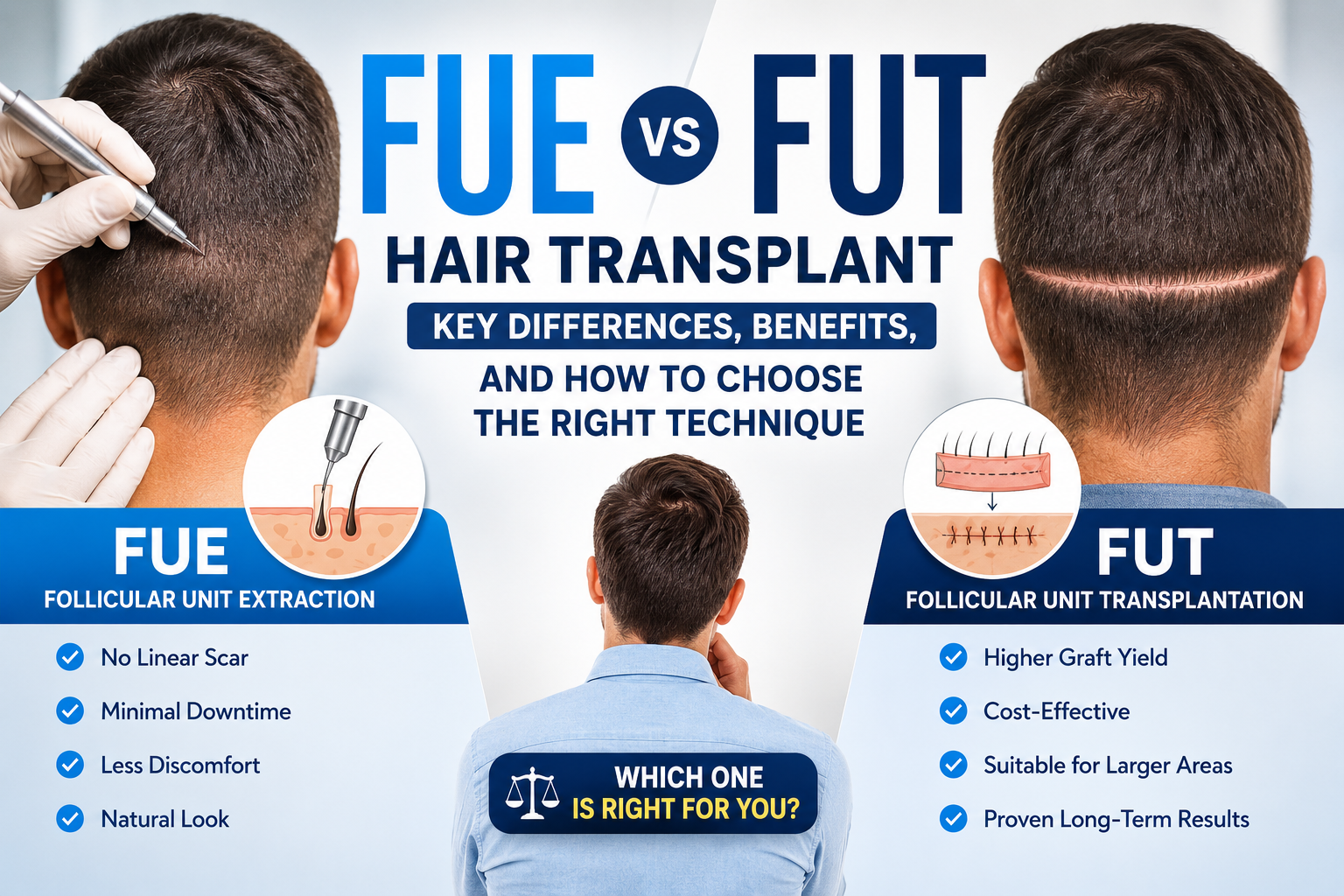
FUE stands for Follicular Unit Extraction. As the name suggests, this technique involves extracting individual follicular units directly from the scalp, one at a time.
During an FUE procedure, the donor area is typically trimmed or shaved to allow the surgeon to see the follicles clearly. Local anaesthesia is applied to ensure the patient remains comfortable throughout, since the procedure is performed while the patient is fully conscious. Using a specialised micro-punch tool, typically measuring between 0.6 and 1.0 millimetres in diameter, the surgeon carefully extracts each follicular unit individually. Once the required number of grafts has been harvested, the surgeon prepares the recipient area by making tiny incisions, and the follicles are then carefully placed into position.
Because each follicle is removed individually, there are no large incisions and no stitches required in the donor area. Instead, each extraction point heals as a very small, circular dot scar. In most cases, these dots are so fine and spread across such a wide area that they are virtually undetectable, even when the head is shaved.
The FUE technique is widely considered the more advanced of the two methods, and its popularity has grown substantially over the past decade. Patients are drawn to it for several reasons: the minimal visible scarring, the faster and less uncomfortable recovery, the absence of stitches, and the greater flexibility it offers in terms of future hairstyling choices. It is also preferred by patients who keep their hair very short, since the tiny dot scars are far less noticeable than the linear scar left by FUT.
However, FUE does have its limitations. Because follicles are extracted one by one, the procedure takes longer than FUT, particularly when a large number of grafts is required. In cases of advanced baldness requiring thousands of grafts, multiple sessions may be necessary. The technique also requires a very high level of surgical skill to ensure that individual follicles are extracted cleanly without damage, which makes the expertise of the surgeon a critical factor in the quality of outcomes.
Understanding the FUT Hair Transplant Technique
FUT stands for Follicular Unit Transplantation. This technique is sometimes referred to as the strip method, which accurately describes its most distinctive feature.
Rather than extracting follicles one at a time, the FUT technique involves removing a horizontal strip of scalp tissue from the donor area, typically from the back of the head. The length and width of the strip depend on the number of grafts needed. Once the strip has been removed, the edges of the wound are sutured closed, leaving a linear scar that runs across the back of the head. This scar is typically concealed by the surrounding hair and is not visible in most everyday hairstyles.
The removed strip is then taken to a laboratory area where a team of skilled technicians works under magnification to carefully dissect the tissue into individual follicular units. These units are then prepared for transplantation. Meanwhile, the surgeon creates the recipient sites in the balding area, and the follicles are implanted with precision.
The key advantage of FUT is its ability to yield a high number of grafts in a single session. Because an entire strip of scalp is removed, the technique allows for the collection of a large volume of follicular units efficiently and quickly. For patients with extensive baldness who require a significant number of grafts to achieve meaningful coverage, FUT can deliver results in a shorter surgical timeframe than FUE.
The trade-off is the linear scar in the donor area. While this scar can be concealed effectively with longer hair, it may become visible if the patient chooses to wear their hair very short. The recovery following FUT also tends to be longer and slightly more uncomfortable than FUE, as the sutured wound requires more time to heal and patients may experience a sensation of tightness or pulling at the back of the head for several weeks.
The Core Difference Explained Simply
If you want to distil the difference between these two techniques into a single sentence, it comes down to this: FUE removes hair follicles one by one, while FUT removes a strip of scalp from which many follicles are then extracted.
Everything else, including the recovery experience, the scarring, the number of grafts that can be achieved in one session, and the suitability for different patients, flows from this one fundamental difference in the extraction method. Understanding this makes it much easier to evaluate which technique aligns better with your own priorities and medical needs.
Scarring: What to Expect From Each Technique
Scarring is one of the most common concerns patients raise when considering a hair transplant. It is important to approach this topic with honesty: there is no such thing as a completely scar-free hair transplant surgery. Both techniques leave some degree of scarring in the donor area. The critical difference lies in the type, size, and visibility of those scars.
With FUE, the scars are numerous but tiny. Each follicle extraction leaves a small, circular dot that typically measures less than a millimetre. These dots are scattered across the donor area rather than concentrated in one line. Over time, they heal and fade, and in most cases are only visible when the head is shaved very short. For patients who prefer to keep a buzz cut or enjoy the freedom of short hairstyles, this is a significant advantage.
With FUT, a single linear scar runs horizontally across the back of the scalp. The length of this scar depends on how many grafts were needed, and the quality of the resulting scar can vary depending on individual healing factors and the skill of the surgeon who closes the wound. When hair is worn at a medium to long length, the surrounding hair covers the scar completely and it remains invisible. However, if the patient ever wishes to cut their hair very short, the scar may become visible.
Choosing between these two scar profiles ultimately comes down to how you plan to wear your hair in the long term. This is a question worth thinking about carefully, since hair preferences can change over time.
Recovery: What the Healing Journey Looks Like
The recovery process differs meaningfully between the two techniques, and this is another factor that weighs heavily in many patients' decisions.
Following an FUE hair transplant, the donor area heals relatively quickly since there are no stitches involved. Patients typically experience mild redness and minor swelling for a few days. Small scabs form at each extraction point and fall away naturally within seven to ten days. Most patients feel comfortable returning to light daily activities within a week, and the overall recovery is generally described as manageable and minimally disruptive.
Following a FUT hair transplant, the recovery is more involved. The sutured wound at the donor site requires time to heal, and stitches are usually removed after ten to fourteen days. During this period, patients may feel a persistent tightness or pulling sensation at the back of the head. Physical activity, particularly anything that increases blood pressure or involves bending forward, is restricted for longer than with FUE. The overall recovery timeline is extended, and the donor area may remain tender for several weeks.
One experience that both techniques share is the phenomenon known as shock loss, which can be alarming if patients are not warned about it in advance. In the weeks following surgery, the newly transplanted hair sheds. This is entirely normal and does not indicate that the procedure has failed. The follicles remain active beneath the surface, and new hair growth begins to emerge gradually over the following months. Most patients begin to see meaningful results at around three to four months, with the full outcome typically visible at twelve months.
Natural-Looking Results: Which Technique Looks Better?
One of the most reassuring things to understand about both FUE and FUT is that neither technique inherently produces more natural-looking results than the other. The naturalness of the final outcome is determined not by which method is used to extract the follicles, but by the skill and artistry of the surgeon who designs the hairline and places the grafts.
A natural-looking hair transplant result depends on several key factors: the design of the hairline, which should be soft and slightly irregular rather than perfectly straight; the angle and direction at which each follicle is implanted, which must mimic the natural growth pattern of the surrounding hair; the strategic placement of single-hair grafts at the front of the hairline with denser grafts placed further back; and the overall distribution of hair density across the treated area.
A poorly executed FUE procedure can look just as unnatural as a poorly executed FUT procedure. Conversely, in the hands of a skilled, experienced surgeon, both techniques are fully capable of delivering results that are completely indistinguishable from natural hair growth. This is why the choice of surgeon is arguably the single most important decision a hair transplant patient can make, more important even than the choice of technique.
Graft Numbers and the Question of Density
The number of grafts a patient needs depends on the extent of their hair loss, the size of the area to be covered, and the density they wish to achieve. A graft is the natural unit consisting of a hair follicle along with the surrounding tissue, and a single graft may contain between one and four individual hairs.
For patients with limited hair loss who require only a modest number of grafts, perhaps to refine a receding hairline or add density to a thinning crown, FUE is an excellent choice. The procedure can be completed in a single session, the recovery is relatively straightforward, and the scarring is minimal.
For patients with more advanced hair loss requiring a large number of grafts to achieve meaningful coverage, FUT has a significant advantage in terms of yield. Because an entire strip of scalp is harvested and then meticulously dissected, the technique can produce a higher number of viable grafts in a single session than FUE typically can. This makes FUT particularly valuable for patients who need extensive restoration and want to minimise the number of surgical sessions required.
It is worth noting that for some patients with very advanced hair loss, a combination approach may be the most appropriate plan, using FUT for an initial high-yield session followed by FUE in a subsequent session to optimise coverage while managing the donor area carefully.
Donor Area Management and Long-Term Planning
One aspect of hair transplant planning that does not always receive the attention it deserves is the management of the donor area over the long term. The donor area, like every other part of the scalp, is finite. Once follicles are removed, they do not regenerate. This means that thoughtful planning is essential, particularly for younger patients whose hair loss may continue to progress.
With FUE, follicles are extracted from a relatively wide area across the donor zone. If too many grafts are taken from a concentrated region, patchiness can develop in the donor area, and the overall density of the remaining hair may be compromised. Experienced surgeons are careful to distribute extractions evenly to prevent this.
With FUT, follicles are harvested from a single strip of scalp, and the surrounding donor hair remains entirely untouched. This can make FUT a more conservative approach in terms of preserving the overall donor supply, which is a consideration of real importance for patients who may need additional transplant sessions in the future.
For young patients who are still in the early stages of hair loss, a cautious, long-term approach is essential. A responsible surgeon will always consider not just your current hair loss, but the likely trajectory of your hair loss in the years ahead, and plan accordingly.
Session Duration: How Long Will You Be in the Clinic?
The time required to complete a hair transplant procedure varies between the two techniques and depends significantly on the number of grafts being transplanted.
FUE procedures generally take longer than FUT for equivalent numbers of grafts, because each follicle must be individually extracted using the micro-punch tool. A session involving a large number of grafts may last many hours, and in some cases the work may be spread across two consecutive days. Patients are seated or reclined for the duration, with breaks provided, and since local anaesthesia is used throughout, there is no pain involved. However, the length of the session can feel demanding.
FUT procedures are typically completed more quickly, because the strip removal itself is a relatively fast step, and the subsequent follicle preparation is handled simultaneously by the technician team while the surgeon prepares the recipient sites. This means that more grafts can often be transplanted in a shorter overall timeframe.
For patients with busy schedules or those who find extended surgical sessions daunting, this difference in session duration is a practical consideration worth factoring into the decision.
Choosing the Right Technique for You
Having explored both techniques in detail, the question of which one is right for you comes down to a careful and honest assessment of your own circumstances. There is no universal answer, and anyone who tells you that one technique is categorically superior to the other is oversimplifying a decision that deserves nuance.
Consider the extent of your hair loss. If you have moderate thinning confined to a specific area, FUE may be perfectly sufficient. If you have advanced baldness across a large portion of your scalp, FUT may be better positioned to deliver the coverage you need within a manageable number of sessions.
Consider the quality and density of your donor area. A patient with a generous donor supply has more flexibility in choosing their technique. A patient with a limited donor area requires careful surgical planning to ensure that the available follicles are used as efficiently as possible.
Consider how you wear your hair. If you prefer a short hairstyle or like to shave your head, the dot scars of FUE are far preferable to the linear scar of FUT. If you wear your hair at a medium or longer length, FUT's scar is unlikely to be an issue.
Consider your recovery expectations. If a faster, less intrusive recovery is important to you, FUE has a meaningful advantage. If you are comfortable with a longer recovery in exchange for a higher graft yield in a single session, FUT may serve you well.
Consider your age and future plans. Younger patients in particular should think carefully about the progression of their hair loss and ensure that they are working with a surgeon who takes a long-term, planned approach rather than simply addressing the current situation in isolation.
Above all, seek out a qualified, experienced surgeon whose work you have researched thoroughly, who listens carefully to your concerns, and who gives you an honest assessment of your options rather than promoting one technique over another for commercial reasons.
The Importance of the Right Surgeon
The outcome of a hair transplant procedure is determined as much by the skill of the surgeon as by the technique selected. An experienced, meticulous surgeon can produce outstanding results with either FUE or FUT, while an inexperienced or careless practitioner can deliver disappointing outcomes with either method.
When researching surgeons, look for someone with substantial documented experience in hair transplant surgery, before-and-after photographs of real patients that demonstrate consistently natural-looking results, and a consultation process that feels thorough, transparent, and personalised. A good surgeon will never push you towards one technique before carefully evaluating your scalp, your hair loss pattern, your donor area density, and your long-term goals.
At Shobhit Aesthetics, every patient receives an individualised assessment before any recommendation is made. The focus is always on what will produce the best, most natural, and most sustainable result for each specific person, using whichever technique best serves their unique medical and aesthetic needs.
Conclusion
Both FUE and FUT hair transplants are clinically proven, highly effective approaches to restoring hair in areas affected by balding and thinning. Each has genuine strengths, and each has limitations. Neither is universally superior. The right choice is the one that aligns with your hair loss profile, your donor area condition, your lifestyle preferences, your recovery expectations, and your long-term plans.
The most important steps you can take are to educate yourself thoroughly, consult with a skilled and honest surgeon, and approach the process with realistic expectations. Hair transplant surgery will not give you back the hair of your youth. What it can do is restore meaningful density, improve your hairline, and give you a natural, lasting result that makes a real difference to how you look and feel.
Take your time, ask the right questions, and trust the process.
Frequently Asked Questions (FAQs)
Q1: What is the difference between FUE and FUT hair transplant techniques?
FUE removes individual hair follicles one at a time using a micro-punch tool, leaving small dot scars across the donor area. FUT removes an entire strip of scalp, yielding more grafts at once but leaving a linear scar at the back of the head. The extraction method is the defining difference between both techniques.
Q2: Which is better: FUE or FUT for natural-looking results?
Neither technique is inherently superior for natural results. The appearance of the outcome depends primarily on the surgeon's skill in designing the hairline and placing grafts at the correct angle and direction. Both FUE and FUT, when performed by an experienced professional, can deliver completely natural-looking, indistinguishable results for the right candidate.
Q3: Does FUE or FUT leave visible scars?
Both techniques leave scars, but they differ in type. FUE leaves numerous tiny circular dot scars scattered across the donor area, which are rarely visible even at short hair lengths. FUT leaves a single linear scar at the back of the scalp that is typically covered by surrounding hair but may become noticeable if hair is cut very short.
Q4: Which hair transplant method offers faster recovery?
FUE generally offers a faster and more comfortable recovery since no stitches are involved. Redness and scabbing resolve within seven to ten days, and patients return to normal activity quickly. FUT recovery takes longer due to the sutured wound, with stitches remaining for ten to fourteen days and a prolonged sensation of tightness at the donor site.
Q5: How do I choose between FUE and FUT for my hair loss condition?
The right choice depends on the extent of your hair loss, your donor area density, your preferred hairstyle, your recovery expectations, and your surgeon's clinical assessment. FUE suits moderate loss and short hair preferences, while FUT is better for advanced baldness requiring high graft numbers. Always consult a qualified surgeon for a personalised recommendation.
Q6: Is a hair transplant a permanent solution to hair loss?
Yes, hair transplant results are considered permanent. The transplanted follicles are harvested from the donor area, which is genetically resistant to the hormonal changes that cause pattern baldness. Once successfully implanted, these follicles continue to grow hair for life. However, surrounding non-transplanted hair may continue to thin over time, requiring future planning.
Q7: Will the transplanted hair look and feel like my natural hair?
Yes, because the transplanted follicles are your own hair follicles, the texture, colour, and growth pattern of the new hair will match your existing hair precisely. Once the transplanted hair has grown in and the scalp has fully healed, the results are typically indistinguishable from natural hair and can be washed, cut, and styled normally.
Q8: At what age can someone undergo a hair transplant?
Most surgeons prefer to wait until a patient is in their mid-to-late twenties before performing a hair transplant, since hair loss patterns are often still progressing in younger individuals. Performing surgery too early may result in an unnatural appearance as surrounding hair continues to thin. A responsible surgeon will always assess the trajectory of your hair loss and plan accordingly.
Q9: How many sessions will I need to achieve my desired result?
The number of sessions depends on the extent of your hair loss and the technique chosen. Many patients with moderate hair loss achieve satisfactory results in a single session. Those with advanced baldness may require two or more sessions to achieve optimal density. FUT can typically yield more grafts per session than FUE, which may reduce the total number of sessions needed.
Q10: When will I see the final results of my hair transplant?
After surgery, transplanted hair sheds within two to four weeks, which is a normal part of the process. New growth begins emerging at around three to four months. Significant visible improvement is typically noticeable at six months, and the full final result, with complete density and natural growth established, is generally visible at twelve months following the procedure.